TVET Lab Equipments contains six engine teaching models for technical and vocational training: sectioned four-stroke diesel and petrol engines, a two-stroke gasoline engine, and three steam engine models, one with a boiler. They show how pistons, valves and crankshafts turn fuel or steam into motion, so learners can study an engine’s working parts before handling a real one.
Engine models in the range
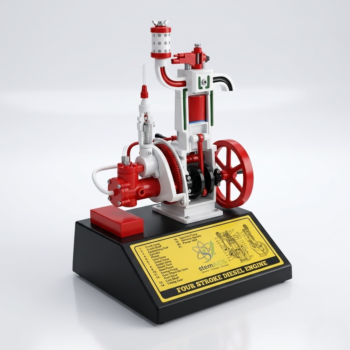
Internal combustion: the Petrol Engine Model Four Stroke shows the intake, compression, power and exhaust strokes of a spark-ignition engine, with two crankshaft turns per cycle. The Four Stroke Diesel Engine Model adds compression ignition and fuel injection, and the Two Stroke Gasoline Engine Model shows ported gas exchange and crankcase compression.
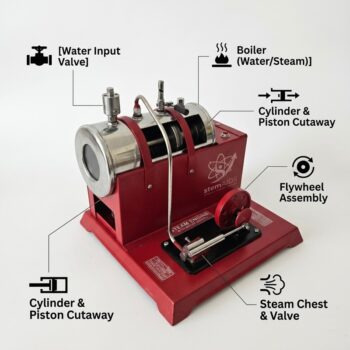
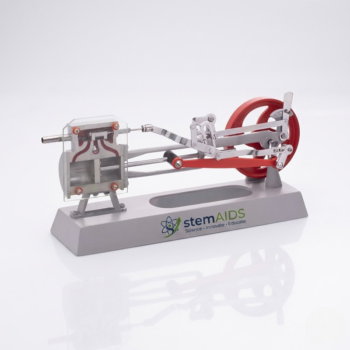
Steam: the Steam Engine Cutaway Model with Boiler follows the path from boiler heating to piston motion, the Steam Engine Demonstration Model shows steam pressure turned into piston and rotary motion, and the Steam Technology Model introduces the conversion of heat into mechanical energy.
Choosing models for a course
- Automotive and mechanical trades usually start with the four-stroke petrol model, then compare it with the diesel model to show spark ignition against compression ignition.
- Two-stroke engines power many small machines such as some motorcycles, chainsaws and outboard motors, so the two-stroke model suits small-engine courses.
- Physics and thermodynamics lessons on heat engines can begin with the steam models before moving to internal combustion.
- During a demonstration, turn the crank slowly and pause at each stroke so learners can see the valve and piston positions.
Related Categories
- Physics Equipments lists engine and generator models, a Stirling engine and a car engine combustion model.
- Stem Kits adds working models of pumps, hydraulics and power generation for younger classes.
Frequently Asked Questions
What is the difference between a two-stroke and a four-stroke engine?
A four-stroke engine completes intake, compression, power and exhaust in four piston strokes, or two turns of the crankshaft, and uses valves. A two-stroke engine completes the cycle in two strokes, one crankshaft turn, using ports in the cylinder wall and crankcase compression instead of valves.
How does a diesel engine differ from a petrol engine?
A petrol engine draws in a fuel-air mixture and ignites it with a spark plug. A diesel engine compresses air alone until it is very hot, then injects fuel, which ignites from the heat of compression, so no spark plug is needed.
Why are cutaway engine models used in technical training?
A cutaway removes part of the casing so learners can see parts that are normally hidden, such as the piston, connecting rod, crankshaft and valves, and follow their positions through the cycle. It is a safe way to learn how an engine works before working on a real one.
How does a steam engine produce motion?
Water is heated in a boiler to make steam under pressure. The steam pushes a piston along a cylinder, and a connecting rod and crank turn that back-and-forth movement into rotation of a flywheel or shaft.
Do the diesel and two-stroke models run on fuel?
No. The diesel and two-stroke engines are sectioned display and demonstration models that are not fuelled or run. Their purpose is to show how the internal parts move through each stage of the cycle.
Last updated: November 2026
Showing all 6 results