General Items gathers the everyday accessories a physics lab draws on across many practicals: a vernier calliper, spherometer and stop clock, slotted masses and pendulum bobs, a calorimeter, magnets, 100 g spools of resistance wire and small energy models. Trays, storage boxes, gloves and goggles for keeping the bench organised and safe are listed here as well.
What’s in the range
Measurement: the Vernier Calliper Stainless Steel takes external, internal and depth readings, the Precision Spherometer measures radius of curvature, the Round Stop Clock times pendulums and reactions, and the Precision Slotted Mass Set 2.5kg loads springs, wires and pulleys.
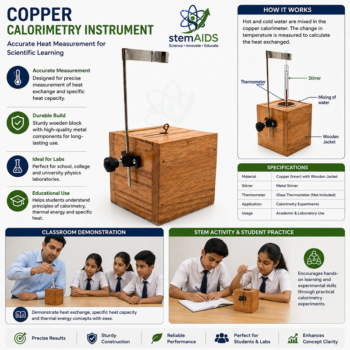
Mechanics, heat and magnetism: the Six Metal Pendulum Bob Set, the Copper Calorimetry Instrument, the Thermal Expansion Ring and Ball Set and the Horseshoe Magnet, alongside a U-core magnetic field apparatus.
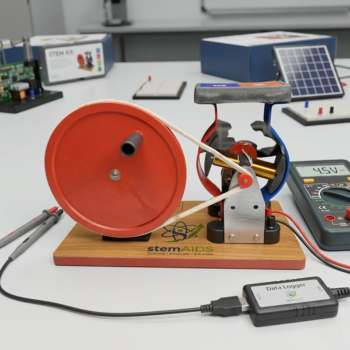
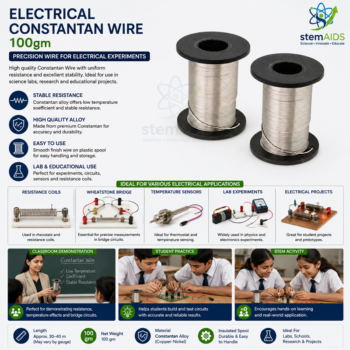
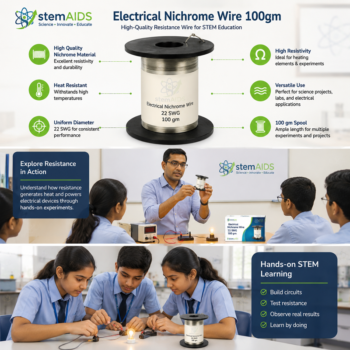
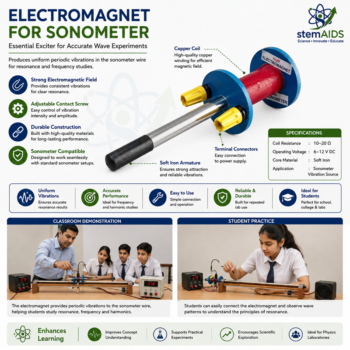
Wires and electrical parts: nichrome, constantan, copper, brass and steel wire, such as the Electrical Nichrome Wire 100gm, plus an electromagnet for the sonometer, a heating coil and carbon rods for electrolysis. Small wind, water turbine and generator models round out the group.
How to choose
- For length practicals, a vernier calliper reads to a finer division than a metre rule, while a spherometer measures the small rise of a curved surface.
- Pick resistance wire by job: nichrome for heating coils and Joule heating, constantan where resistance should change little with temperature, and copper for connections.
- Use bobs of different metals at the same string length to show that a simple pendulum’s period does not depend on the mass of the bob.
- A copper calorimeter suits specific heat and method-of-mixtures experiments because copper conducts well, so the vessel and its contents settle at one temperature quickly.
Related Categories
- Measuring Instruments adds micrometers, spring balances, weight sets and electrical meters.
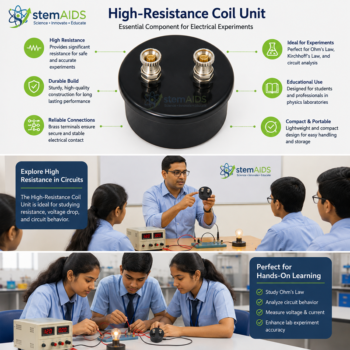
- Electrical and Electronics supplies the power sources used with resistance wires and heating coils.
- Solar Energy Kits complements the wind and water energy models with solar-powered ones.
Frequently Asked Questions
What is a spherometer used for?
A spherometer measures the radius of curvature of a lens or curved mirror. Its three legs rest on the surface and the central micrometer screw is turned until it just touches; the screw reading and the spacing of the legs give the radius of curvature.
How do you read a vernier calliper?
Read the main scale at the zero of the vernier scale, then find the vernier mark that lines up exactly with a main-scale mark. Multiply that vernier division by the least count, add it to the main-scale reading and correct for any zero error.
Does the mass of the bob change a pendulum’s period?
No. For small swings, the period of a simple pendulum depends on its length and on the acceleration due to gravity, not on the mass of the bob. Timing bobs of different metals at the same length is a simple way to show this.
Why is nichrome wire used for heating coils?
Nichrome has a high resistivity and resists oxidation when hot, so a short length gives useful heating without burning through. That makes it the usual choice for heating coils and Joule’s law experiments.
What does the ring and ball experiment show?
It shows the thermal expansion of a solid. At room temperature the ball just passes through the ring; once the ball is heated it expands and no longer fits, and after it cools it passes through again.
Last updated: November 2026
Bestsellers in General Items





Showing 1–12 of 38 results