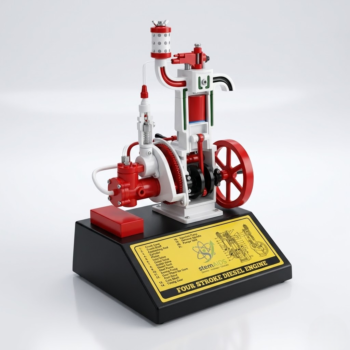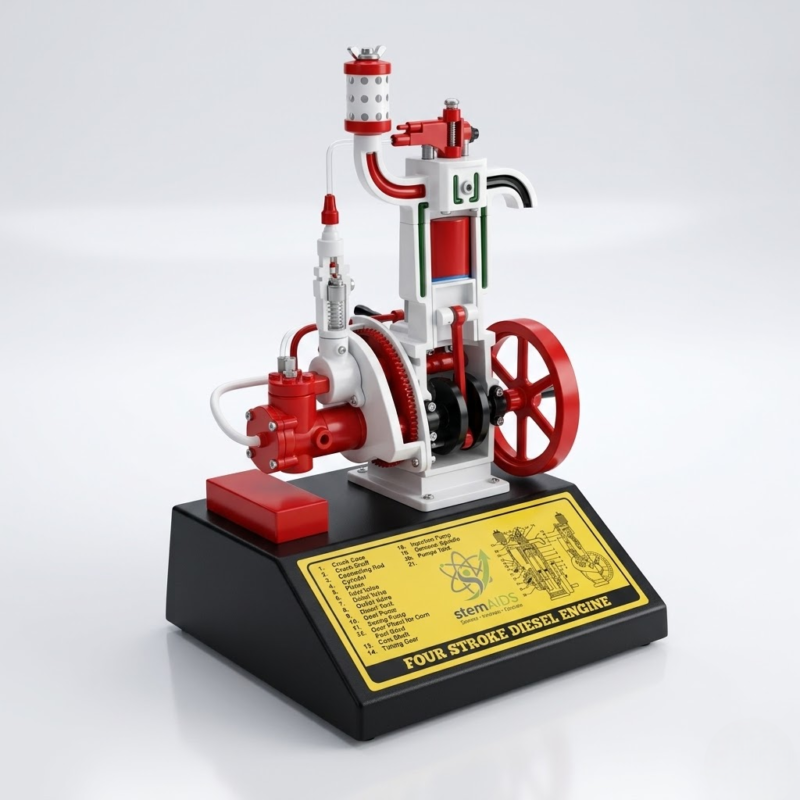
Quick Answer: The Four Stroke Diesel Engine Model is a cut-away (sectioned) teaching model of a compression-ignition diesel engine, used in TVET and mechanical engineering classes to show the intake, compression, power and exhaust strokes and how diesel fuel ignites without a spark plug.
Compression Ignition, Stroke by Stroke
A diesel engine draws in air only. On the intake stroke, the piston moves down with the inlet valve open and the cylinder fills with air. On the compression stroke both valves close and the piston squeezes that air into a small space; the compression ratio is far higher than in a petrol engine, and the air becomes hot enough to ignite fuel.
Just before the top of the stroke, the injector sprays diesel into the hot air as a fine mist, and it ignites on contact. That is the power stroke, which drives the piston down and turns the crankshaft through the connecting rod. On the exhaust stroke, the exhaust valve opens and the rising piston pushes out the burnt gases.
The four strokes take two full turns of the crankshaft, so the camshaft that opens the valves is geared to run at half crankshaft speed. With no spark plug, many diesels use glow plugs to pre-heat the combustion chamber for cold starts.
Why Diesel Matters in TVET Courses
Diesel engines power most trucks, buses, tractors, generator sets and irrigation pumps, so mechanics, agricultural technicians and plant operators meet them daily. The sectioned diesel model lets trainees connect each component to a fault they may later diagnose, such as poor compression from worn rings or a leaking injector.
Applications
- Teaching the four-stroke compression-ignition cycle in automotive, diesel mechanic and farm machinery courses
- Comparing diesel and petrol engines alongside a spark-ignition model
- Explaining valve timing and the camshaft-to-crankshaft relationship
- Introducing fuel injection and cold-start systems
Care & Handling
- Never put fuel, oil or water into the diesel model; it is for display and demonstration only.
- Move any hand-operated parts gently and do not force them past a stop.
- Dust the cut-away surfaces with a soft brush before lessons so the internal parts stay visible.
Specifications
| Engine represented | Four-stroke diesel, compression ignition |
| Construction | Sectioned (cut-away) model for display and demonstration |
| Teaching focus | Intake, compression, power and exhaust strokes; fuel injection; valve operation |
| Running | Not a working engine; never fuelled |
| Suitable courses | TVET, ITI diesel mechanic and polytechnic mechanical engineering |
Why Choose LabEquip
Diesel mechanic and agricultural machinery trainers often place the Four Stroke Diesel Engine Model next to the Petrol Engine Model Four Stroke to compare ignition systems, with the Two Stroke Gasoline Engine Model completing the set. Ask for a quotation via the contact page or browse TVET Lab Equipments for steam and engine models.
Frequently Asked Questions
How does a diesel engine ignite its fuel without a spark plug?
Air is compressed so strongly that its temperature rises well above the ignition point of diesel fuel. When the injector sprays fuel into this hot air near the top of the compression stroke, it ignites by itself.
What is the main difference from a four-stroke petrol engine?
A petrol engine draws in a fuel-air mixture and ignites it with a spark at a lower compression ratio. A diesel draws in air only, compresses it much more and injects fuel directly, relying on the heat of compression for ignition.
Why does the camshaft turn at half crankshaft speed?
Each valve must open once per cycle, and a four-stroke cycle takes two crankshaft revolutions. Gearing the camshaft at half speed gives one valve opening for every two turns of the crank.
What are glow plugs for?
In a cold engine the compressed air may not get hot enough to ignite the fuel. Glow plugs are small electric heaters in or near the combustion chamber that warm it before and during starting.
Why are diesel engines used in trucks and tractors?
They produce strong turning force at low speed and are more fuel-efficient than petrol engines of similar size, which suits heavy loads, long running hours and machinery such as pumps and generators.
Can the model be run or fuelled?
No. It is built for display and demonstration, showing the parts and the order of the strokes, and is not a working engine. If you need to know whether its piston and valves turn by hand, ask through the contact page before ordering.
Last Updated: October 2026