Metalware covers the stands, clamps, holders and burners that hold glassware in place and supply heat during practical work: retort and burette stands, three-prong and burette clamps, boss heads, a tripod and wire gauze, Bunsen burners and spirit lamps, tongs, test tube holders and test tube stands. Despite the name, several stands and clips in the range are made of plastic, polypropylene or acrylic.
Stands, clamps and supports
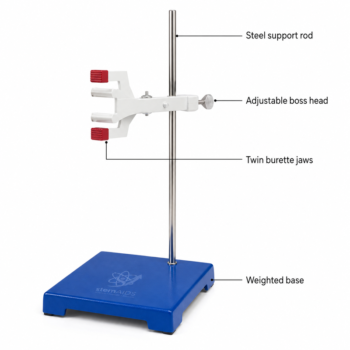
The Universal Retort Stand is the base for most set-ups, fitted with a Scientific Boss Head Clamp and a Precision Three Prong Clamp for flask necks and condensers. Titrations use the Laboratory Burette Stand or a Burette Holder Clamp on a support rod, and a dual burette holder takes two burettes side by side.
Heating and handling
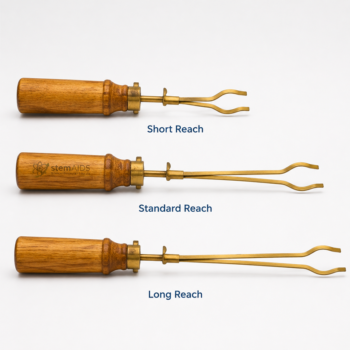
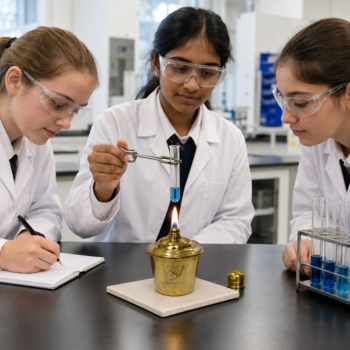
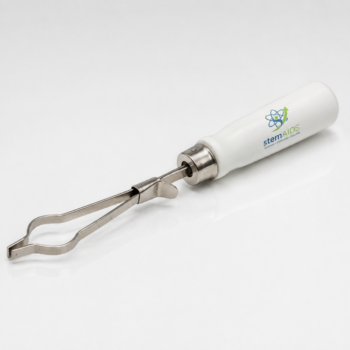
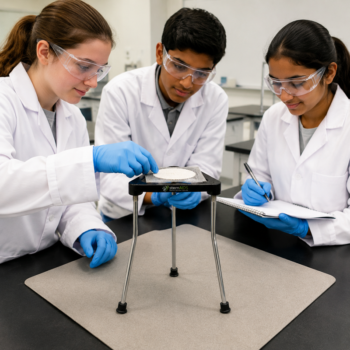
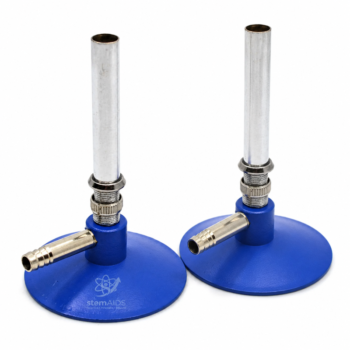
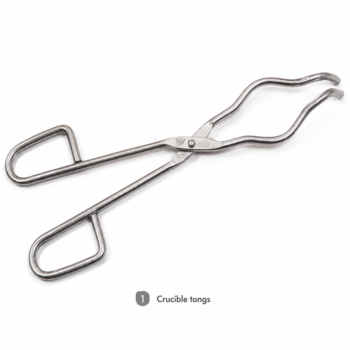
Flame heating is done with the Laboratory Bunsen Burner Set of 2 or an Alcohol Spirit Lamp, with the vessel resting on Wire Mesh Gauze for Laboratory Use over a Metal Tripod Stand. Hot crucibles are moved with Crucible Handling Tongs, and test tubes are held in brass or metal holders and racked in wire, plastic or three-tier stands.
How to choose
- Use a three-prong clamp for round apparatus such as flask necks and condensers, and a burette clamp for burettes, which must hang exactly upright.
- Choose a Bunsen burner where gas is piped to the bench; a spirit lamp suits small-scale heating where there is no gas supply.
- Wire gauze with a ceramic centre spreads the flame’s heat so beakers and flasks are not heated at a single spot.
- Plastic test tube stands resist corrosion from spills but should not take tubes straight from the flame; let tubes cool or use a wire stand.
Related Categories
- Lab Glassware supplies the beakers, flasks and burettes that these stands and clamps hold.
- Chemistry Lab Equipments lists distillation and reflux assemblies built on retort stands.
- General Lab Products adds more burette clamps, boss heads, retort stands and tongs.
Frequently Asked Questions
What is a boss head used for?
A boss head joins a clamp or a second rod to the upright rod of a retort stand. One screw grips the stand rod and the other grips the clamp, so the clamp can be fixed at any height and turned to the angle the set-up needs.
Why is wire gauze placed between the flame and a beaker?
Wire gauze spreads the heat of the flame over a wider area and gives the vessel a flat, steady support on the tripod. This reduces hot spots that can crack glass and makes boiling smoother.
What is the difference between a Bunsen burner and a spirit lamp?
A Bunsen burner burns gas from a bench supply, and its air hole adjusts the flame from yellow to a hotter blue. A spirit lamp burns alcohol through a wick, needs no gas line and gives a smaller, gentler flame for small-scale heating.
How should a burette be clamped for a titration?
Fix the burette in a burette clamp so it hangs vertically, with the scale facing you and the tip just inside the neck of the flask. A vertical burette gives true readings at the meniscus and lets drops fall cleanly into the flask.
How do you get a blue flame from a Bunsen burner?
Light the burner with the air hole closed, which gives a yellow safety flame, then open the air hole gradually. More air gives more complete combustion and the hot blue flame used for heating; close it again when the burner is left unattended.
Last updated: November 2026
Bestsellers in Metalware




Showing 1–12 of 25 results