Quick Answer: The Two Stroke Gasoline Engine Model is a sectioned teaching model of a two-stroke petrol (spark-ignition) engine, used in TVET and engineering classes to show how the engine completes its cycle in two piston strokes, using ports in the cylinder wall instead of valves.
The Two-Stroke Cycle
A two-stroke engine produces a power stroke every time the crankshaft turns once, twice as often as a four-stroke engine. It does this by combining jobs: each movement of the piston does work above it in the cylinder and below it in the crankcase at the same time.
On the upstroke, the piston compresses the fuel-air mixture in the cylinder while the crankcase below fills with a fresh charge. Near the top, the spark plug fires. On the downstroke, the burning gas drives the piston down; the piston first uncovers the exhaust port, letting burnt gas escape, and then the transfer port, through which the fresh charge, slightly compressed in the crankcase, rushes in and helps push the exhaust out. This overlap is called scavenging.
Because the piston itself opens and closes the ports, the engine needs no camshaft or valve gear. That keeps it light and simple, which is why two-strokes have been used in mopeds, chainsaws, small outboard motors and garden machinery. The same overlap also lets some fresh mixture escape with the exhaust, the main reason two-strokes use more fuel and emit more unburnt hydrocarbons.
Specifications
| Engine represented | Two-stroke petrol (gasoline), spark ignition |
| Model type | Sectioned display and demonstration model |
| Teaching focus | Two-stroke cycle, ported gas exchange and crankcase compression |
| Operation | Display model; not fuelled or run |
| Course fit | TVET, ITI, polytechnic and school technical departments |
Applications
- Teaching the two-stroke spark-ignition cycle in automotive and mechanical TVET courses
- Comparing ported gas exchange with valve-operated four-stroke engines
- Explaining crankcase compression and why many two-strokes run on oil mixed with fuel
- Introducing the emissions and fuel-economy differences between engine types
Care & Handling
- Never add fuel or oil to the two-stroke model or try to run it.
- Turn any movable parts slowly by hand and stop at the end of their travel.
- Brush dust out of the sectioned passages so the ports stay easy to see.
- Store it with projecting parts protected, away from bench edges.
Why Choose LabEquip
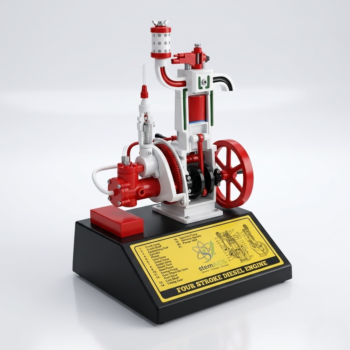
Automotive and mechanical instructors usually set the Two Stroke Gasoline Engine Model beside the Four Stroke Diesel Engine Model or the Petrol Engine Model Four Stroke, so different engine cycles can be compared in one session. Request a quotation through the contact page; related models are in TVET Lab Equipments.
Frequently Asked Questions
Why does a two-stroke engine have no valves?
The piston acts as the valve. As it moves up and down, its side covers and uncovers the inlet, transfer and exhaust ports in the cylinder wall, timing the gas flow without a camshaft.
Why is oil mixed with the fuel in many two-stroke engines?
The crankcase is used to pre-compress the fresh charge, so it cannot hold an oil sump as a four-stroke does. Oil is mixed into the petrol, or injected separately, so the mixture lubricates the crankshaft and piston as it passes through.
What is scavenging?
Scavenging is the clearing of burnt gas from the cylinder by the incoming fresh charge. In a two-stroke, the transfer and exhaust ports are open together for a moment, so some fresh mixture is lost with the exhaust.
Why are two-stroke engines less fuel-efficient?
Part of the fresh fuel-air mixture escapes through the exhaust port during scavenging, and burning oil with the fuel adds to emissions. This is why many countries have moved small vehicles from two-stroke to four-stroke engines.
How does this model compare with the four stroke diesel model?
The two-stroke model shows spark ignition and port-controlled gas exchange with a power stroke every revolution. The four stroke diesel model shows compression ignition, valves and one power stroke every two revolutions.
Does the model run?
No. It is a sectioned display and demonstration model, not a working engine, and must never be fuelled. Ask through the contact page whether the crankshaft and piston on the current model can be turned by hand.
Last Updated: October 2026