Last updated: September 2026
Quick Answer: The Steam Engine Cutaway Model with Boiler is a sectioned, display-style teaching aid that exposes the boiler, steam path, cylinder and piston sections of a classic reciprocating steam engine, so students can see how thermal energy is converted into mechanical motion. It is supplied as an educational demonstration model; live-steam (heated, pressurised) operation has not been confirmed for this listing, so schools requiring a functional unit should confirm this with LabEquip before ordering.
Product Description
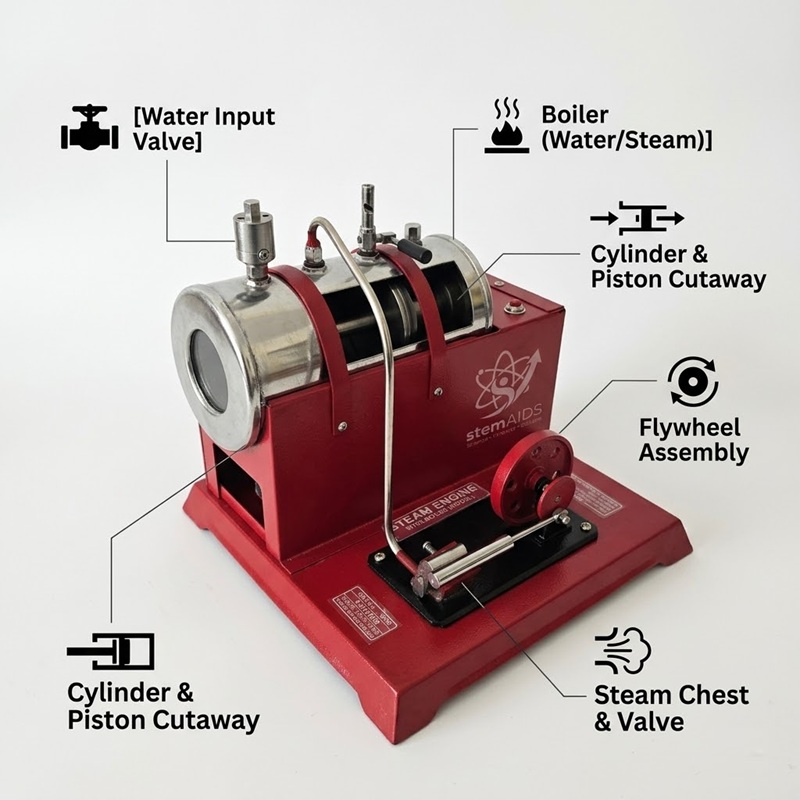
This Steam Engine Cutaway Model with Boiler from LabEquip is built to support classroom and laboratory instruction on the operating principles of a conventional reciprocating steam engine. In this type of system, thermal energy heats water inside a boiler to generate steam; the pressurised steam is then directed toward a cylinder, where it can act on a piston to produce reciprocating mechanical motion.
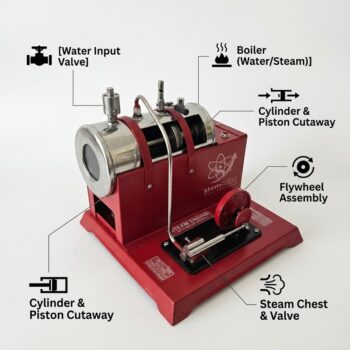
Because several working parts sit inside a sealed housing on a full-size engine, a cutaway presentation is used so that internal components normally hidden from view can be identified and discussed. The model is intended to help learners locate the boiler, steam path, cylinder, piston and mechanical-output sections represented in the unit, and connect each part to the stage of the steam cycle it represents.
This item is supplied as an educational demonstration model. LabEquip has not separately confirmed whether the specific unit shipped under this listing is designed for live-steam operation (that is, actual heating and pressurisation of the boiler). Institutions that require a functional, heat-and-pressure-rated unit should confirm this directly with our team before ordering.
What This Model Helps Students Learn
- Identify the boiler, steam path, cylinder, piston and mechanical-output sections represented in the cutaway.
- Explain how a boiler transfers thermal energy to water to produce steam.
- Trace the steam path from the boiler toward the engine cylinder.
- Describe how steam pressure acting on a piston can produce reciprocating motion.
- Understand how a connecting rod and crank convert reciprocating motion into rotary motion, where these parts are represented in the model.
- Identify the exhaust or return pathway shown in the cutaway.
Specifications
| Attribute | Detail |
|---|---|
| Product name | Steam Engine Cutaway Model with Boiler |
| Category | TVET Lab Equipments – physics & engineering demonstration models |
| Product type | Sectioned (cutaway) static/demonstration teaching model |
| Intended use | Teaching steam-engine operating principles: boiler heating, steam path, piston motion, mechanical output |
| Operating status | Supplied as a display/demonstration unit; live-steam (heated, pressurised) operation is not confirmed for this listing |
| Recommended for | School and college physics departments, TVET/technical training institutes, STEM demonstration centres |
Exact external dimensions, base materials and the specific internal components exposed by this cutaway were not included in the specification on file. Contact LabEquip for a technical drawing or detailed spec sheet before finalising a purchase order that depends on precise measurements.
Safety Note
Treat this product as a non-heated educational display model unless LabEquip explicitly confirms functional steam operation for the specific unit ordered. Do not add water or fuel, apply heat, or pressurise the boiler without approved operating instructions from the manufacturer. Live steam, hot surfaces and pressurised vessels can cause severe burns or pressure-related injury.
Care & Maintenance
- Keep cutaway surfaces, labels and mechanical parts clean and free of dust.
- Operate any movable components gently and only within their intended range of travel.
- Do not heat, pressurise, lubricate or dismantle the boiler or engine mechanism unless the manufacturer’s instructions specifically permit it.
- Store the model securely to protect projecting pipes, rods, valves and the flywheel from impact damage.
Why Choose LabEquip
Our TVET Lab Equipment range covers engine, turbine and energy-conversion demonstration models alongside our wider Physics Laboratory Products and STEM Kits ranges. Browse our full Product Categories for related teaching aids covering thermodynamics, mechanics and energy conversion.
Frequently Asked Questions
What does the cutaway section show?
The specific components exposed on this cutaway – cylinder, piston, valve, steam-passage or boiler sections – have not been separately itemised for this listing. Please confirm the exact configuration with LabEquip before finalising an order that depends on a particular internal view.
How does a steam engine with a boiler work?
In a conventional system, a boiler produces steam by heating water. The steam then enters the engine and can act on a piston, and the resulting reciprocating motion is converted into rotary mechanical output via a connecting rod and crank.
Does this model actually generate steam?
Live-steam operation has not been confirmed for this listing. Treat the apparatus as a demonstration model unless LabEquip explicitly confirms that the boiler is designed to be heated and pressurised.
Does the model include a working piston and flywheel?
The specific moving components included in this configuration have not been separately verified. Do not assume an operational piston, crankshaft, valve gear or flywheel is present until this has been confirmed with our team.
Can students heat the boiler during demonstrations?
Not unless approved manufacturer instructions explicitly identify this specific unit as functional steam equipment. Boiler heating and pressurisation require purpose-designed safety controls and trained supervision.