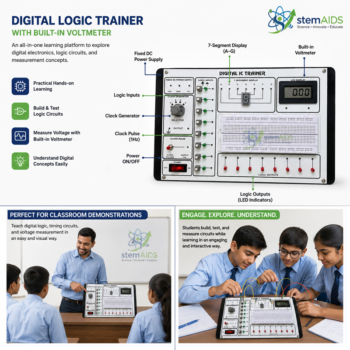
Electrical and Electronics brings together fifty-three items for current-electricity and electronics practicals: regulated power supplies, battery eliminators and step-down transformers, cells and cell substitutes, Ohm’s law and Wheatstone bridge set-ups, and trainer boards for diodes, transistors, logic gates and operational amplifiers. It serves senior secondary physics through to undergraduate electronics laboratories.
Power sources and cells
Low-voltage supplies include the Regulated DC Power Supply (2-12V, 2A), the Battery Eliminator AC/DC 12V 2A and the Step Down Transformer (2-12V) 2A AC. For EMF and electrochemistry work there is the Daniell Cell Substitute 1.08V, an electronic source with a fixed 1.08 V DC output, and the Leclanche Cell Working Model.
Experiment boards and trainers
Circuit laws are covered by the Ohm’s Law Experimental Kit with Integrated Power Supply and the Portable Wheatstone Bridge. Semiconductor practicals use the PN Junction Diode Characteristics Trainer, a socket-type Zener diode apparatus and the Transistor V-I Characteristics Trainer for a BJT in common-emitter configuration. The Digital Logic Gate Experiment Kit and the operational amplifier trainers cover digital and analogue electronics, with FET, SCR and UJT apparatus for college courses.
How to choose
- Use a regulated DC supply where a steady voltage matters, as in V-I characteristics; a battery eliminator suits general circuits, and an AC step-down transformer suits experiments that need alternating current.
- Panel-mounted trainers stand up well to repeated student use, while socket-type apparatus lets a damaged diode be swapped without soldering.
- Diode, Zener and Ohm’s law boards suit senior secondary physics; FET, SCR, UJT and op-amp trainers suit college electronics.
- The Daniell cell substitute gives a steady reference EMF for potentiometer work without preparing copper sulphate and zinc sulphate solutions.
Related Categories
- Measuring Instruments provides the ammeters, voltmeters and galvanometers these circuits are read with.
- Rheostat has the variable resistors used to set current in Ohm’s law and characteristic experiments.
- Keys and Switches supplies plug and tapping keys for opening and closing the circuits.
Frequently Asked Questions
What is the difference between a battery eliminator and a regulated power supply?
Both replace dry cells with a low voltage taken from the mains. A regulated supply holds its output steady as the load changes, which suits characteristic curves and precise readings; a basic battery eliminator suits general circuits where a small change in voltage does not matter.
How do you plot the V-I characteristics of a PN junction diode?
In forward bias, raise the voltage in small steps and record the current, which stays near zero until the knee voltage and then rises steeply. In reverse bias only a very small current flows until breakdown. Plot current against voltage for both directions on one graph.
What is a Zener diode used for in the lab?
A Zener diode is made to work in reverse breakdown, where the voltage across it stays nearly constant over a wide range of current. Students plot its reverse characteristic to find the Zener voltage and see how it acts as a simple voltage regulator.
Why is a step-down transformer used in a physics lab?
It lowers the mains voltage to a safe, low AC voltage for experiments that need alternating current, such as driving an electromagnet beside a sonometer wire or studying transformer action. Students should never connect an experiment directly to the mains.
What does a Wheatstone bridge measure?
It measures an unknown resistance by balancing it against known resistances. At balance the galvanometer reads zero, and the ratio of the bridge arms gives the unknown value without relying on the resistance of a meter.
Last updated: November 2026
Bestsellers in Electrical and Electronics







Showing 1–12 of 53 results