Search

Quick answer: STEMAids manufactures and supplies 3 wire-wound rheostats for variable-resistance control, priced from ₹400 to ₹515, all listed on stemaids.com on 28 August 2026. Eduscope Smart Learning Solutions Private Limited is Udyam-registered for laboratory equipment manufacturing (UDYAM-DL-06-0069460) and ISO 9001:2015 certified, supplying schools, colleges and vocational institutes across India and for export.

STEMAids supplies rheostats as part of its Electronics Lab Equipment Manufacturer and Physics Lab Equipment Supplier range across Delhi and pan-India.

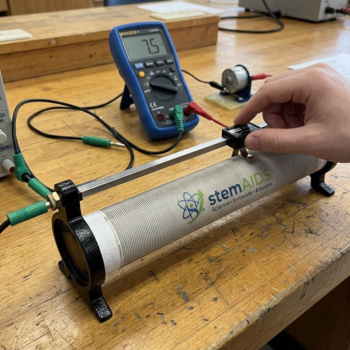
A rheostat is the apparatus a physics practical reaches for whenever current or voltage in a circuit needs to be varied smoothly rather than switched on and off — the sliding contact along a resistance wire lets a student dial in a specific current for an Ohm’s-law verification, a potentiometer calibration, or a bulb-brightness demonstration. The three rheostats in this range differ mainly in length and current rating, which determines both the resistance range available and how much current the winding can safely carry.

What the Rheostat range covers

Product Price Curriculum / lab use
Physics Lab Sliding Rheostat ₹405 General-purpose sliding-contact resistance control for standard secondary-level circuit practicals
Rheostat 8 Inch 100 Ohm 1.6A ₹400 Compact 100-ohm, 1.6A-rated unit suited to lower-current Ohm’s-law and resistance practicals
Wire Wound Rheostat 12 Inch ₹515 Longer 12-inch winding for a wider resistance range, suited to senior-secondary and undergraduate circuit practicals

Choosing between the three comes down to the resistance range and current a practical needs: the Rheostat 8 Inch 100 Ohm 1.6A is specified where both the maximum resistance and current draw are known and modest, while the Wire Wound Rheostat 12 Inch gives a longer winding — and therefore a finer, wider adjustment range — for practicals where a student needs to sweep current or voltage across a broader interval, such as plotting a current-voltage characteristic curve.

Applying the 6-S Framework to Rheostat

Because a rheostat sits directly in the current path of a circuit, the 6-S Framework matters more here than in most low-cost categories. Syllabus: confirm the resistance range and current rating a practical calls for before ordering — CBSE and state-board Ohm’s-law and potentiometer experiments generally specify a particular resistance range. Specification: ask for the ohm rating and ampere rating together, since a rheostat undersized for the circuit’s current draw can overheat. Safety: rheostats used near their rated current limit should be issued with basic handling guidance, as the winding can become warm during extended use. Sturdiness: the sliding contact and winding should hold consistent resistance across a full academic year of student handling. Spares: sliding-contact assemblies are the most frequently reordered part on a rheostat that sees heavy classroom use. Supporting documents: manufacturer specification sheets and the statutory document pack are available via the Tenders page for institutional and government procurement.

Frequently Asked Questions

What is included in the Rheostat category?

Three wire-wound rheostats for variable-resistance circuit control, priced from ₹400 to ₹515, all listed on stemaids.com on 28 August 2026.

Which rheostat should I order for a standard Ohm’s-law practical?

The Rheostat 8 Inch 100 Ohm 1.6A (₹400) suits standard secondary-level Ohm’s-law practicals where the resistance range and current are modest and well within its 100-ohm, 1.6A rating.

What is the difference between the 8-inch and 12-inch rheostats?

The Rheostat 8 Inch 100 Ohm 1.6A gives a compact unit for lower-current practicals. The Wire Wound Rheostat 12 Inch (₹515) has a longer winding, giving a wider and finer resistance adjustment range for senior-secondary and undergraduate practicals that sweep current or voltage across a broader interval.

Can a rheostat be used to control brightness in a bulb-circuit demonstration?

Yes. Any of the three rheostats can be wired in series with a bulb to vary current and demonstrate brightness change; the Physics Lab Sliding Rheostat (₹405) is the general-purpose option most commonly specified for this demonstration.

What current rating do these rheostats carry?

The Rheostat 8 Inch 100 Ohm 1.6A is rated at 1.6A. For the Physics Lab Sliding Rheostat and Wire Wound Rheostat 12 Inch, confirm the specific ampere rating against the product listing before specifying for a higher-current circuit — verify before procurement.

Is STEMAids a registered manufacturer of these rheostats?

Yes. Eduscope Smart Learning Solutions Private Limited is a Udyam-registered micro manufacturing enterprise (UDYAM-DL-06-0069460) and is ISO 9001:2015 certified. See the About page for the full registration and certification details — manufacturer-stated, verify before citing in procurement documents.

Related Categories

Rheostat sits within Physics Equipments alongside Electrical and Electronics for circuit-building components, Measuring Instruments for ammeters and voltmeters, Keys and Switches for circuit-control components, and General Items for resistance wire and consumables.

See also: Electrical and Electronics.

Showing all 3 results

Sort by

Physics Lab Sliding Rheostat

Original price was: ₹830.00.Current price is: ₹405.00.
(0 Reviews)
Original price was: ₹830.00.Current price is: ₹405.00.

Rheostat 8 Inch 100 Ohm 1.6A

Original price was: ₹820.00.Current price is: ₹400.00.
(0 Reviews)
Original price was: ₹820.00.Current price is: ₹400.00.

Wire Wound Rheostat 12 Inch

Original price was: ₹1,050.00.Current price is: ₹515.00.
(0 Reviews)
Original price was: ₹1,050.00.Current price is: ₹515.00.

Back to Top
Select your currency
INR Indian rupee
Product has been added to your cart
Compare (0)