Chemistry Lab Equipments holds 235 items for school, college and analytical chemistry: burettes, condensers, flasks and adapters with interchangeable ground-glass joints, distillation, extraction and gas-generation assemblies, reagent and wash bottles, pipettes and stands, electrolysis apparatus, practical kits on polymers and ion tests, and a set of wireless sensors for live data logging.
Glass apparatus and assemblies
Titration uses burettes with different taps, from the Burette, PTFE Key to the screw-action Burette, Rotaflow. Distillation and reflux are built from condensers such as the Condenser, Liebig (Sampling) and Condenser, Allihn with interchangeable joints, or come ready as the Distillation Assembly, Simple Type. The Soxhlet Extraction Apparatus and the Kipps Gas Generating Apparatus, Borosilicate Glass cover extraction and gas preparation.
Kits and data logging
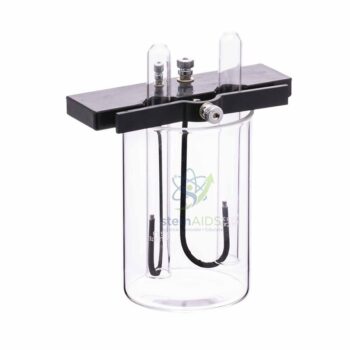
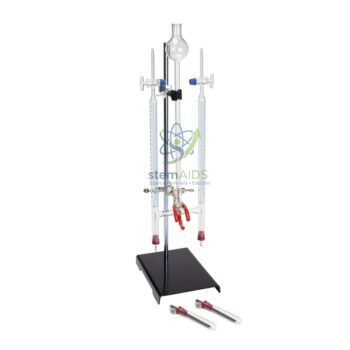
The Hofmann Electrolysis Apparatus splits water into gases collected in two graduated tubes. Practical kits include the Nylon Synthesis kit for Students and the Silver Mirror Kit for the Tollens’ test, and Redy wireless sensors for pH, temperature, conductivity, pressure and more log readings live.
How to choose
- Burette taps: glass keys need a thin film of grease, PTFE keys run without grease, and screw-action valves give the finest control for dropwise addition.
- Condensers: Liebig for straightforward distillation, Allihn bulb condensers fitted upright for reflux, and Graham coil condensers where a long cooling path is needed in a short length.
- Choose interchangeable-joint glassware so flasks, adapters and condensers from one set fit together without corks.
- Wireless sensors suit experiments that change over time, such as a titration curve or the temperature of a reaction, because readings are graphed as they happen.
Related Categories
- Lab Glassware supplies everyday beakers, flasks, measuring cylinders and bottles.
- Metalware provides the stands, clamps and burners these assemblies are built on.
- LEP Kits offers microscale chemistry kits for schools working with small volumes.
Frequently Asked Questions
What is the difference between Liebig, Allihn and Graham condensers?
A Liebig condenser has a straight inner tube and is used sloping for distillation. An Allihn condenser has a chain of bulbs that gives more cooling surface and is used upright for reflux. A Graham condenser carries the vapour through a glass coil inside the water jacket.
How does a Kipp’s apparatus work?
Acid from the top globe reaches a solid in the middle globe and gas is produced. When the outlet tap is closed, gas pressure pushes the acid back up and away from the solid, so the reaction stops and gas is made only while it is being drawn off.
What is a Soxhlet extractor used for?
It extracts a substance from a solid, such as oil from seeds, with a small volume of solvent that is boiled, condensed and dripped through the sample again and again. Each cycle uses freshly distilled solvent, so extraction continues without constant attention.
What does the Hofmann electrolysis apparatus show?
It shows that water splits into hydrogen and oxygen in a 2 to 1 ratio by volume when a current passes through acidified water. The gases collect in the two graduated tubes, so their volumes can be read and the gases tested.
Why are interchangeable ground-glass joints used?
Ground-glass joints have a standard taper, so a cone of one size fits any socket of the same size. Apparatus can be assembled and changed quickly with a close seal and without rubber or cork in contact with hot vapours.
Last updated: November 2026
Bestsellers in Chemistry Lab Equipments


Showing 1–12 of 235 results