






















Sale
In Stock
Gold Leaf Electrostatic Apparatus
Original price was: $5.64.$2.71Current price is: $2.71.
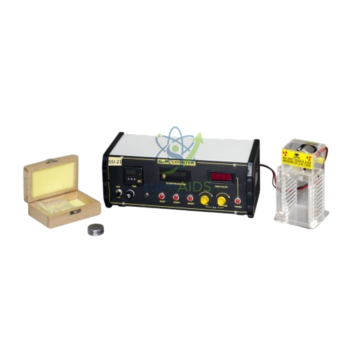
Quick Answer: The Gold Leaf Electrostatic Apparatus is a gold leaf electroscope for detecting electric charge. The listing image shows a transparent-sided case on a base, a top terminal on an insulated support rod, a thin gold leaf beside the rod, a scale for reading the leaf’s angle and a separate earth terminal.
How the Leaf Reveals Charge
When charge reaches the top terminal, it spreads down the metal rod and onto the gold leaf. The leaf and the rod now carry charge of the same sign, so they repel and the leaf rises away from the rod. The greater the charge, the wider the angle, which the scale behind the leaf helps students compare. Gold is used because it can be beaten into leaf so thin and light that a tiny force moves it.
The gold leaf electroscope does more than detect charge. It can be charged by induction by bringing a charged rod near, earthing the terminal briefly and then removing the earth before the rod. Once charged with a known sign, it identifies an unknown charge: the leaf rises further for a like charge and falls for an opposite one. It also separates conductors from insulators, since a conductor touched to a charged cap lets the leaf collapse.
The case keeps draughts off the leaf and slows the leakage of charge. A classic extension places a clean zinc plate on the cap to show the photoelectric effect with an ultraviolet lamp, observed with suitable eye protection. Whether a zinc plate or charging rods are included should be confirmed when ordering.
Specifications
| Instrument type | Gold leaf electroscope |
| Indicator | Thin gold leaf beside a metal support rod |
| Housing | Transparent-sided case on a base, as pictured |
| Connections | Top terminal and earth terminal |
| Reading | Scale for comparing leaf deflection |
| Charging rods and accessories | Confirm at enquiry |
Applications
- Detecting static charge and comparing its size
- Charging by conduction and by induction
- Testing the sign of an unknown charge
- Distinguishing conductors from insulators
- Demonstrating the photoelectric effect with a zinc plate and ultraviolet light
Care & Handling
- Never touch the gold leaf; it tears at the lightest contact and cannot be straightened.
- Keep the case closed and the insulating support clean and dry so charge does not leak away.
- Move the instrument gently and upright, since a jolt can fold the leaf against the case.
- Store it in a dry cupboard; humidity is the main reason an electroscope stops holding charge.
Why Choose LabEquip
Physics teachers buy this electroscope for electrostatics practicals that run from charging by friction to the photoelectric effect. LabEquip offers it in the STEM kits range as everyday physics lab equipment, and the Electrical Van De Graaff Generator can supply a large charge for class demonstrations. Send enquiries through the contact page.
Frequently Asked Questions
How does an electroscope detect charge?
Charge on the top terminal spreads to the rod and the leaf. Because both carry the same sign of charge, they repel each other and the leaf lifts away from the rod. No leaf movement means the object brought near carries no detectable charge.
How do I charge the electroscope by induction?
Bring a charged rod close to the cap without touching it, touch the cap briefly with a finger or earth wire, remove the earth, and then take away the rod. The electroscope is left with a charge opposite in sign to the rod.
How can I tell whether an unknown object is positive or negative?
First give the electroscope a known charge, for example negative from a polythene rod rubbed with wool. Bring the object near the cap: if the leaf rises further, the object is negative too; if it falls, the object is positive or uncharged, so repeat with a positively charged electroscope to decide.
Why does the leaf slowly fall after charging?
Charge gradually leaks away through moist air and along the surface of the insulating support. On humid days this happens faster. Keeping the insulator clean and dry and the case closed slows the leakage.
How is the photoelectric effect shown with an electroscope?
A clean zinc plate on the cap is charged negatively and lit with ultraviolet light. The leaf falls as electrons are ejected from the zinc. Visible light, however bright, has no effect, and a positively charged plate does not discharge, which supports the photon model of light.
Can the electroscope measure voltage?
Only roughly. The leaf angle increases with the potential of the cap, and the scale helps compare readings, but the instrument is not calibrated in volts. It is used to detect and compare charge rather than to measure it precisely.
Last Updated: September 2026
You must be logged in to post a review.
Bestsellers




Sale

Sale

Sale


Reviews
There are no reviews yet.