
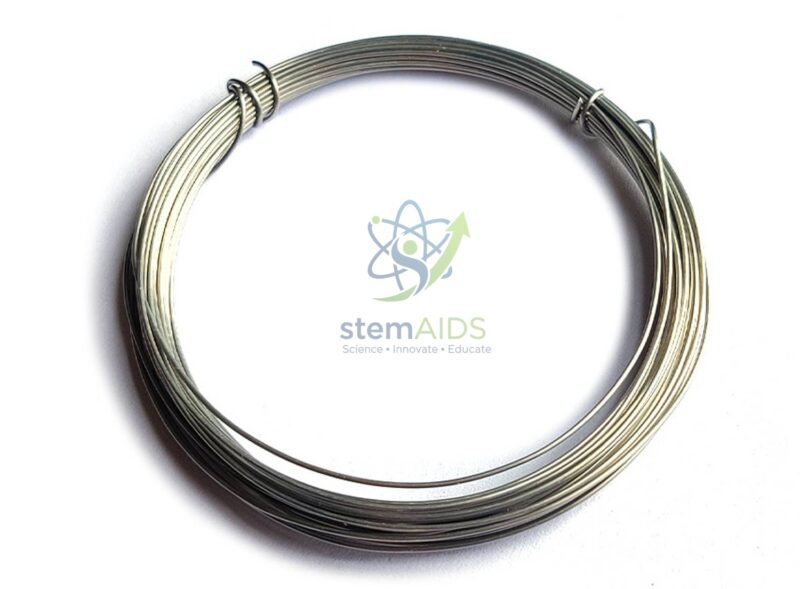
Quick Answer: This copper wire has a diameter of 0.5 mm: the 5/10 mm in the title is the continental way of writing five tenths of a millimetre, not a range from 5 to 10 mm. Copper wire 0.5 mm thick is used in the physics lab for winding coils and electromagnets, making connections and resistance experiments.
Why Copper, and Why This Diameter
Copper is the standard conductor in electrical work because it combines very low resistivity with good flexibility and is easy to solder. At this diameter the wire is thin enough to wind neatly into many turns on a small former, yet thick enough to handle without kinking and to carry the currents of school electromagnet and coil experiments without excessive heating.
The resistance of a wire depends on its length, cross-sectional area and material: R = ρL / A. For a round wire the area is π times the radius squared, and here the radius is 0.25 mm. Students can calculate the expected resistance of a measured length using the resistivity of copper from a data book, then measure it, which also shows why long, thin wires are needed before copper’s resistance becomes noticeable at all.
Winding Coils and Electromagnets
For electromagnets and induction coils, the wire is wound on an iron nail, a bolt or a plastic former. More turns and more current give a stronger field, and students can count turns against the number of paper clips lifted. Adjacent turns must be insulated from each other, so either enamelled wire is used, or bare wire is spaced out or wrapped with insulation between layers. Whether this wire is bare or enamelled therefore affects how it is used, and enamel must be removed from the ends before connecting. For resistance coil work, the copper wire for resistors is a related listing.
Specifications
| Product | Copper wire |
| Diameter | 0.5 mm (5/10 mm), as titled |
| Cross-section | About 0.196 mm², from π × (0.25 mm)² |
| Material | Copper |
| Uses | Coils, electromagnets, connections, resistance experiments |
| Finish (bare or enamelled) and length per reel | Confirm at enquiry |
Applications
- Winding electromagnets and counting turns against lifting strength
- Making induction coils for experiments with magnets and galvanometers
- Resistance calculations using length, cross-sectional area and resistivity
- Connections and links on circuit boards and student projects
Care & Handling
- Unwind wire from the reel rather than pulling it off the side, which twists and kinks it
- Wind coils neatly and under light tension so the turns lie side by side
- If the wire is enamelled, remove the enamel only at the ends, using fine abrasive paper
- Store the reel in a dry place, as copper tarnishes in damp air and tarnish raises contact resistance
Why Choose LabEquip
Physics departments buy copper wire 0.5 mm thick on reels for electromagnet and coil practicals and for project work. LabEquip can supply it by length or reel; state how much you need through our contact page, and see related physics lab equipment.
Frequently Asked Questions
Does 5/10 mm mean the wire is 5 to 10 mm thick?
No. It means five tenths of a millimetre, that is 0.5 mm, following a notation common in continental European catalogues. The wire is a fine conductor suitable for winding coils.
How many turns are needed for an electromagnet?
There is no single figure. The field strength rises with the number of turns and the current, so students often compare 10, 20 and 30 turns at the same current and record how many paper clips each version lifts.
What is the resistance of the wire?
Use R = ρL / A with the resistivity of copper from a data book and a cross-sectional area of about 0.196 square millimetres. The result is small for short lengths, so long coils are needed to measure a resistance comfortably.
Is the wire suitable for mains wiring?
No. Single thin wire is for low-voltage experiments, coils and projects. Mains installations need proper insulated cable of the correct size, fitted to local rules.
Why does the wire get warm in an electromagnet experiment?
Current through any resistance produces heat at a rate of I squared R. In a coil with many turns and a large current the heat builds up, so switch the electromagnet off between readings.
How should the ends be prepared for connection?
Clean the ends to bright copper with fine abrasive paper so the clip or terminal makes good contact. If the wire is enamelled, remove the enamel completely from the length that will be connected.
Last Updated: October 2026








Reviews
There are no reviews yet.