











In Stock
Uni-bloc Guardian 5000 for Tubes
₹6,580.00
Quick Answer: The Uni-bloc Guardian 5000 for Tubes is a one-piece round heating block with rings of deep wells that holds test tubes on a Guardian 5000 hotplate or hotplate stirrer. The Guardian 5000 uni-bloc for tubes heats every tube from the sides and base at once, like a dry bath on the hotplate.
One-Piece Block vs Sectional Blocks
The Guardian 5000 heating accessories come in two styles. A uni-bloc is a single solid disc drilled with one size of well; a sectional block is a wedge-shaped segment, and several segments are combined on a base plate. The uni-bloc is the simpler choice when a lab always works with one tube size: one piece to place, no base plate, and every well identical.
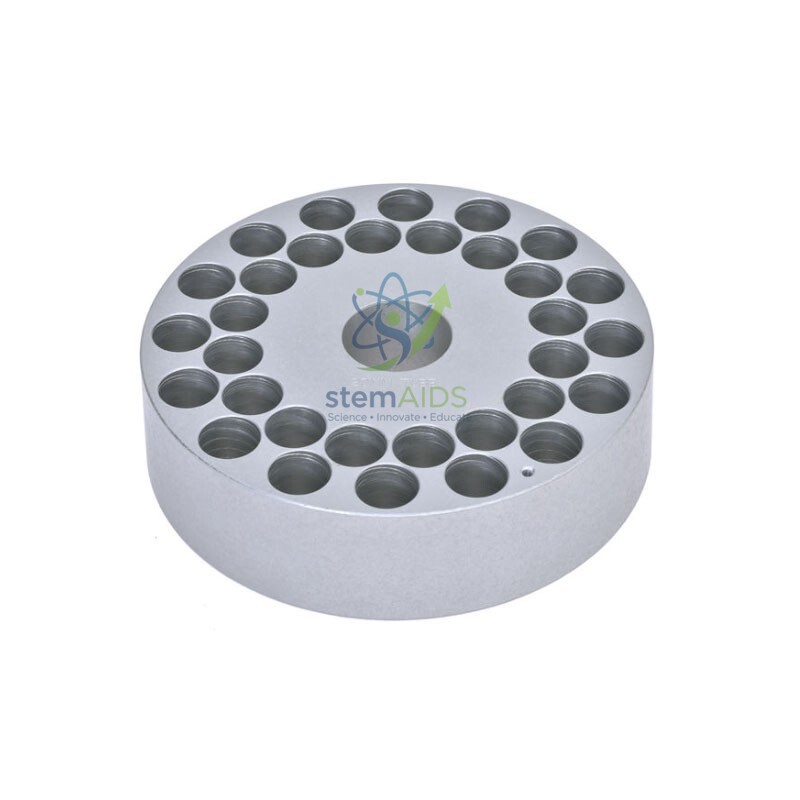
The listing photograph shows a thick silver-coloured disc with two concentric rings of deep round wells around a central opening, plus a small hole near the edge of the kind usually used for a temperature probe. Deep wells surround most of each tube, which helps the tube contents follow the block temperature closely.
The image file for this listing refers to 20 mm test tubes, but the title does not state the well diameter or the number of wells. Tubes that fit loosely heat slowly, so the well size should be checked against the tubes you use, such as standard glass test tubes.
Specifications
| Product type | One-piece heating block (uni-bloc) for test tubes |
| Listed for | Guardian 5000 hotplates and hotplate stirrers |
| Form (from photo) | Solid round block with two rings of deep wells and a central opening |
| Probe hole | Small side hole visible in photo |
| Well diameter and number of wells | Confirm at enquiry |
Applications
- Heating a class set of test tubes to the same temperature for a food test or enzyme practical
- Incubating samples in tubes at a steady temperature without a water bath
- Warming reagent tubes before a reaction in teaching or quality-control labs
- Boiling-water-free heating steps where tubes must stay dry on the outside
Care & Handling
- Use tubes that match the well diameter for good heat transfer
- Check the block temperature with a probe in the side hole or in a water-filled tube
- Lift the block only when cool, or with heat-resistant gloves
- Keep wells clean and dry; a broken tube’s residue should be removed once cool
Why Choose LabEquip
Schools and colleges choose the uni-bloc for tubes when every practical uses the same tube size and they want a quick, one-piece set-up on their Guardian hotplates. LabEquip can confirm the well size and supply it with tubes from our general lab products range; contact us with the tube diameter you use.
Frequently Asked Questions
What is the difference between a uni-bloc and a sectional block?
A uni-bloc is one solid disc with a single well size. Sectional blocks are wedge-shaped segments that combine on a base plate, so different tube and vial sizes can be heated together.
Which test tube size does the uni-bloc for tubes take?
The image file refers to 20 mm tubes, but the title does not state it. Ask us to confirm the well diameter when you enquire so your tubes fit snugly.
Does the uni-bloc need a base plate?
No. It is a single piece made to sit directly on the Guardian 5000 top plate. The base plate is used with sectional blocks.
How do I know the temperature inside the tubes?
Place a probe in the small side hole, or put a thermometer in a tube of water in one of the wells, and allow time to settle.
Can the block be used on a hotplate stirrer while stirring?
Yes. The block sits on a hotplate stirrer like any vessel. Stirring only matters if the tubes hold small stir bars, and the block’s thickness weakens coupling, so expect gentle mixing at most.
Can I use the block for vials instead of tubes?
Only if the vials match the well diameter. A separate uni-bloc for vials is listed with smaller, shallower wells.
Last Updated: September 2026
You must be logged in to post a review.
Bestsellers




Reviews
There are no reviews yet.