
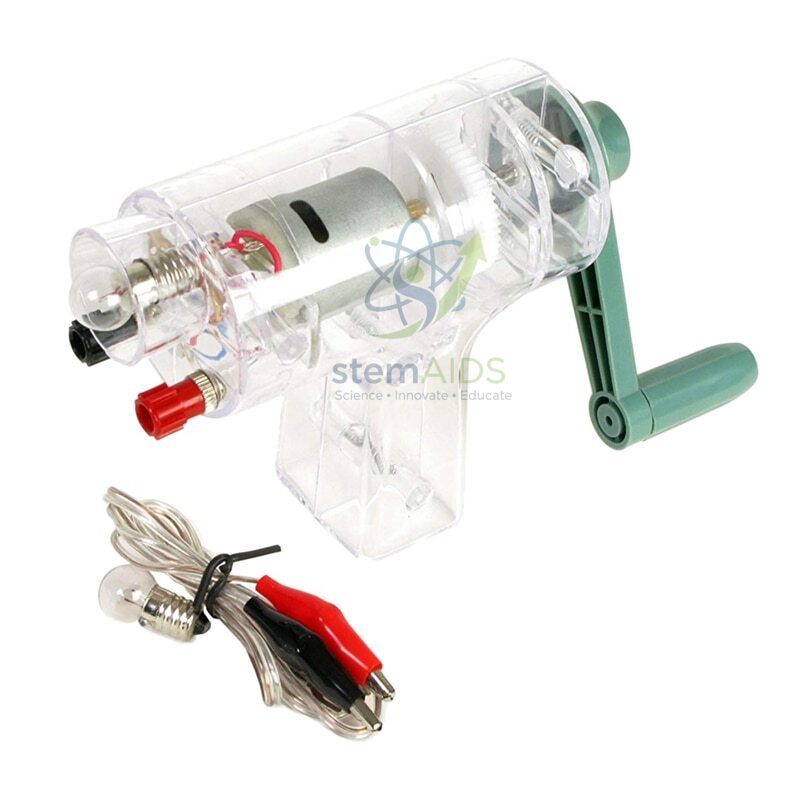
Quick Answer: The Manual Electric Generator is a hand-crank generator in a transparent casing, fitted with leads ending in crocodile clips, that produces electricity as its handle is turned. Students use the manual electric generator to power small lamps or motors directly and to feel how drawing more current makes the handle harder to turn.
Gears, Magnets and Coils Inside the Casing
Turning a handle by hand is slow, a turn or two each second. Inside the clear casing, a gear train multiplies that rotation so the small generator at its heart spins many times faster, which is needed because the induced voltage depends on how quickly the magnetic flux through the coils changes.
The product photograph shows the clear cylindrical body with a green crank at one end and two leads with red and black crocodile clips. Students can see the gears turning as they crank, which helps them connect the effort of their arm with what happens inside.
Feeling Energy Conservation in Your Arm
With the clips not connected, the crank turns freely. Clip on a small lamp and it becomes noticeably stiffer; add a second lamp in parallel and stiffer again. Each time more current is drawn, the coils produce a stronger opposing magnetic force, in line with Lenz’s law, and the arm has to do more work every second.
This is energy conservation made physical. The electrical energy delivered to the lamps comes from the work done on the crank, plus a share lost to friction and heating in the gears and coils.
Applications
- Lighting a small lamp and comparing the effort with and without the load
- Driving a small motor directly from human effort
- Charging a capacitor and then using it to run a load briefly
- Connecting two generators together to show one driving the other as a motor
Care & Handling
- Turn the crank at a steady, moderate speed; very fast cranking can overdrive small lamps and wear the gears
- Keep the crocodile clips apart when the generator is not connected to a load
- Do not drop the generator, as the clear casing can crack
- Wipe the casing with a damp cloth only
Specifications
| Device | Hand-crank electric generator |
| Casing | Transparent body with internal gearing visible |
| Output leads | Red and black leads with crocodile clips |
| Drive | Hand crank |
| Output rating | Confirm at enquiry |
Why Choose LabEquip
Schools buy hand-crank generators in class sets because every student can feel the link between effort and electrical energy for themselves. LabEquip supplies them with the power level indicator and other physics equipment; class quantities can be requested on the contact page.
Frequently Asked Questions
Does the generator produce AC or DC?
Connect a voltmeter and turn the crank one way, then the other. If the reading changes sign with the direction of cranking but stays steady in one direction, the generator gives DC, which is common for hand-crank teaching models.
Why is the handle harder to turn with a lamp connected?
Current flowing in the coils creates a magnetic force that opposes the rotation, as Lenz’s law predicts. The extra effort is the work being converted into electrical energy for the lamp.
How fast should the handle be turned?
Steadily and at a moderate pace. Very fast cranking raises the voltage and can overdrive small lamps, and it also wears the gears faster without improving the lesson.
Can the generator charge a capacitor?
Yes. Cranking with a capacitor connected stores energy that can then run a small lamp or motor briefly. Observe the polarity marked on electrolytic capacitors and stay within their voltage rating.
How can students estimate the power they produce?
Connect a resistor with an ammeter in series and a voltmeter across it, crank steadily, and multiply voltage by current. Comparing results across the class makes a lively data activity.
What happens if two generators are clipped together?
Cranking one makes the other’s handle turn by itself: the first works as a generator and the second as a motor. It is a memorable demonstration that motors and generators are the same machine.
Last Updated: October 2026






Reviews
There are no reviews yet.