
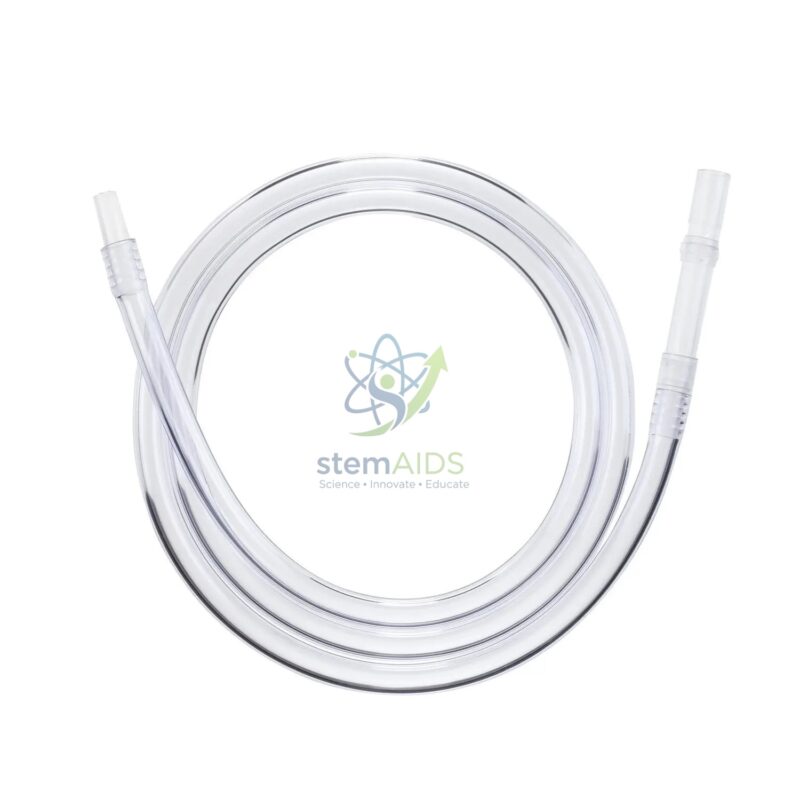
Quick Answer: This item is a flexible gas delivery tube: a length of clear plastic tubing with a rigid connector at each end, as pictured. A gas delivery tube carries the gas produced in a reaction vessel to wherever it is collected or tested, such as a syringe, an inverted vessel in a water trough or a tube of limewater.
What a Delivery Tube Does
In gas preparations, the vessel where the reaction happens is rarely the place where the gas is collected. A delivery tube links the two. Rigid glass delivery tubes are traditional, but they break easily and have to be bent to shape. A flexible gas delivery tube bends by hand, can be routed round a clamp stand, and the connectors at its ends let it be joined quickly to a stopper outlet, a syringe or another length of tubing.
The clear wall is useful in teaching. Students can see bubbles moving along the tube, notice condensation from a warm gas, and spot the moment when liquid starts to creep back towards the reaction vessel.
Preventing Suck-Back
If a heated reaction tube is allowed to cool while the far end of the delivery tube is still under water, the gas inside contracts and water is drawn back towards the hot glass, which can crack it. The rule is to lift the end of the tube out of the water before the heating stops. With cold reactions the same thing can happen more gently when the reaction slows, so the end of the tube should still be removed at the end of the experiment.
Specifications
| Product | Flexible gas delivery tube |
| Shown in photograph | Clear coiled tubing with a rigid connector at each end |
| Function | Carries gas from a reaction vessel to a collector or test liquid |
| Connects to | Stopper outlets, syringes and other tubing with matching connectors |
| Material and length | Confirm at enquiry |
Where the Tube Is Used
- Leading hydrogen or oxygen from a reaction tube to an inverted vessel in a water trough
- Bubbling a gas through limewater or an indicator solution
- Connecting a bottle reaction vessel to a graduated syringe
- Replacing worn tubing in a gas collection set
Care & Handling
- Lift the free end out of water before heating stops to avoid suck-back
- Flush the tube with clean water after bubbling it through limewater or salt solutions, then let it drain
- Do not pass hot gases straight from a flame or furnace through the plastic tube
- Replace the tube if it becomes cloudy, stiff or cracked at the connectors
Why Choose LabEquip
Schools order spare delivery tubes because tubing is the part of a gas kit that wears out first. LabEquip supplies them to match the complete gas collection set and the rest of its physics lab equipment, and you can contact LabEquip to check the connector fit.
Frequently Asked Questions
Why use flexible tubing instead of a glass delivery tube?
Flexible tubing bends by hand, does not shatter if knocked, and connects quickly to syringes and stoppers. Glass tubes need careful bending and can break when pushed into a stopper.
What is suck-back and how is it avoided?
Suck-back is liquid being drawn back up the tube into the reaction vessel as the gas inside cools and contracts. Take the end of the tube out of the water before you stop heating.
Can the tube carry hot gases?
It is meant for gases at or near room temperature. Very hot gases can soften plastic tubing, so let gases cool in a glass section first.
How do I know the connectors are sealed?
Close one end and blow gently or press a connected syringe. If there is no leak, the plunger springs back. Re-seat any connector that hisses or bubbles under water.
Can the tube be cut to a shorter length?
Plastic tubing can be cut with sharp scissors, but the end connectors are on the original ends. Cut only if you have spare connectors or another way to join the tube.
Is it suitable for chlorine or other reactive gases?
Plastic tubing can be attacked by some reactive gases and solvents. Use it mainly for common school gases such as hydrogen, oxygen and carbon dioxide.
Last Updated: October 2026




Reviews
There are no reviews yet.