
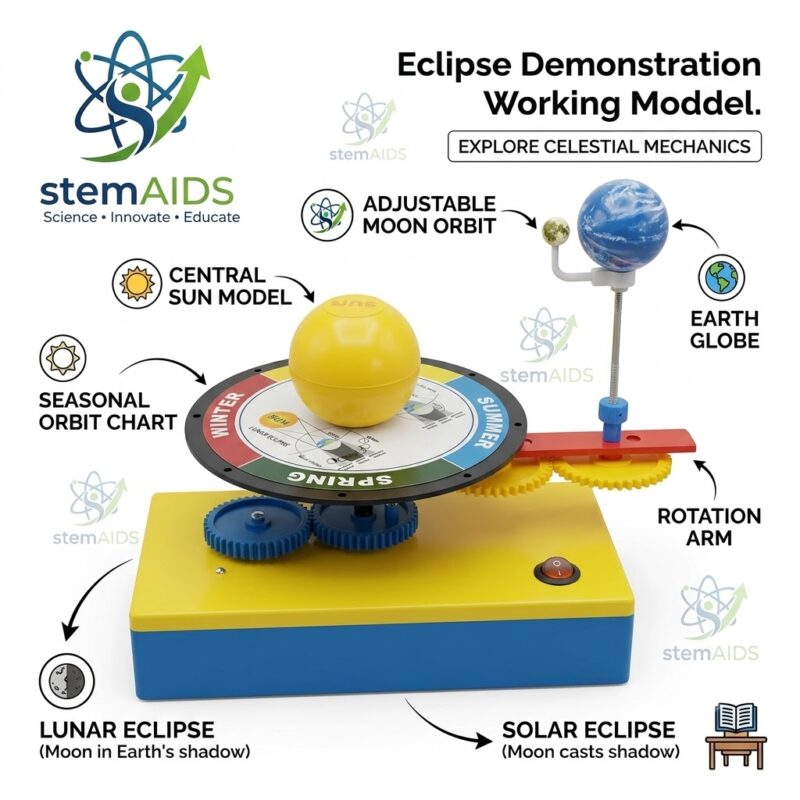
Quick answer: The Eclipse Demonstration Working Model shows how the Sun, Earth and Moon must align to produce a solar or lunar eclipse, letting students see the umbra and penumbra shadows and compare the two eclipse arrangements directly.
Product Description
The LabEquip Eclipse Demonstration Working Model provides a physical representation of the two principal eclipse arrangements. A solar eclipse is demonstrated by positioning the Moon between the Sun and Earth. A lunar eclipse is demonstrated by positioning Earth between the Sun and Moon.
The working format helps learners compare the umbra and penumbra while distinguishing between solar and lunar eclipse geometry.
Specifications
| Specification | Detail |
|---|---|
| Product name | Eclipse Demonstration Working Model |
| Brand | LabEquip |
| Product category | Astronomy laboratory apparatus; eclipse demonstration model |
| Primary function | Demonstrating solar and lunar eclipse alignment and shadow formation |
Suggested Use
- Position the Moon between the Sun and Earth components to demonstrate a solar eclipse.
- Position Earth between the Sun and Moon components to demonstrate a lunar eclipse.
- Point out the umbra (full shadow) and penumbra (partial shadow) regions in each arrangement.
- Discuss why eclipses do not occur every month, relating this to orbital tilt.
Care & Maintenance
- Handle the Sun, Earth and Moon components carefully to avoid damaging any moving mechanism.
- Keep components clean and free of dust for clear visual demonstration.
- Store the model in a stable location when not in use.
- Check any moving joints or rods periodically for wear.
Why Choose LabEquip
For related astronomy teaching resources, see our Large Solar System Model, Hanging Planetary System Display, or visit the LabEquip homepage to browse our full catalogue of astronomy lab kits.
Related Products
- Solar and Lunar Eclipse Educational Model: Another eclipse teaching model with a focus on umbra, penumbra and why eclipses are not monthly events.
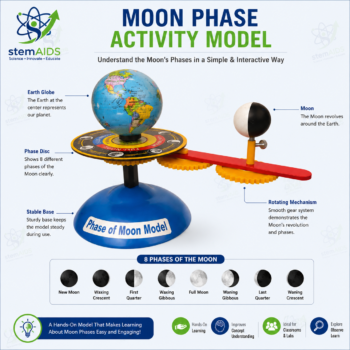
- Phases of Moon Working Model: Shows the full lunar cycle, so students can see why eclipses occur only at new and full moon.
- Earth Sun Planetarium: An Earth-Sun planetarium for placing eclipses within the wider motion of Earth and Moon.
- Sun Structure Model: A model of the Sun’s layers, including the corona that becomes visible during a total solar eclipse.
Frequently Asked Questions
How do you show a solar eclipse on an eclipse demonstration model?
Line up the parts so the Moon sits directly between the Sun and Earth. The Moon’s shadow then falls on a small part of the Earth model, and students can see that only people in that patch would see the Sun blocked. Dimming the room lights makes the shadow much easier to see.
How is a lunar eclipse set up on the working model?
Move the Earth between the Sun and the Moon so the three are in a straight line. The Moon passes into Earth’s shadow and is darkened. Because Earth’s shadow is large, the whole Moon can be covered, and the eclipse is visible from anywhere on Earth where the Moon is above the horizon.
At which Moon phase can a solar or a lunar eclipse happen?
A solar eclipse can only happen at new moon, when the Moon is between the Sun and Earth. A lunar eclipse can only happen at full moon, when Earth is between the Sun and the Moon. Asking students to identify the phase at each eclipse position on the model links eclipses with the lunar cycle.
Why is an eclipse model never to scale?
The Sun is roughly 400 times wider than the Moon and also about 400 times farther away, which is why both look about the same size in our sky. At true scale the Sun would be far too large and the Moon far too small and distant to fit a classroom, so models enlarge the Moon and shorten the distances.
Why does totality last only minutes in a solar eclipse but much longer in a lunar eclipse?
In a solar eclipse the tip of the Moon’s dark shadow is only a narrow spot on Earth and moves quickly, so any one place stays in it for a few minutes at most. In a lunar eclipse the Moon has to cross Earth’s much wider shadow, so the total phase can last over an hour.
What should students record during an eclipse model demonstration?
Ask them to sketch the order of Sun, Earth and Moon for each eclipse, shade the dark full-shadow region and the lighter partial-shadow region, and note which part of Earth would see the event. Writing a one-line explanation under each sketch makes a quick check of understanding.
Last Updated: November 2026




Reviews
There are no reviews yet.