
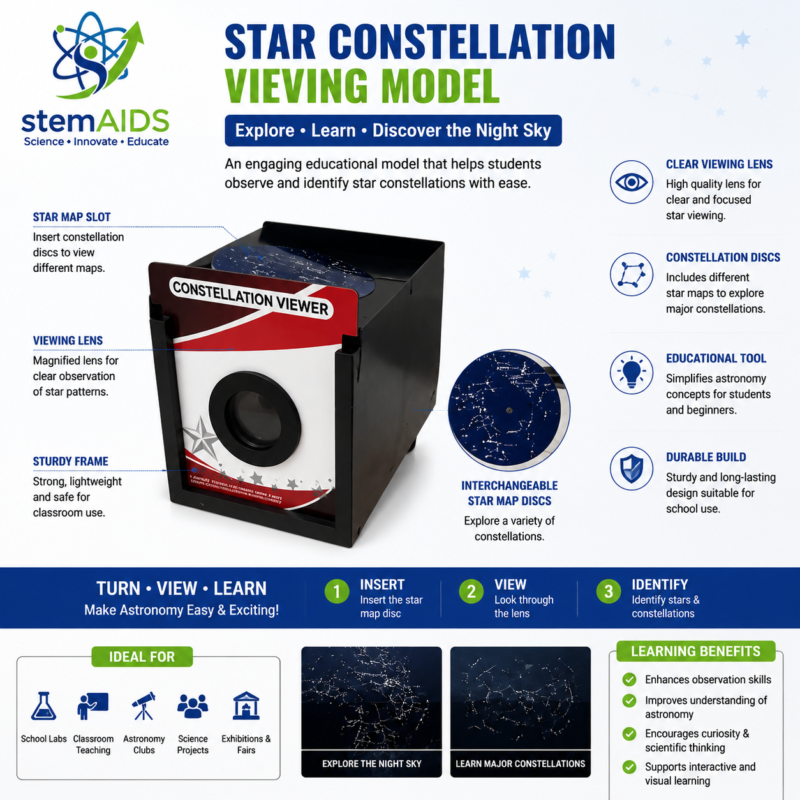
Quick answer: The Star Constellation Viewing Model helps students identify and compare recognised star patterns in the night sky, connecting constellation diagrams with real stellar arrangements for classroom astronomy lessons.
Product Description
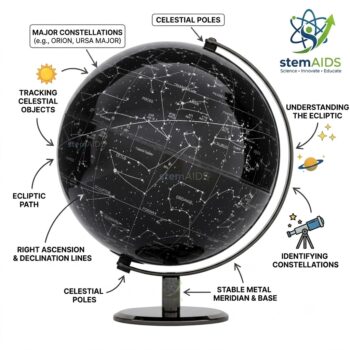
The LabEquip Star Constellation Viewing Model provides a visual reference for introducing constellations as apparent patterns formed by stars viewed from Earth. It supports lessons on constellation identification, celestial direction, seasonal visibility, and the difference between an apparent star pattern and a physically connected group of stars.
The model helps prepare students for supervised sky-observation activities by familiarising them with common constellation shapes beforehand.
Specifications
| Specification | Detail |
|---|---|
| Product name | Star Constellation Viewing Model |
| Brand | LabEquip |
| Product category | Astronomy laboratory apparatus; constellation teaching model |
| Primary function | Identifying and comparing recognised star patterns in the night sky |
Suggested Use
- Use the model indoors to introduce students to common constellation shapes before an outdoor observation session.
- Discuss how constellations are apparent patterns rather than physically connected groups of stars.
- Relate constellation visibility to season and viewing direction.
- Combine with a planisphere for a fuller night-sky teaching activity.
Care & Maintenance
- Handle the model carefully to avoid damaging printed star patterns.
- Keep the model clean and free of dust for clear classroom visibility.
- Store the model in a dry location when not in use.
- Avoid prolonged exposure to direct sunlight to reduce fading of printed details.
Why Choose LabEquip
For related astronomy teaching resources, see our Planisphere, Astronomical Globe Model, or visit the LabEquip homepage to browse our full catalogue of astronomy lab kits.
Related Products
- Planisphere: A planisphere for working out which of the learned constellations are visible on a given night.
- Astronomical Globe Model: An astronomical globe that places constellations on the full celestial sphere.
- Celestial Globe: A celestial globe showing star positions in three dimensions for comparison with the model.
- Astronomical Telescope F36050: A beginner refracting telescope for looking closer at star clusters within the constellations.
Frequently Asked Questions
What is a constellation?
A constellation is a named region of the sky containing a recognisable pattern of stars, such as Orion or Ursa Major. Astronomers divide the whole sky into 88 official constellations, so every star belongs to one. The patterns help observers find their way around the sky.
Are the stars in a constellation close to each other in space?
Usually not. The stars only look close because they lie in the same direction from Earth; some may be much farther away than others. Seen from another part of the galaxy the pattern would look completely different. This is a key idea to discuss with the model.
Why do we see different constellations in different seasons?
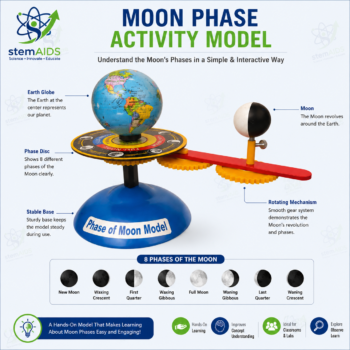
As Earth orbits the Sun, the night side faces a different part of space each month. Constellations behind the Sun are hidden in daylight, while those opposite the Sun are visible all night. Over a year the whole band of constellations along the ecliptic comes into view.
How can students find the Pole Star using constellations?
In the northern sky, follow the two end stars of the Big Dipper’s bowl in Ursa Major. Extend the line about five times their spacing to reach Polaris, the Pole Star. It marks north and stays nearly fixed while other stars circle it through the night.
What is the difference between a constellation and an asterism?
A constellation is one of the 88 official sky regions. An asterism is a familiar star pattern that is not an official constellation, such as the Big Dipper, which is part of Ursa Major. Many beginners learn asterisms first because they are easier to spot.
How should a constellation model be used before a night-sky observation?
Practise the shapes of a few bright constellations indoors with the model, noting the brightest stars and their positions relative to each other. Outdoors, let eyes adapt to the dark for about twenty minutes and look for the same shapes, which are often larger than students expect.
Last Updated: November 2026




Reviews
There are no reviews yet.