
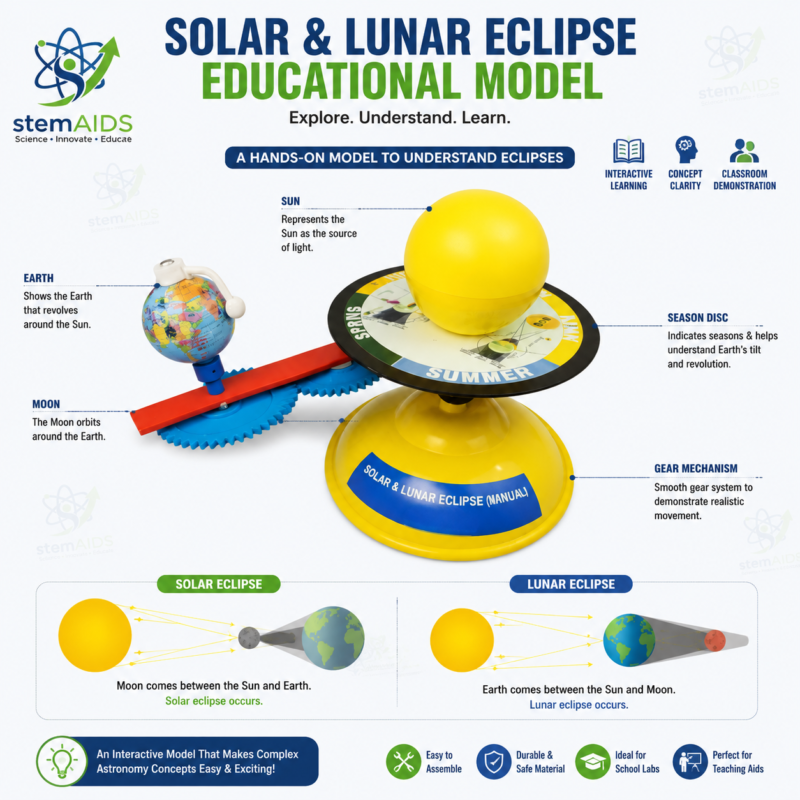
Quick Answer: The Solar and Lunar Eclipse Educational Model is a teaching model that arranges the Sun, Earth and Moon so students can see both kinds of eclipse: a solar eclipse when the Moon passes between the Sun and Earth, and a lunar eclipse when Earth’s shadow falls on the Moon.
Two Eclipses, One Line-Up
Both eclipses depend on the three bodies lining up, but in a different order. In a solar eclipse the Moon is in the middle and its small shadow sweeps across a narrow track on Earth; anyone standing in the dark central shadow, the umbra, sees a total eclipse, while people in the wider penumbra see only part of the Sun covered. In a lunar eclipse Earth is in the middle, and its much larger shadow covers the whole Moon, so everyone on the night side of Earth can watch.
The eclipse educational model lets students set up each arrangement and look along the line from Earth. It also answers the question they always ask next: if the Moon goes round Earth every month, why is there not an eclipse every month? The Moon’s orbit is tilted by about five degrees to Earth’s orbit, so at most new and full moons the shadow passes above or below. Eclipses happen only when a new or full moon falls near one of the two crossing points, which is why they come in seasons roughly six months apart.
Specifications
| Type | Sun-Earth-Moon eclipse teaching model |
| Demonstrates | Solar eclipse (total, partial) and lunar eclipse |
| Key terms | Umbra, penumbra, new moon, full moon, orbital tilt |
| Subjects | Science, geography, physics (shadows and light) |
Care & Handling
- Store the eclipse model with its Sun, Earth and Moon parts in place or bagged together so nothing goes missing.
- If a lamp is fitted, let it cool before packing the model away and keep cables untangled.
- Dust with a soft, dry brush.
Applications
- Explaining solar and lunar eclipses in middle-school science
- Teaching umbra and penumbra as an application of straight-line light and shadows
- Preparing a class to observe an upcoming eclipse safely
- Discussing why total solar eclipses are rare at any one place
Why Choose LabEquip
Science teachers covering light, shadows and the Earth-Moon system use this model to replace hand-drawn diagrams that students find hard to picture in three dimensions. LabEquip lists it in its Astronomy Lab Kits; it follows on well from the Phases of Moon Working Model. Order enquiries go through the contact page.
Related Products
- Eclipse Demonstration Working Model: A working eclipse model for setting up each Sun-Earth-Moon line-up step by step as a demonstration.
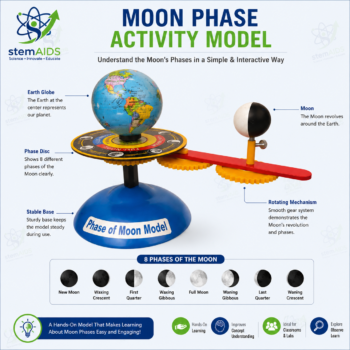
- Moon Phase Activity Model: A student moon phase activity that builds the new and full moon positions needed for eclipses.
- Sun Structure Model: A model of the Sun’s structure, showing the corona and chromosphere seen during totality.
- Solar System Working Model: A working solar system model that places the Earth-Moon system in its orbit around the Sun.
Frequently Asked Questions
Why don’t we get a solar and a lunar eclipse every month?
The Moon’s orbit is tilted by about five degrees to Earth’s orbit, so at most new and full moons the shadow passes above or below. Eclipses only happen when a new or full moon falls close to one of the two points where the orbits cross, so they come in eclipse seasons roughly six months apart.
Why does the Moon turn red during a total lunar eclipse?
Some sunlight still reaches the Moon after passing through Earth’s atmosphere. The air scatters away most of the blue light and bends the remaining reddish light into Earth’s shadow, so the Moon glows copper or deep red. In effect it is lit by all the sunrises and sunsets on Earth at that moment.
What is the difference between the umbra and the penumbra in an eclipse?
The umbra is the dark central part of a shadow, where the light source is completely blocked. The penumbra is the lighter outer part, where the source is only partly blocked. Standing in the Moon’s umbra you see a total solar eclipse; in its penumbra you see a partial one.
What causes an annular solar eclipse?
The Moon’s orbit is slightly elliptical. When a solar eclipse happens with the Moon near its farthest point from Earth, it looks a little smaller than the Sun and cannot cover it completely, leaving a bright ring of sunlight around the dark disc. This is called an annular, or ring, eclipse.
How can a class watch a real solar eclipse safely?
Never look at the Sun directly, through sunglasses, or through binoculars or a telescope without a proper solar filter. Use purpose-made solar eclipse viewers in good condition, or project the Sun’s image with a pinhole onto white card and look at the card. Only during the brief total phase is the Sun safe to view without a filter.
Why do more people see a lunar eclipse than a total solar eclipse?
Everyone on the night side of Earth can see a lunar eclipse, because the Moon itself darkens. A total solar eclipse is only seen along the narrow path where the Moon’s dark shadow touches Earth, so most people see a partial eclipse or none at all.
Last Updated: November 2026





Reviews
There are no reviews yet.