
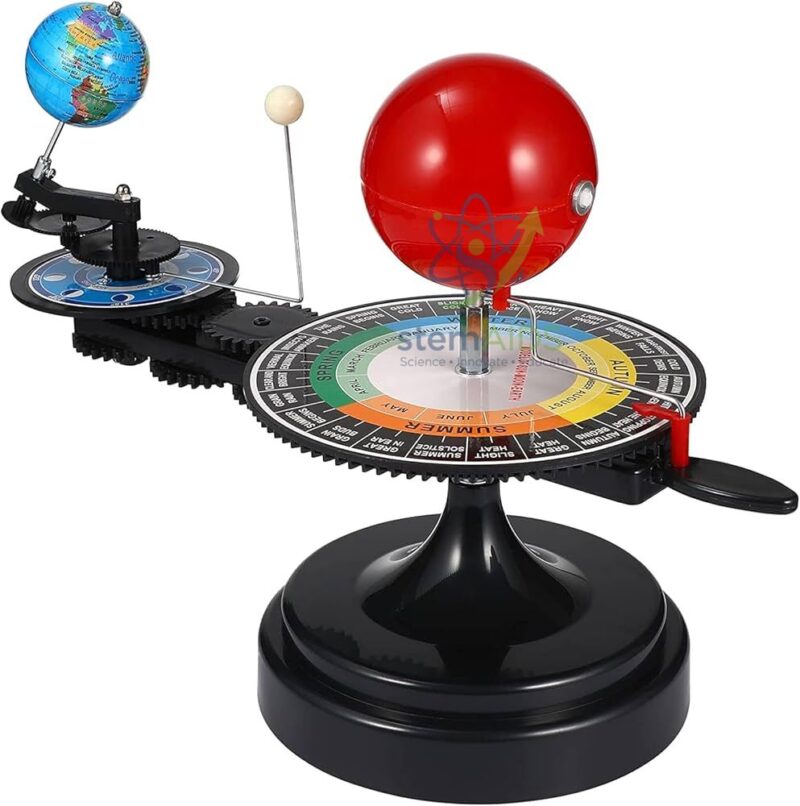
Quick Answer: The Earth Sun planetarium is a geared tellurion model: a large Sun globe at the centre, an Earth globe on a turning arm and, in the photo, a small Moon, driven by a hand crank. It shows how Earth’s rotation, tilt and orbit produce day and night, the seasons and the year.
What the Model Demonstrates
Turning the crank carries the Earth around the Sun while gears keep its axis tilted in the same direction in space throughout the orbit. That fixed tilt is the key to the seasons: when the Northern Hemisphere leans towards the Sun it receives more direct sunlight and longer days, and six months later the situation is reversed. Many students believe seasons come from a changing distance to the Sun, and the model corrects that idea clearly.
The photograph shows a dial around the base marked with the calendar, so the Earth’s position can be matched to months, solstices and equinoxes. A small Moon on its own arm circles the Earth, letting teachers show why we see phases and why a solar or lunar eclipse needs the Sun, Earth and Moon to line up.
Mechanical tellurions cannot keep true scale: the Sun is shown far smaller and closer than reality. Say so in class to avoid creating a new misconception. The model is a guide to the geometry of the Earth, Sun and Moon, not to their sizes or distances.
Specifications
| Product | Earth Sun planetarium (tellurion) model |
| As pictured | Sun globe, tilted Earth globe, small Moon, geared arm and calendar dial |
| Operation | Hand crank, per the photo |
| Topics | Day and night, seasons, the year, lunar phases, eclipses |
| Light source, if any, and dimensions | Confirm at enquiry |
Applications
- Geography and science lessons on day, night and the seasons
- Explaining solstices and equinoxes with the calendar dial
- Demonstrating lunar phases and the conditions for eclipses
- Introducing time zones by turning the Earth on its axis
Handling & Care
- Turn the crank slowly and in the direction the gears are designed for; forcing it can strip them
- Dust the globes with a soft brush and keep solvents off printed surfaces
- Carry the model by its base, not by the arms
- Store it covered and away from direct sunlight, which fades globe printing
Why Choose LabEquip
Primary and secondary schools and astronomy clubs buy a tellurion as a shared demonstration model for whole-class teaching. LabEquip lists it among its general lab products, next to related astronomy lab kits and the Coriolis effect apparatus; order through the contact page.
Frequently Asked Questions
What causes the seasons, according to the model?
The tilt of Earth’s axis, which keeps pointing the same way as Earth orbits the Sun. Each hemisphere has summer when it leans towards the Sun and receives more direct light and longer days.
Is the Earth closest to the Sun in summer?
Not for the Northern Hemisphere. Earth is closest to the Sun in early January, during the northern winter. The change in distance is small and is not the cause of the seasons.
Can the Earth Sun planetarium show lunar phases?
Yes. Moving the Moon around the Earth shows how its sunlit half is seen from different angles, giving new moon, quarters and full moon in turn.
Why don’t eclipses happen every month?
The Moon’s orbit is tilted by about five degrees to Earth’s orbit, so the Sun, Earth and Moon line up exactly only at certain times of year. In most months the Moon passes slightly above or below the line.
Is the model to scale?
No. Sizes and distances are compressed so the model fits on a desk. Point this out in class, because at true scale the Sun would be far larger and the Earth far more distant.
How should the model be used with a large class?
Darken the room if the model has a light, place it at the front at eye level and turn the crank slowly, pausing at the solstices and equinoxes. Students can sketch the Earth’s position and lit half for each season.
Last Updated: October 2026




Reviews
There are no reviews yet.