
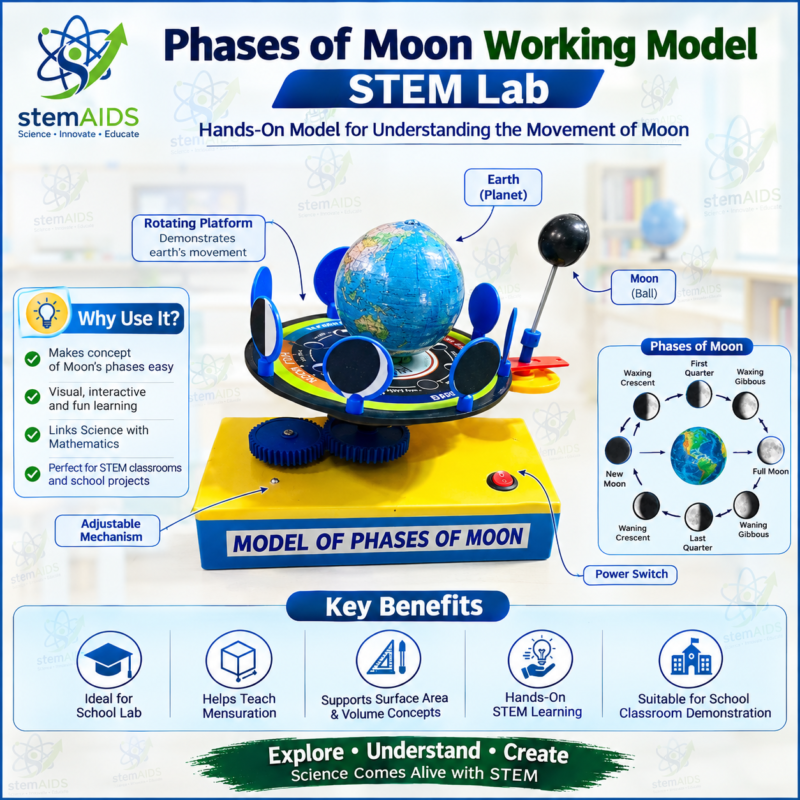
Quick Answer: The Phases of Moon Working Model is a mechanical teaching model in which the Moon is moved around Earth so the class can see why its sunlit portion appears to grow and shrink. It demonstrates the full cycle from new moon through first quarter and full moon to last quarter.
What the Moving Parts Demonstrate
The key idea the phases of moon working model makes visible is that half of the Moon is always lit by the Sun. What changes over a month is how much of that lit half faces Earth. When the Moon lies between Earth and the Sun, the lit side faces away and we see a new moon; a quarter of an orbit later we see half the disc lit; when Earth lies between, the whole lit face is towards us and the Moon is full.
Because the model moves the Moon around Earth in order, the teacher can stop at each position and ask the class to predict the shape before looking. This is also the clearest way to dismantle the common belief that the phases are caused by Earth’s shadow; the model shows the shadow is not involved except during a lunar eclipse, which only occurs at full moon.
It differs from the Moon Phase Activity Model, which is designed for students to handle and record phases themselves. The working model suits whole-class demonstration; many teachers use it first and then hand out the activity version.
Applications
- Demonstrating the lunar cycle and the names of the phases in primary and middle-school science
- Explaining why we always see the same face of the Moon (synchronous rotation)
- Showing where the Moon must be for solar and lunar eclipses before studying eclipses in detail
- Supporting a month-long Moon observation diary with a model students can refer back to
Care & Handling
- Turn the mechanism gently and in the intended direction; forcing a stiff joint can strip gears or bend arms.
- Keep the phases of moon working model covered when stored so dust does not collect in moving parts.
- If the model uses a lamp or batteries, switch it off after the lesson and remove batteries before long breaks.
Specifications
| Type | Working (moving) demonstration model |
| Shows | Moon orbiting Earth with the Sun’s direction fixed |
| Phases demonstrated | New, crescent, quarter, gibbous and full, waxing and waning |
| Use | Teacher-led whole-class demonstration |
| Drive, light source and dimensions | Confirm at enquiry |
Why Choose LabEquip
Primary and middle-school science teachers buy this model because moving the Moon in front of the class explains the phases far faster than a static diagram. LabEquip lists it in the Astronomy Lab Kits collection, and quantities for several classrooms can be requested through the contact page.
Frequently Asked Questions
Are the phases of the Moon caused by Earth’s shadow?
No. Half the Moon is always sunlit, and the phase depends on how much of that lit half faces Earth as the Moon orbits. Earth’s shadow falls on the Moon only during a lunar eclipse, which can happen only at full moon.
Why do we always see the same side of the Moon?
The Moon turns once on its axis in the same time it takes to orbit Earth, so the same face stays towards us. This synchronous rotation came about through tidal forces over a very long time.
How long does a full cycle of phases take?
About 29.5 days from one new moon to the next. That is longer than the 27.3 days the Moon takes to orbit Earth relative to the stars, because Earth moves along its own orbit during the month.
How is this different from the Moon Phase Activity Model?
The working model has moving parts for the teacher to demonstrate the cycle to the whole class. The activity model is intended for students to use themselves, arranging or recording each phase as a hands-on exercise.
What is the difference between waxing and waning?
Waxing means the lit part is growing, from new moon towards full; waning means it is shrinking again towards the next new moon. Seen from the Northern Hemisphere a waxing Moon is lit on its right-hand side.
How can the demonstration be made clearer?
Darken the room and place a single bright lamp on the Sun side. Let students view from Earth’s position, at eye level with the model, so they see the lit shape rather than the model from above.
Last Updated: September 2026







Reviews
There are no reviews yet.