
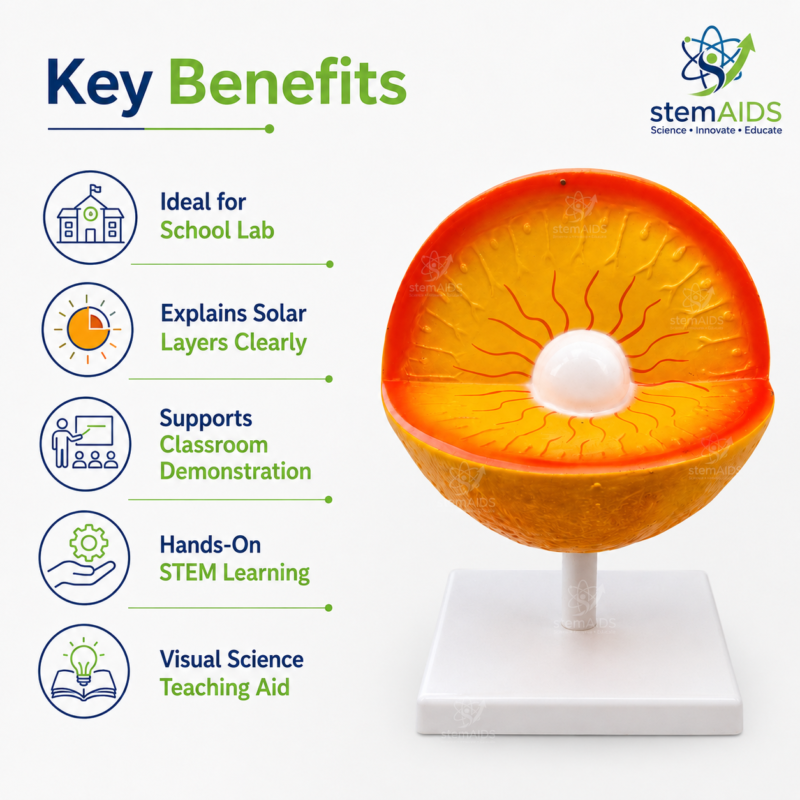
Quick Answer: The Sun Structure Model is a classroom teaching model that presents the Sun as a series of distinct layers, from the core where nuclear fusion takes place, through the radiative and convective zones, to the photosphere, chromosphere and corona. It is used to teach the Sun as a star rather than as a uniform ball of fire.
The Sun as a Layered Star
Students tend to picture the Sun as a single glowing sphere. A sun structure model breaks that picture into regions that each do something different. At the centre, the core is where hydrogen nuclei fuse into helium and release energy. Around it, the radiative zone passes that energy outwards very slowly as light is absorbed and re-emitted countless times. Further out, the convective zone carries heat to the surface in rising and sinking currents of hot gas, much like water in a heated pan.
The photosphere is the layer we see as the visible surface; the granular texture photographed on it is the top of those convection cells, and sunspots appear there as darker, cooler patches. Above it lie the thin reddish chromosphere and the faint, extended corona, both normally hidden by the glare of the photosphere and seen by eye only during a total solar eclipse.
Using the Model in Lessons
- Introducing the Sun as a star and the source of energy for life on Earth in middle-school science
- Explaining nuclear fusion and energy transport in senior physics and earth-science units
- Linking sunspots and solar activity to auroras and radio disturbances on Earth
- Preparing students to understand what becomes visible during a total solar eclipse
- Revision and science exhibitions, where students name each layer and explain its role
Specifications
| Type | Educational model of the Sun |
| Represents | Internal layers (core, radiative zone, convective zone) and the solar atmosphere |
| Surface features | Photosphere, where sunspots and granulation are seen |
| Subject areas | Physics, earth and space science, geography |
| Size, materials and labelling | Confirm at enquiry |
Care & Handling
- Keep the Sun structure model out of direct sunlight and away from radiators so painted layers and labels do not fade or warp.
- Dust with a soft, dry brush; avoid solvents or wet cloths on printed labels.
- Store it covered on a shelf rather than stacked under other models.
Why Choose LabEquip
Science teachers covering the solar system usually want one model that shows the inside of a star alongside the planetary models they already use. LabEquip offers the Sun structure model within its Astronomy Lab Kits, where it pairs naturally with the Solar System Working Model. For school quantities, write to the team via the contact page.
Frequently Asked Questions
Which layers of the Sun should students be able to name?
From the centre outwards: the core, the radiative zone and the convective zone inside the Sun, then the photosphere, chromosphere and corona that make up its surface and atmosphere. Sunspots, granules and prominences are features on or above the photosphere.
How does energy get from the core to the surface?
In the radiative zone energy moves as light that is repeatedly absorbed and re-emitted, a process that takes a very long time. In the outer convective zone, hot gas rises, cools at the surface and sinks again, carrying heat much faster.
Why is the corona hotter than the visible surface?
The photosphere is a few thousand degrees, yet the corona reaches over a million degrees. The heating is linked to the Sun’s magnetic field, which carries energy up into the thin outer atmosphere; the exact mechanism is still an active research question and a good discussion point.
What are sunspots?
Sunspots are regions of the photosphere where strong magnetic fields hold back convection, so less heat reaches the surface and the area looks dark next to its surroundings. Their numbers rise and fall over a solar cycle of roughly eleven years.
Why can the corona only be seen during a total eclipse?
The corona is far fainter than the photosphere, so it is lost in the glare in normal daylight. When the Moon completely covers the photosphere during totality, the pearly corona becomes visible around the dark disc.
Which classes is the model suited to?
It works as an introduction to the Sun as a star in middle-school science and as a reference for fusion, energy transfer and solar activity in senior physics and earth science. Teachers adjust how much detail they draw out of each layer.
Last Updated: September 2026







Reviews
There are no reviews yet.