Maths Kit offers nine hands-on manipulatives for primary and middle-school mathematics: an abacus in two sizes, a decimal abacus, Cuisenaire strips, place value cards, a fraction wheel, a Pythagoras theorem kit, a seven-piece tangram and a colour square puzzle. Each turns an abstract idea such as place value, fractions or area into something students can move, test and talk about.
What’s in the range
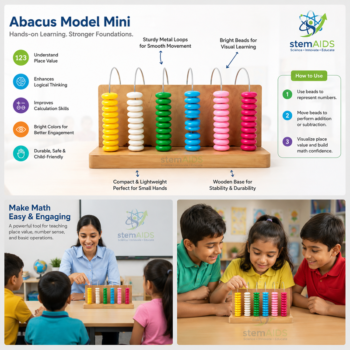
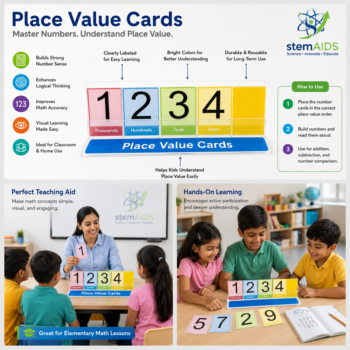
Number and place value: the Abacus Model, the individual-size Abacus Model Mini, the Decimal Abacus Model and layered Place Value Cards for building and expanding numbers.
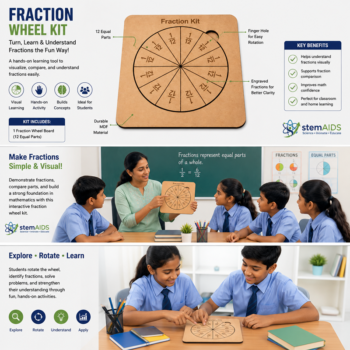
Fractions and ratio: the Fraction Wheel Kit shows fractions as parts of a whole, and the colour-coded Cuisenaire Strips Model shows them as lengths, with uses in factors, multiples and early algebra.
Geometry and reasoning: the Pythagoras Theorem Kit for right-angled triangles, the Tangram Kit for shape composition, area and symmetry, and the Colour Square Puzzle for pattern recognition and problem-solving.
Matching the kit to the topic
- Early number work and place value to hundreds: the abacus and place value cards.
- Decimals: the decimal abacus extends place value to the right of the decimal point.
- Fractions: start with the fraction wheel for parts of a whole, then use Cuisenaire strips to compare and add fractions as lengths.
- Geometry: the tangram suits primary shape work, and the Pythagoras kit suits middle-school geometry.
- The mini abacus is sized for individual use, so each student can work along with the teacher’s demonstration.
Related Categories
- Mathematics School Lab Products extends the range to algebra tiles, geoboards, mensuration and trigonometry models.
- Educational Charts includes primary, upper primary and senior mathematics wall charts.
Frequently Asked Questions
What are maths manipulatives?
Maths manipulatives are physical objects that students move to represent a mathematical idea, such as beads on an abacus for place value or segments of a wheel for fractions. Handling them builds a concrete picture before students move on to written symbols.
How are Cuisenaire rods or strips used?
Each colour stands for a length from one to ten units. Students line strips up to find number bonds, compare lengths as fractions and ratios, and build trains of strips for addition, multiplication and factor work.
What does an abacus teach young learners?
An abacus shows place value directly: each rod is a place, and beads moved on that rod count ones, tens or hundreds. Students use it for counting, exchanging ten of one place for one of the next, and adding or subtracting with carrying.
How does a tangram help with geometry?
A tangram’s seven pieces fit together into a square and into many other shapes. Rearranging them shows that area stays the same when the shape changes, and it builds understanding of symmetry, angles and transformations.
How can Pythagoras’ theorem be shown with a kit?
A typical kit compares squares built on the three sides of a right-angled triangle. The pieces of the squares on the two shorter sides fit exactly into the square on the longest side, showing that a squared plus b squared equals c squared.
Last updated: November 2026
Showing all 9 results