Keys and Switches holds the six small circuit controls a school or college physics bench uses to start, stop and redirect current: two plug keys, a four contact plug key, a tapping key, a reversing key and a pencil jockey. Each suits a different kind of practical, from a simple Ohm’s law circuit to a metre bridge or tangent galvanometer, so most labs keep more than one type.
What each key does
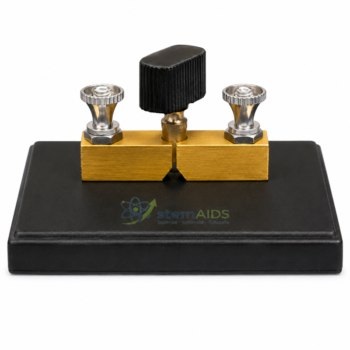
The Single Circuit Plug Key opens or closes one circuit path when its plug is inserted or removed, and the Electrical Switching Plug Key does the same job of connecting or isolating the supply in general circuit work. The Four Contact Plug Key has four contact positions, so one key can make, break or select between several connections in resistance-comparison and bridge practicals.
The Physics Lab Tapping Key closes the circuit only while it is pressed and springs open on release. The Reversing Key Commutator reverses the current through a chosen branch without any rewiring, and the Pencil Jockey Physics Model touches a resistance wire at any chosen point for metre bridge, Wheatstone bridge and potentiometer work.
Choosing the right key for the experiment
- For a circuit that stays on while a set of readings is taken, such as a V-I table, a plug key is simpler because it holds its position.
- Where current should flow only for a moment, for example while looking for a null point or checking a galvanometer deflection, use the tapping key so the wire and cells are not warmed or drained.
- Experiments that compare readings with current in both directions, such as the tangent galvanometer or the magnetic field of a coil, need the reversing key commutator.
- Slide-wire experiments need a jockey as well as a key: the key controls the main circuit while the jockey finds the balance point.
Good practice at the bench
Keep plugs and sockets clean and dry, because a loose or tarnished contact adds resistance that shows up as unsteady readings. Take the plug out whenever the circuit is idle. Press the jockey on the wire and lift it again rather than dragging it along, since scraping the wire changes its resistance per unit length.
Related Categories
- Rheostat models are wired in series with these keys to set the current in the same circuits.
- Electrical and Electronics supplies the power sources, cells and bridge apparatus these keys control.
- Measuring Instruments has the galvanometers, ammeters and voltmeters read while a key is closed.
Frequently Asked Questions
What is the difference between a plug key and a tapping key?
A plug key stays closed for as long as the plug sits in its socket, so it suits circuits that run steadily while readings are taken. A tapping key closes only while it is held down and opens as soon as it is released, which suits brief checks such as finding a balance point.
Why is a key used in an electric circuit in the physics lab?
A key is the switch of a laboratory circuit. It lets the student complete the circuit only when a reading is needed and break it the rest of the time, which protects cells, meters and resistance wire from running warm and keeps the readings steadier.
What is a jockey used for in a metre bridge experiment?
The jockey is the sliding contact that touches the bridge or potentiometer wire at any chosen point. Moving it along the wire changes the length on each side until the galvanometer shows no deflection, and that balancing length gives the unknown resistance or emf.
What does a reversing key or commutator do?
It changes the direction of current in part of a circuit without the wires being swapped by hand. Taking readings with current in both directions and averaging them cancels some errors, which is why it is used in tangent galvanometer experiments.
Why should the plug be removed when readings are not being taken?
Removing the plug stops current flowing when it is not needed. Current heats the resistance wire and coils, which changes their resistance, and it runs down the cells, so leaving the key open between readings keeps the results more consistent.
Last updated: November 2026
Showing all 6 results