

In Stock
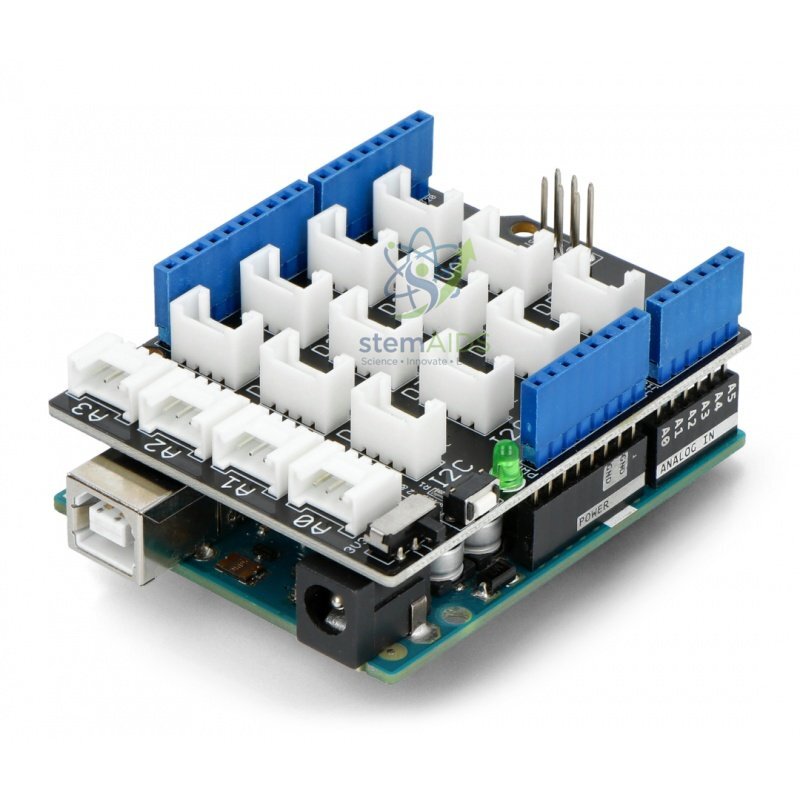
Programming interface with Arduino Uno R4 Wi-Fi
₹326.00
Quick Answer: The Programming Interface with Arduino Uno R4 Wi-Fi is a genuine Arduino Uno R4 Wi-Fi development board built around a 32-bit Renesas RA4M1 (Arm Cortex-M4) microcontroller with an onboard ESP32-S3 module for Wi-Fi and Bluetooth, making it a capable platform for STEM education, IoT projects, and programming practice from middle school through college and engineering training.
Description
This board upgrades the classic Uno form factor with a 32-bit Renesas RA4M1 microcontroller running at 48 MHz, 256 kB of flash memory, and 32 kB of SRAM, giving learners more headroom for larger sketches and more complex logic than earlier 8-bit Uno boards. An onboard ESP32-S3 module adds Wi-Fi and Bluetooth connectivity for IoT and cloud-connected projects, while the built-in 12×8 LED matrix lets students display simple graphics, animations, and status indicators without any extra wiring. With USB-C, Wi-Fi, Bluetooth, UART, I2C, SPI, and CAN bus support, plus a built-in Real-Time Clock and DAC, this interface is well suited to progressively more advanced coursework in robotics control, automation, and embedded systems, and is compatible with the Arduino IDE and Arduino Cloud for both classroom and remote-learning setups.
Specifications
| Product Name | Programming Interface with Arduino Uno R4 Wi-Fi |
| Brand | LabEquip |
| Board Platform | Arduino Uno R4 Wi-Fi |
| Main Microcontroller | Renesas RA4M1, 32-bit Arm Cortex-M4 |
| Clock Speed | 48 MHz |
| Wireless Module | ESP32-S3 for Wi-Fi and Bluetooth connectivity |
| Flash Memory | 256 kB |
| SRAM | 32 kB |
| Operating Voltage | 5V logic level |
| Input Voltage | 6V to 24V through VIN pin or barrel jack |
| Display Feature | Onboard 12×8 LED matrix |
| Programming Support | Arduino IDE, Arduino Cloud, and compatible programming tools |
| Connectivity | USB-C, Wi-Fi, Bluetooth, UART, I2C, SPI, and CAN bus support |
| Special Features | Real-Time Clock, DAC, CAN bus, HID via USB, LED matrix, and cloud compatibility |
| Recommended Use | STEM education, IoT projects, programming practice, robotics control, automation, and embedded systems training |
| User Level | Middle school, high school, college, engineering, maker lab, and training institute level |
Compatibility & Safety Note
- Program via USB-C using the Arduino IDE or Arduino Cloud; the board is not backward pin-identical in every respect to 8-bit Uno boards, so check shield compatibility (especially voltage levels) before stacking older shields.
- Operates at 5V logic; confirm any connected sensor, module, or shield is 5V tolerant before wiring it to the digital or analog pins.
- Power the board within its rated 6V to 24V input range via VIN or the barrel jack; do not exceed this range when using an external supply.
- Handle the board by its edges and avoid touching the RA4M1 microcontroller or ESP32-S3 module directly to reduce the risk of static discharge damage.
- Keep the board away from moisture and conductive debris, particularly around the CAN bus and USB-C connectors.
Why Choose LabEquip
LabEquip’s TLM Kits range is built around genuine Arduino boards and compatible accessories, so schools and training institutes can standardise on a consistent programming platform across courses. This Uno R4 Wi-Fi interface pairs well with the Ethernet Shield for Arduino for wired networking comparisons alongside its onboard Wi-Fi, the Real-Time Clock Module for extended timekeeping projects, the Prototyping Shield for building custom circuits, and the Serial to Parallel Conversion module for expanding available I/O.
Frequently Asked Questions
What microcontroller does the Arduino Uno R4 Wi-Fi use?
It uses a Renesas RA4M1, a 32-bit Arm Cortex-M4 microcontroller running at 48 MHz.
Does this board have built-in Wi-Fi?
Yes, it includes an onboard ESP32-S3 module that provides both Wi-Fi and Bluetooth connectivity.
What can the onboard LED matrix be used for?
The 12×8 LED matrix can display simple graphics, animations, icons, and status indicators directly from your sketch, without extra wiring.
How much memory does this board have?
It has 256 kB of flash memory and 32 kB of SRAM.
What programming tools are supported?
It works with the Arduino IDE, Arduino Cloud, and other compatible programming environments.
What communication interfaces does it support?
It supports USB-C, Wi-Fi, Bluetooth, UART, I2C, SPI, and CAN bus, in addition to a built-in Real-Time Clock and DAC.
Last Updated: September 2026
You must be logged in to post a review.
Bestsellers





Reviews
There are no reviews yet.