














In Stock
Vivarium
Vivarium features a micro-mesh airflow interface designed to prevent CO2 accumulation while maintaining stable humidity levels for sensitive micro-arthropods and amphibians.
Impact-Resistant Crystalline Architecture utilizes high-transmittance, UV-stabilized polymers that provide 360-degree visual access without optical distortion, ensuring accurate data collection and photographic documentation of developmental stages.
₹1,870.00
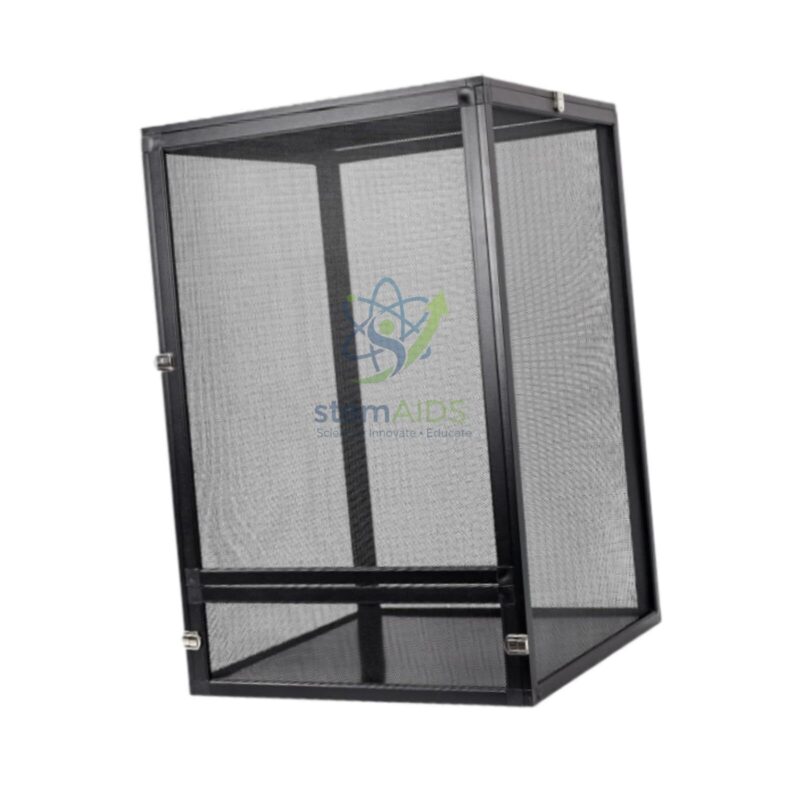
Quick Answer: The Vivarium is a ventilated enclosure for keeping small live animals, pictured as a tall black-framed cage with fine mesh on every side and a front opening panel. A mesh vivarium suits animals that need plenty of air and something to climb, such as caterpillars becoming butterflies, stick insects and praying mantises.
Why a Mesh Enclosure
Mesh walls give far more ventilation than a glass or plastic tank, which prevents the stale, damp air that encourages mould on food plants and droppings. They also give climbing insects a grip on every surface, and caterpillars can hang from the mesh roof to pupate. The trade-off is humidity: moisture escapes quickly, so a light misting or a damp substrate is needed for species that dislike dry air.
The tall shape in the listing photo leaves room for branches of food plant stood in a water pot, which keeps leaves fresh for longer. Plug the neck of the pot with cotton wool or foil so small larvae cannot fall in and drown. The front opening lets students change food and remove droppings without lifting the whole enclosure.
A mesh enclosure is not suitable for aquatic animals, burrowing species or animals that need constant high humidity and warmth. For those, a solid-walled tank or the Cage Terrarium with its ventilated lid may fit better. Where extra warmth is needed, an Infrared Lamp 75W can be clamped outside the mesh at one end.
What Students Can Observe
- The complete life cycle of butterflies or moths, from caterpillar to pupa to adult
- Feeding, moulting and camouflage in stick insects and leaf insects
- Predator behaviour in praying mantises fed on small live insects
- Short-term keeping of grasshoppers or crickets for behaviour experiments
Specifications
| Type | Mesh-sided enclosure for small live animals |
| Frame | Black frame, as pictured |
| Walls | Fine mesh on all sides, as pictured |
| Access | Front opening panel |
| Dimensions and mesh material | Confirm at enquiry |
Care & Handling
- Remove droppings and old leaves every day or two to keep the enclosure clean and dry.
- Keep the vivarium out of direct sun, where the temperature inside can rise quickly.
- Mist lightly with clean water if the species needs humidity, avoiding pooled water.
- Wash the mesh with mild soapy water between uses and let it dry fully.
Why Choose LabEquip
Primary teachers, biology departments and nature clubs use a mesh vivarium when a class wants to follow a life cycle from start to finish. LabEquip lists it in the General Lab Products range.
Frequently Asked Questions
Which animals suit a mesh enclosure?
Climbing and flying insects that need good ventilation: butterfly and moth caterpillars, stick and leaf insects, praying mantises, grasshoppers and crickets. Animals needing water, burrowing space or constant high humidity need a different enclosure.
How do I keep food plants fresh inside?
Stand cut branches in a narrow jar of water and block the neck around the stems with cotton wool or foil so small larvae cannot drown. Replace the branches when the leaves start to wilt or dry.
How can butterflies be released after emerging?
Let the new adult hang for a few hours until its wings are fully expanded and dry, then open the enclosure outdoors on a warm, calm day near flowering plants. Release species only where they occur naturally.
Does the vivarium need heating?
Most insects kept in class do well at normal room temperature. If a species needs extra warmth, place a lamp outside the mesh at one end so the animals can move between warm and cooler zones, and check the temperature with a thermometer.
How often should the enclosure be cleaned?
Remove droppings and wilted leaves every day or two, and give the enclosure a full wash between different groups of animals. Frass left to build up grows mould quickly, especially if the base gets damp.
Can several species share one enclosure?
It is safer not to mix them. Predators such as mantises eat other insects, and even plant-feeders can compete or spread disease. Keep one species, and ideally one batch of the same age, per enclosure.
Last Updated: September 2026
You must be logged in to post a review.
Bestsellers




Reviews
There are no reviews yet.