























In Stock
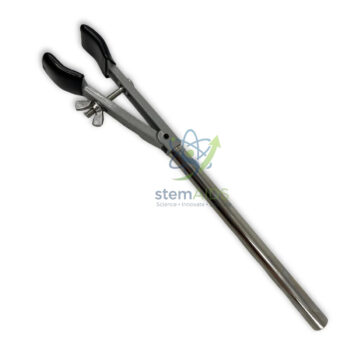
Three Finger Condenser Clamp
Self-Centering Tripod Grip: The asymmetric three-finger design (one on one side, two on the other) naturally centers the condenser within the jaws, providing a secure, 360-degree hold.
360° Swivel & Lock Head: Equipped with a rotating head that allows the condenser to be positioned at any angle, horizontal, vertical, or inclined, making it perfect for complex manifold assemblies.
$3.05
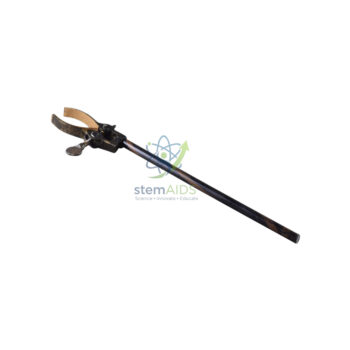
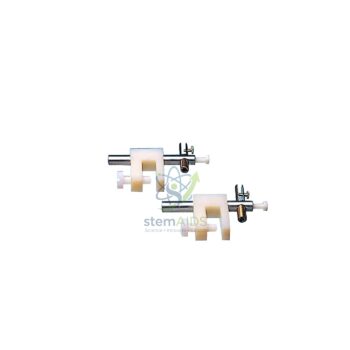
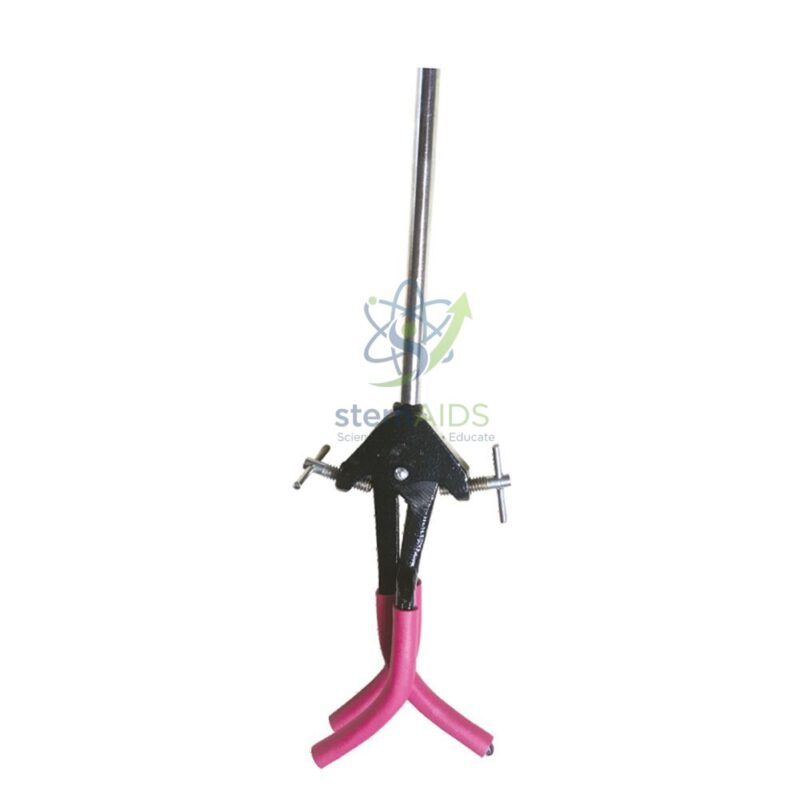
Quick Answer: The Three Finger Condenser Clamp is a clamp whose three covered fingers close around the outer jacket of a condenser to hold it in line with the flask. The listing photograph shows a black body with pink-covered fingers, screw fittings and a rod for fitting to a stand.
Holding a Condenser without Straining It
A condenser is long, heavier still with its jacket full of water, and joined to the flask or still-head by a ground-glass joint. If the clamp pulls it even slightly out of line, the joint takes the strain, and that is where glass apparatus most often cracks. The job of a three finger condenser clamp is to support the jacket so that the joint only has to seal, not carry weight.
Three fingers centre the round jacket, and the covers protect it. Fit the flask clamp first, attach the condenser to the flask, and only then bring the condenser clamp to the jacket, adjusting the stand and boss head until the fingers meet the glass without pushing it. Tighten gently: enough to hold, not so much that the jacket cannot settle as the apparatus warms.
Clamp the condenser roughly at its middle, near its balance point, and support the water tubing so its weight does not twist the jacket. A Liebig condenser in distillation or an Allihn condenser upright for reflux both suit this clamp. For a two-jaw design with curved jaws, see the retort clamp for condenser.
Applications
- Supporting a Liebig condenser sloping down from a still-head in simple distillation
- Holding a reflux condenser upright above a round-bottom flask
- Steadying a fractionating column above a flask
- Holding the condenser of a Soxhlet extractor in line with the extractor body
Care & Handling
- Position the clamp after the joint is made, so the clamp follows the glassware rather than forcing it.
- Keep the finger covers clear of the heating mantle or flame.
- Check the covers for splits; bare metal fingers on glass create stress points.
Specifications
| Type | Three finger clamp for condensers |
| Fingers | Three, pink-covered (as pictured) |
| Body | Black in the listing photograph |
| Mounting | Rod for a boss head on a retort stand |
| Holds | Condenser jackets, columns, flask necks |
| Jaw opening | Confirm at enquiry |
Why Choose LabEquip
Organic chemistry teaching labs set up distillation and reflux every week, and each rig needs a condenser clamp as well as a flask clamp. LabEquip lists this clamp in General Lab Products with boss heads and stands to match.
Frequently Asked Questions
Where should a condenser be clamped?
Near its middle, close to its balance point, with the clamp brought to the condenser’s natural position after the joint is made. This keeps weight off the ground-glass joint.
Why do joints crack during distillation?
Usually because a clamp pulls the condenser out of line, putting a bending load on the joint, or because tubing twists the jacket. Align the clamp to the glass and support heavy tubing.
How tight should a condenser clamp be?
Just enough to hold the jacket in position. Overtightening squeezes the glass and leaves no room for small movement as the apparatus warms.
Can this clamp hold a flask neck?
Yes, three fingers grip any round neck within their range. Many labs use the same pattern for both the flask and the condenser on one rig.
Should the water go in at the top or bottom of the condenser?
In at the lower inlet and out at the upper outlet. The jacket then stays full of cold water, and condensation takes place along its whole length.
Do I need a second stand for the condenser?
For small condensers one stand with two clamps is usually enough. Long or heavy condensers are steadier on a second stand placed beside the first.
Last Updated: September 2026
You must be logged in to post a review.
Bestsellers




Reviews
There are no reviews yet.