
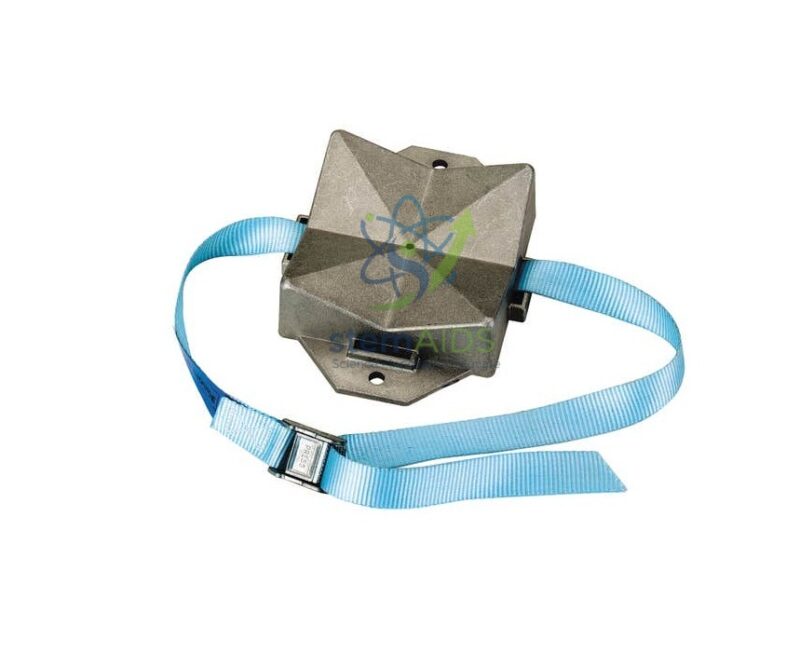
Quick Answer: The Fastening Collar for Disposable and Refillable Bottles is a metal bracket with an adjustable buckle strap, as pictured, that holds a small gas bottle or disposable gas can upright against a wall, bench upright or similar support. A gas bottle fastening collar stops the bottle being knocked over, which protects its valve and anything connected to it.
Why Gas Bottles Must Be Restrained
A gas bottle is tall and narrow, with its valve, regulator and tubing at the top, so its centre of mass sits high over a small base. A light knock can tip it, and a fall can snap tubing off, bend a valve or break a gauge. With a pressurised container the worst case is a broken valve releasing gas at speed. Holding the bottle above its midpoint with a gas bottle fastening collar removes that risk for the small bottles found in teaching labs.
The design in the photograph combines a rigid bracket, fixed in place, with an adjustable strap and buckle, so one collar can hold a slim disposable can one week and a refillable bottle the next.
Fixing and Using the Collar
Fix the fastening collar’s bracket to a wall, bench upright or other solid support with fixings suited to that surface, at a height that puts the strap above the middle of the bottle you use most. Stand the bottle on a level floor or shelf, pass the strap around it and pull it tight through the buckle so the bottle cannot rock. Open the valve and connect apparatus only once the bottle is held.
Release the strap only after the valve is closed and any regulator or tubing has been removed or depressurised. Bottles in storage stay strapped too, not just the one in use.
Where Collars Are Fitted
- Holding a disposable compressed-gas can upright while a valve and tubing are connected
- Securing a refillable oxygen bottle beside the demonstration bench
- Restraining bottles in a prep room or store between lessons
Specifications
| Product | Fastening collar for disposable and refillable gas bottles |
| Construction in photograph | Metal bracket with an adjustable strap and buckle |
| Mounting | Bracket fixed to a wall, bench upright or similar support |
| Holds | Disposable gas cans and small refillable gas bottles, upright |
| Bottle diameter range and fixing hardware | Confirm at enquiry |
Care & Handling
- Look over the strap for fraying or cuts and replace it if damaged
- Keep the bracket fixings tight; a loose bracket gives no protection
- Keep the buckle free of dirt so it locks fully
- Stand the bottle on the floor or a shelf so the collar only prevents tipping rather than carrying the weight
Why Choose LabEquip
Prep rooms that store a 10 bar compressed gas can or a refillable Minitop oxygen bottle for demonstrations fit collars so every bottle has its own restraint. LabEquip can add collars to a gas-equipment order from our physics lab equipment range; contact LabEquip with the bottle sizes you use.
Frequently Asked Questions
Where on the bottle should the strap go?
Above the middle of the bottle, where it can stop the bottle tipping. A strap near the base leaves the heavy top free to swing over.
Can one collar hold two bottles?
Each bottle should have its own restraint. Two bottles in one strap can slip against each other, and one can work loose when the other is taken out.
Is a collar needed for small disposable gas cans?
Yes. A small can still has a valve and tubing on top, and knocking it over can bend the valve or pull the tubing off. Restraining it is quick and removes that risk.
What should the bracket be fixed to?
A solid wall, a bench upright or another firm support, using fixings suited to that surface. A bracket screwed into a thin panel can pull out if a bottle is knocked.
Can the collar be used on a trolley?
It can be fitted to any solid upright the bracket can be fixed to. Trolleys built for gas cylinders usually have their own chain or strap, which should be used whenever the bottle is moved.
Which bottle sizes fit the strap?
The strap adjusts, which is why the collar suits both disposable and refillable bottles. The range of diameters it closes around can be confirmed at enquiry, so tell us the bottles you use.
Last Updated: October 2026








Reviews
There are no reviews yet.