










In Stock
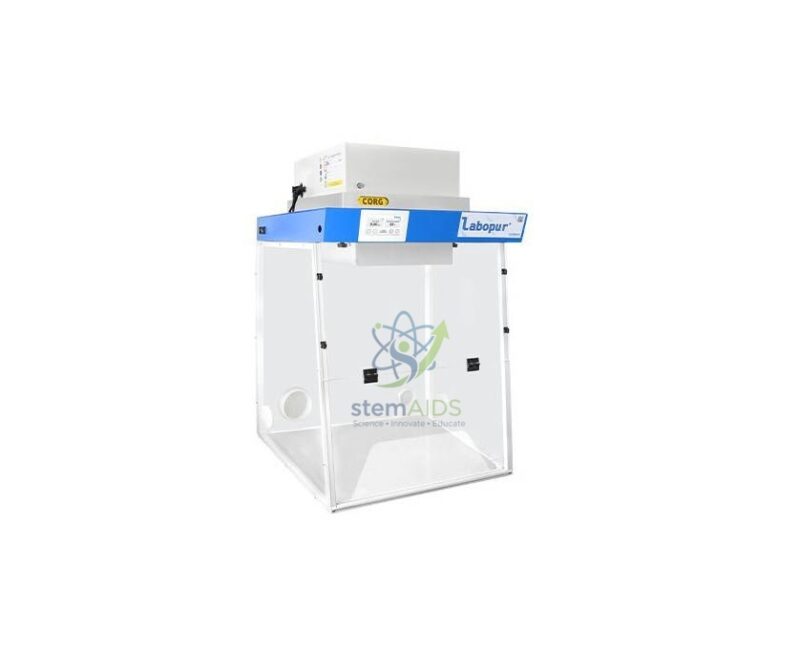
Labopur Class 2 Filtration Hood
₹68,950.00
The StemAids Labopur Class 2 Filtration Hood is a ductless recirculating laboratory hood designed for safer handling of compatible chemical vapours, powders, and laboratory substances under controlled filtration conditions. It is suitable for chemistry laboratories, pharmaceutical labs, research facilities, schools, colleges, industrial QC laboratories, and institutional science laboratories where filtered air recirculation is required.
Product Description
The StemAids Labopur Class 2 Filtration Hood is designed to capture and filter hazardous vapours or particles generated during laboratory handling. Instead of exhausting air outside through ducting, the hood draws contaminated air through a suitable filter system and returns filtered air back into the room.
This Class 2 filtration hood is based on NF X 15-211 ductless filtration hood principles. Depending on the chemical or powder handled, it can be used with activated carbon filters for vapours, HEPA filters for particles, or combined filtration configurations. Filter selection must always be matched with the chemicals, quantities, exposure risk, and laboratory safety assessment.
Important Note: This is a chemical filtration hood, not a Class II biological safety cabinet. It is intended for compatible chemical vapour or particle filtration applications and should not be used for biological containment unless the selected model is specifically certified for that purpose.
Product Specifications
| Parameter | Details |
|---|---|
| Product Name | Labopur Class 2 Filtration Hood |
| Brand | StemAids |
| Reference Type | Labopur H Series / Class 2 ductless filtration hood type |
| Product Type | Ductless recirculating filtration hood / chemical filtration hood |
| Compliance Reference | NF X 15-211 Class 2 filtration hood reference |
| Filtration Type | Activated carbon filter, HEPA filter, or combined filter depending on selected application |
| Filter Options | Organic vapour filter, polyvalent organic/corrosive vapour filter, formaldehyde vapour filter, ammonia vapour filter, HEPA particle filter |
| Average Face Velocity | Approx. 0.4 to 0.6 m/s depending on model and operating condition |
| Airflow | Approx. 170 m³/h for selected reference configurations |
| Power Supply | 220–240 V, 50 Hz depending on supplied model |
| Fan Power | Approx. 10 W for selected reference configurations |
| Fan Noise Level | Approx. 57 dB(A), excluding airflow noise, depending on model |
| Standard Monitoring | Airflow measurement, hour counter, and sampling point depending on configuration |
| External Equipment Passages | 4 protected access ports for cable or service passage, depending on model |
| Work Area | Melamine, HPL, tempered glass, or model-specific worktop depending on supplied configuration |
| Body Construction | Epoxy-coated steel body with transparent PMMA panels depending on model |
| Access Design | Ergonomic hand passages or trapezoidal opening depending on hood version |
| Application | Chemical vapour filtration, powder handling support, sample preparation, reagent handling, and laboratory fume containment |
| Suitable For | Chemistry labs, pharmaceutical labs, educational labs, research labs, industrial QC labs, and institutional laboratories |
Key Features
- Ductless recirculating design reduces the need for external exhaust ducting
- NF X 15-211 Class 2 reference design for filtered chemical handling
- Activated carbon filtration for suitable chemical vapours
- Optional HEPA filtration for compatible particle-handling applications
- Airflow monitoring helps support safe operating conditions
- Sampling port supports filter saturation checking
- Hour counter helps track filter usage and maintenance intervals
- Transparent working area improves visibility during handling
- Low power consumption compared with ducted exhaust systems
- Suitable for schools, colleges, laboratories, and quality-control environments
How to Use
- Place the StemAids Labopur Class 2 Filtration Hood on a stable, level, and clean laboratory bench or approved support stand.
- Confirm that the selected filter type is suitable for the chemicals, vapours, powders, or particles being handled.
- Connect the hood to the correct electrical supply as mentioned on the rating plate.
- Switch on the ventilation system before starting any chemical handling activity.
- Check the airflow indicator or airflow monitor before use.
- Keep the working opening clear and avoid blocking the air intake or filter area.
- Place only the required chemicals, containers, and apparatus inside the work zone.
- Perform handling slowly and carefully to avoid disturbing airflow containment.
- Keep containers closed when not actively in use.
- After completing work, allow the hood to run for a short purge period as per laboratory SOP.
- Clean the work surface using a compatible laboratory cleaning method.
- Record filter usage hours and check filter saturation according to safety procedure.
Applications
- Chemical vapour handling under filtered conditions
- Reagent preparation and sample handling
- Powder handling when suitable particle filtration is installed
- Formaldehyde vapour handling with correct filter selection
- Ammonia vapour handling with suitable filter configuration
- Organic solvent vapour filtration where compatible
- Educational chemistry demonstrations
- Pharmaceutical and industrial QC sample preparation
- Research laboratory chemical handling
- Laboratory work where ductless filtration is preferred
Safety and Handling Guidelines
- Always verify chemical compatibility before using the hood.
- Use only the correct filter type for the substances being handled.
- Do not use the hood for unknown, highly toxic, explosive, radioactive, or incompatible substances without a formal risk assessment.
- Do not use for biological containment unless the hood is specifically certified for that purpose.
- Do not exceed the chemical quantity or exposure limit allowed by the filter capacity.
- Check filter saturation regularly using the recommended testing method.
- Replace saturated filters before continuing laboratory work.
- Do not block airflow slots, hand openings, exhaust area, or filter modules.
- Wear suitable PPE such as gloves, goggles, lab coat, and respiratory protection if required by SOP.
- Keep ignition sources away when handling flammable vapours.
- Follow SDS instructions, institutional chemical safety rules, and local regulations.
- Allow trained personnel to service, test, and replace filters.
Quality and E-E-A-T Notes
The StemAids Labopur Class 2 Filtration Hood supports evidence-based laboratory safety by combining controlled airflow, matched filtration, filter-saturation monitoring, and documented maintenance. For reliable protection, users should perform chemical compatibility checks, follow SDS guidance, maintain filter records, monitor airflow, and replace filters according to verified saturation results and laboratory SOP.
FAQ
1. What is the StemAids Labopur Class 2 Filtration Hood used for?
It is used for filtered handling of compatible chemical vapours, powders, reagents, and laboratory substances under ductless recirculating airflow.
2. What does Class 2 mean in this filtration hood?
In this context, Class 2 refers to the NF X 15-211 ductless filtration hood classification. It should not be confused with a Class II biological safety cabinet.
3. Is this hood ductless?
Yes, it is a ductless recirculating filtration hood. The air is filtered through suitable filters and returned to the laboratory room.
4. What filters can be used?
Filter options may include activated carbon filters for organic vapours, polyvalent filters for mixed vapours, formaldehyde filters, ammonia filters, and HEPA filters for suitable particle applications.
5. Can it be used for solvents?
It can be used for compatible solvent vapours only when the correct activated carbon filter is selected and the quantity handled is within safe filter capacity.
6. Can it be used for powders?
Yes, powder handling may be possible when the hood is equipped with an appropriate particle or HEPA filtration system.
7. How often should the filter be checked?
For Class 2 NF X 15-211 filtration hoods, activated carbon filter saturation should be checked regularly, with 60-hour checking intervals commonly referenced in operating guidance.
8. Does the hood need external ducting?
No, the main advantage of this type of hood is ductless operation. However, laboratory ventilation and room air quality must still be considered.
9. Is it suitable for biological samples?
No, it should not be used as a biological safety cabinet unless the specific model is certified for biological containment.
10. What airflow is required?
Reference configurations operate with an average face velocity of approximately 0.4 to 0.6 m/s. The airflow should be verified before use.
11. What happens if the filter is saturated?
A saturated filter must be replaced before further chemical handling. Continuing work with a saturated filter may release harmful vapours back into the laboratory.
12. Who should select the correct filter?
Filter selection should be done by trained laboratory safety personnel or technical staff using the chemical list, SDS data, concentration, quantity, and exposure risk.
Why Choose StemAids?
StemAids laboratory safety equipment is selected for practical workflows, user protection, and institutional laboratory requirements. The StemAids Labopur Class 2 Filtration Hood supports safer chemical handling, ductless filtration, airflow monitoring, filter maintenance, and controlled laboratory operation for schools, colleges, research laboratories, pharmaceutical units, chemistry labs, and industrial QC departments.
SEO Keywords
StemAids Labopur Class 2 Filtration Hood, Labopur Filtration Hood, Class 2 Ductless Fume Hood, NF X 15-211 Filtration Hood, Laboratory Filtration Hood, Ductless Chemical Fume Hood, Activated Carbon Filtration Hood, HEPA Filtration Hood for Laboratory, Chemical Vapour Filtration Hood, Laboratory Safety Hood, StemAids Laboratory Equipment
You must be logged in to post a review.
Bestsellers




Reviews
There are no reviews yet.