
















In Stock
Berlese Funnel
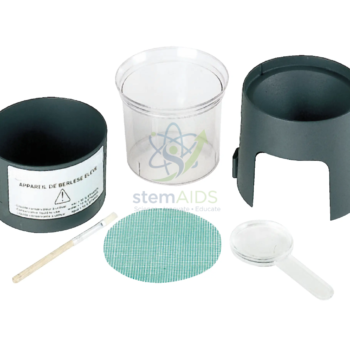
Appareil de Berlèse élève Integrated with a specialized mesh screen within a high-impact conical housing to optimize the downward migration of sensitive invertebrates while preventing debris contamination.
Modular Specimen Collection Interface Features an airtight, threaded reservoir connector designed for high-purity ethanol preservation, ensuring the structural integrity of extracted specimens for subsequent microscopic taxonomic identification.
₹655.00
Quick Answer: The Berlese Funnel is a classroom kit for extracting small soil animals, such as mites, springtails and insect larvae, from leaf litter or topsoil. A sample rests on a mesh above a collecting pot, and as a lamp above dries and warms it, the animals move down and drop into the pot for study.
How Dry Extraction Separates Soil Animals
Most small soil animals avoid light, heat and drying. In this apparatus, a layer of litter sits on a mesh disc inside a cylinder, with a lamp above it. The upper layer dries first, so the animals move downwards, pass through the mesh and fall into a collecting pot below. Over one to several days the sample dries through and most of the active mesofauna leave it.
The kit in the listing photo is a plastic classroom version: a cylinder labelled for the Berlese apparatus, a mesh disc, a dark stand, a clear collecting pot, a small pipette or brush and a hand magnifier. A desk lamp or reflector lamp is placed above the cylinder; no lamp appears in the photo, so plan to use one you already have unless it is confirmed as included.
What goes in the pot depends on the aim. Damp tissue keeps animals alive for observation and release, while a little 70 percent ethanol preserves them for identification. For preserved reference material, the soil microfauna and mesofauna set shows typical groups in microtubes.
Investigations to Try
- Comparing soil animal numbers in leaf litter from woodland, lawn and a flower bed
- Studying the effect of compost or mulch on soil biodiversity
- Building a simple identification key for mites, springtails, beetles and larvae
- Linking decomposers to nutrient cycling in ecology lessons
Specifications
| Type | Funnel apparatus for dry extraction of soil mesofauna |
| Pictured parts | Sample cylinder, mesh disc, stand, collecting pot, pipette or brush, hand magnifier |
| Heat source | Lamp placed above the sample (not shown in the photo) |
| Collecting medium | Damp tissue for live study, or 70 percent ethanol to preserve |
| Typical run time | One to several days, depending on sample moisture |
Care & Handling
- Keep the lamp at a safe distance from the plastic cylinder and never leave it running unattended near paper or dry leaves.
- Use equal volumes of sample from each site so counts can be compared fairly.
- Empty and wash the collecting pot and mesh after each run so animals from one sample do not appear in the next.
- Handle ethanol away from the hot lamp, and keep it capped when not in use.
Why Choose LabEquip
Ecology teachers and environmental science departments pick a Berlese funnel because it reveals a hidden community that a hand search would miss. LabEquip stocks this kit in the General Lab Products range; for a stand-mounted version that also runs a wet extraction for nematodes, see the Berlèse and Baermann Apparatus.
Frequently Asked Questions
What animals does a Berlese funnel collect?
It mainly collects small arthropods that move through soil and litter, such as mites, springtails, small beetles, fly and beetle larvae, pseudoscorpions and small spiders. Worms and nematodes are poorly extracted because they dry out before escaping; a wet Baermann funnel is used for nematodes.
How long should the lamp be left on?
Usually between one and several days, until the sample is dry right through. Thick or wet samples take longer. Checking the pot every few hours at the start shows how the catch builds up.
Why use a lamp instead of simply letting the sample dry?
The lamp creates a gradient: the top becomes warm, bright and dry while the bottom stays cooler and moister. Animals follow that gradient downwards, so more of them fall into the pot instead of dying in the drying litter.
Should the collecting pot contain ethanol or water?
Use ethanol, commonly around 70 percent, when you want to keep specimens for identification. Use damp tissue or moist paper when students will observe live animals and then return them to the soil.
How much sample should be used?
A layer a few centimetres deep that does not overfill the cylinder works well. Measure the same volume from each site, for example a level cupful, so numbers can be compared between habitats.
How should the extracted animals be examined?
Tip the catch into a shallow dish or a small magnifying box and examine it with the hand magnifier or a stereo microscope. Many soil animals are under 2 mm long, so good light and a fine brush for moving them help.
Last Updated: September 2026
You must be logged in to post a review.
Bestsellers




Reviews
There are no reviews yet.