
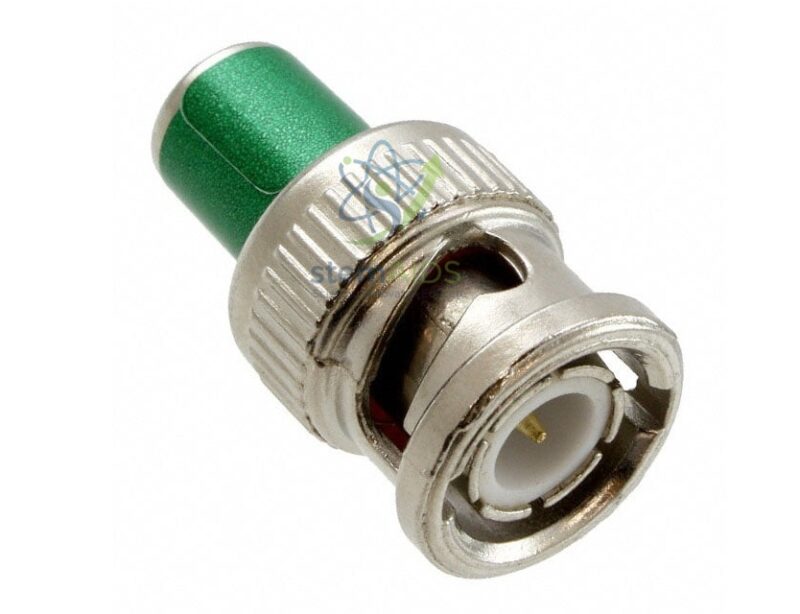
Quick Answer: This 50 ohm BNC terminator is a BNC plug that contains a 50 ohm resistance between its centre pin and its outer shell. Fitted at the end of a 50 ohm coaxial line, it absorbs the signal instead of reflecting it, which is the matched-load condition used in transmission-line practicals and in correct oscilloscope connections.
Why a Line Needs a Matched End
A coaxial cable has a characteristic impedance set by its geometry and insulation, commonly 50 ohms for laboratory and radio work. A signal travelling along the cable sees that impedance at every point. When it reaches the end, whatever is connected decides what happens next: an open end sends the wave back with the same polarity, a short circuit sends it back inverted, and a resistance equal to the characteristic impedance takes in the energy so that nothing returns. The terminator provides that last condition in a single plug, shown in the product photograph with its bayonet collar and closed cap.
Reflections matter more than students expect. With fast edges or long cables, an unterminated line produces ringing and overshoot on an oscilloscope trace, and a square wave that looks distorted may only be badly terminated. Adding the terminator often cleans the trace at once.
Measuring Reflections in Class
A typical practical uses a pulse generator, a long length of 50 ohm cable and a BNC T adapter on the oscilloscope input. With the far end open, the echo appears upright; with the end shorted, it appears inverted; with the terminator fitted, it almost vanishes. Measuring the time between pulse and echo, and knowing the cable length, gives the speed of the signal in the cable, usually a substantial fraction of the speed of light. Replacing the terminator with resistors of other values shows the reflected amplitude changing smoothly, so students can test the reflection coefficient formula, (R minus Z0) divided by (R plus Z0), against their own measurements.
Applications
- Ending a 50 ohm coaxial line in pulse reflection and signal-speed experiments
- Terminating a 50 ohm generator output at the oscilloscope through a T adapter, so the displayed amplitude matches the loaded value
- Comparing open, shorted and matched line ends to show how reflection depends on the load
- Removing ringing from fast-edged square waves seen on an oscilloscope
Specifications
| Product | BNC terminator (terminating plug) for coaxial lines |
| Nominal resistance | 50 ohms, as titled |
| Connector | BNC plug with bayonet locking collar, as in the product photograph |
| Function | Matched termination between centre pin and screen |
| Pairs with | 50 ohm coaxial cable, BNC T adapters, oscilloscopes and generators |
| Power rating | Confirm at enquiry |
Care & Handling
- Check the 50 ohm BNC terminator now and then with an ohmmeter between centre pin and shell; a reading far from 50 ohms means it should be replaced
- Keep terminators on signal-level circuits, because the small internal resistor can dissipate only a limited power
- Store them in a labelled box with the T adapters so they are not mistaken for plain BNC plugs
- Lock and unlock the bayonet collar fully instead of pulling the terminator straight off
Why Choose LabEquip
The terminator is usually bought alongside T adapters and BNC cords by colleges and schools setting up oscilloscope and transmission-line practicals. LabEquip can bundle those fittings into one order for a set of benches; tell us how many stations you are equipping through the contact page. Related instruments are listed under physics equipment.
Frequently Asked Questions
What does a 50 ohm BNC terminator do?
It ends a coaxial line in a resistance equal to the cable’s characteristic impedance, so a signal arriving at the end is absorbed rather than reflected back along the cable. This keeps waveforms clean and is the reference condition in reflection experiments.
When should a terminator be used with an oscilloscope?
Most oscilloscope inputs have a high impedance, so a 50 ohm cable connected straight to them is effectively open at the end. When the source is a 50 ohm generator or the signal has fast edges, fitting the terminator on a T adapter at the input gives a matched load and a truer trace.
Will the terminator change the voltage I measure?
Yes, it can. A 50 ohm generator driving a high-impedance input shows its open-circuit voltage, while the same generator driving 50 ohms shows about half of it, because the internal and load resistances form a divider.
Can a 50 ohm terminator be used on a 75 ohm cable?
It will work as a load, but it is not a matched end for a 75 ohm line, so a small reflection remains. Using the formula (R minus Z0) divided by (R plus Z0), a 50 ohm load on a 75 ohm line reflects about one fifth of the incident voltage, inverted.
How can students check that the terminator is working?
Measure between the centre pin and the outer shell with a multimeter on its resistance range; the reading should be close to 50 ohms. In the reflection experiment, a working terminator makes the echo almost disappear, while a faulty one leaves a clear reflected pulse.
How much power can the terminator handle?
Terminators for oscilloscope work are intended for signal levels, not for absorbing power from amplifiers or transmitters. The rated power for this item can be confirmed at enquiry, and it should never be connected across a supply rail.
Last Updated: October 2026




Reviews
There are no reviews yet.