




















In Stock
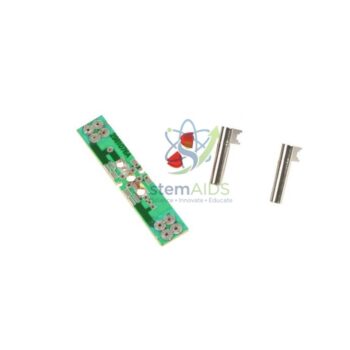
Wireless luxmeter Sensor Redy
Capteur Redy Luxmètre High-Cadence Digital Sampling enables students to analyze flicker frequency and rapid light-level fluctuations in artificial versus natural sources, reinforcing the "Evaluate" level of scientific inquiry.
Wireless/USB Dual Connectivity supports high-fidelity data visualization across institutional local area networks (LAN), facilitating collaborative student peer-review and comparative data synthesis.
$86.29
Quick Answer: The Redy wireless luxmeter sensor measures illuminance, the amount of visible light falling on a surface, in lux, and transmits the readings wirelessly for graphing. A wireless luxmeter sensor gives physics and biology students a number for light that is otherwise judged only by eye.
Lux: Light as the Eye Sees It
Lux means lumens per square metre. Because the lumen is weighted by the sensitivity of the human eye, a properly filtered luxmeter responds most strongly to green-yellow light and much less to deep red or violet; it does not measure total radiant power. That makes it the right instrument for questions about lighting and vision, and a reasonable, if imperfect, way to compare light levels in plant experiments.
Logged readings reveal patterns that single readings hide: illuminance falling with distance from a lamp, the dimming as a second polarising filter is rotated, or daylight changing as clouds pass. The title does not state the measuring range or the spectral filter, and outdoor sunlight can be many times brighter than any classroom.
For plant work that also tracks gas exchange, the wireless CO2 air sensor logs carbon dioxide in the same chamber.
Applications
- Testing the inverse-square law by moving a small lamp away from the sensor
- Verifying Malus’s law with two polarising filters
- Measuring light at the bench, the window and the corridor in a school lighting survey
- Relating light level to the rate of photosynthesis in pondweed
- Comparing the light passed by coloured or frosted filters
Care & Handling
- Keep the light window clean; fingerprints and dust lower the reading.
- Hold or clamp the sensor flat and facing the source, as the angle strongly affects illuminance.
- Shield the sensor from room light when measuring a single lamp in optics experiments.
- Store it dry, with the window covered when not in use.
Specifications
| Measures | Illuminance (visible light on a surface), in lux |
| Response | Weighted to the eye’s sensitivity, as lux readings are by definition |
| Output | Wireless logging and live graphs |
| Typical settings | Classrooms, optics benches, plant growth studies |
| Range and sampling rate | Confirm at enquiry |
Why Choose LabEquip
Physics teachers covering light and optics, and biology teachers running photosynthesis investigations, both find a use for a lux sensor. LabEquip lists this one within its chemistry lab equipment; request range details on the contact page.
Frequently Asked Questions
What is the difference between lux and light intensity?
Lux measures illuminance: visible light arriving on a surface, weighted to the human eye. Light intensity is often used loosely for the same idea, but radiant power in watts also includes infrared and ultraviolet, which a luxmeter ignores.
Why don’t my inverse-square results fit the law exactly?
The law assumes a point source and no stray light. A large bulb, reflections from the bench and room lighting all distort the pattern. Use a small source, darken the room and measure distance to the filament or LED itself.
Can the luxmeter measure sunlight?
Direct sunlight is far brighter than indoor lighting and can exceed the range of sensors made for classroom work. Check the stated maximum before measuring outdoors in full sun.
Is lux suitable for photosynthesis experiments?
It is widely used in schools for comparing light levels, but plants rely heavily on red and blue light, which the lux scale underweights. Keep the same lamp type throughout so readings stay comparable.
Does the angle of the sensor matter?
Yes. Illuminance is greatest when the sensor faces the source directly and falls as it tilts away. Clamp the sensor in a fixed position for repeatable results.
How should the sensor be stored?
Dry, with the light window covered or face down on a clean surface, and away from chemicals whose fumes could cloud the window.
Last Updated: September 2026
You must be logged in to post a review.
Bestsellers





Reviews
There are no reviews yet.