
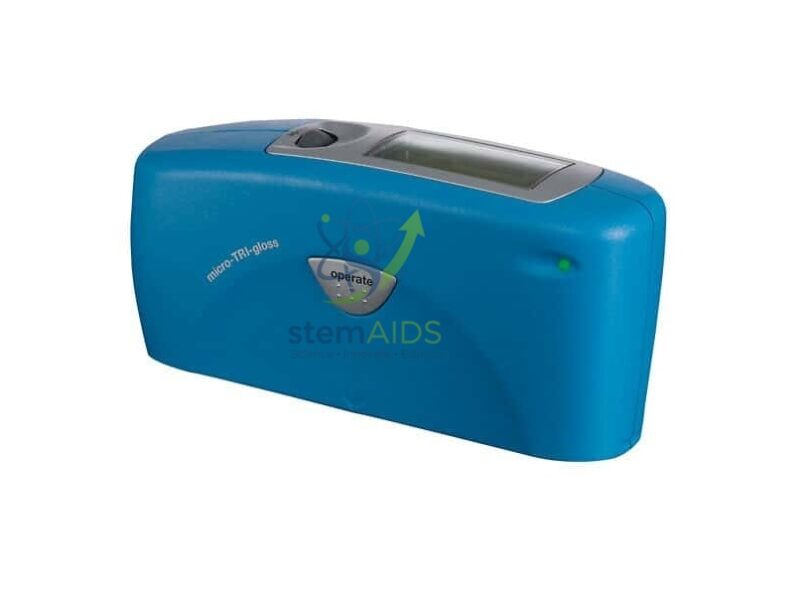
Quick Answer: The Micro-TRI-gloss gloss meter, listed as ‘Micro-TRI-gloss Brillancemeter’, is a handheld instrument that shines light onto a surface at a fixed angle and measures how much is reflected in the mirror direction. The listing photo shows a compact blue unit with a display window and an ‘operate’ button, used to compare the shine of paints, coatings and plastics.
How a Gloss Meter Puts a Number on Shine
‘Brillancemeter’ comes from the French ‘brillancemètre’, meaning gloss meter. Gloss is how mirror-like a surface looks, and the eye judges it inconsistently under different lighting. A gloss meter removes the guesswork: a light source inside the unit sends a beam onto the surface at a set angle, a detector positioned at the mirror angle measures the reflected light, and the result is expressed in gloss units (GU) relative to a calibrated reference.
Gloss measurement uses standard geometries: 60° as the general-purpose angle, 20° to separate high-gloss finishes, and 85° for matt surfaces, where reflection at the other angles is too weak to tell samples apart.
In teaching and research labs a gloss meter makes surface finish measurable. Students can follow how the gloss of a paint film changes as it dries, compare coatings applied at different thicknesses, or record how abrasion and weathering dull a plastic surface. The photo shows a blue housing with the display window on top, an ‘operate’ button on the front and a small indicator lamp.
Specifications
| Item | Handheld gloss meter |
| Listed as | Micro-TRI-gloss Brillancemeter |
| Measures | Specular reflection, reported in gloss units (GU) |
| Form | Compact blue housing with display window and ‘operate’ button (photo) |
Applications
- Following the gloss of paint films as they dry or cure
- Quantifying scratch and abrasion damage on plastic or lacquered test panels
- Materials projects on surface finish, such as polishing metal coupons to increasing smoothness
- Checking that sample panels in a coatings practical start with a consistent finish
Care & Handling
- Calibrate the Micro-TRI-gloss against its reference tile at the start of each measuring session, following its instructions.
- Keep the measuring aperture and the reference tile clean; a fingerprint on either changes the readings.
- Place the meter flat on the sample and lift it off rather than sliding it, so the aperture is not scratched.
- Store it in its case away from dust, and remove the batteries if it will not be used for a long period.
Why Choose LabEquip
University and college labs teaching paints, polymers and surface coatings, along with quality-control training courses, are the typical buyers of a gloss meter like this. It is listed among LabEquip’s chemistry lab equipment; ask about angles and accessories through the contact page.
Related Products
- Wireless luxmeter Sensor Redy: A wireless lux sensor that measures how much light falls on a surface, a useful contrast with gloss, which measures how it reflects.
- Minerals Used in Paints Industry, Set of 15: A set of 15 mineral specimens used as raw materials in paints and coatings, for lessons that link pigments to surface finish.
- Suitcase of Measuring Instruments: A carry case of measuring instruments for lessons on choosing instruments, reading displays and stating units.
- Polypropylene Suitcase with Pre-Cut Foam: A polypropylene case with pre-cut foam that can be plucked to hold the gloss meter and its calibration tile safely.
Frequently Asked Questions
What does a handheld gloss meter like the Micro-TRI-gloss actually measure?
It measures specular reflection: the share of light, sent onto the surface at a fixed angle, that bounces off in the mirror direction. The Micro-TRI-gloss reports this in gloss units, so the shine of two paint panels, plastic mouldings or coated boards can be compared as numbers instead of by eye.
Which angle should be used on a gloss meter: 20, 60 or 85 degrees?
Gloss practice starts with 60 degrees, the general-purpose geometry. If a surface reads above about 70 gloss units at 60 degrees, a 20 degree reading separates high-gloss finishes better; if it reads below about 10, an 85 degree reading separates matt finishes better. Always quote the angle with the result, because values at different angles are not comparable.
What is a gloss unit and why can a mirror read above 100 GU?
The gloss unit scale is fixed by a polished black glass reference that is defined as 100 GU. Surfaces that reflect more strongly than that black glass, such as polished metal or a mirror, can therefore read well above 100, while a flat matt wall paint may read only a few units.
How do I get repeatable readings from a handheld gloss meter?
Check the meter on its calibration tile first, then place it flat on a clean, dry, level part of the sample so no light leaks under the base. Take several readings in different spots and in the same direction, because brushed or textured finishes can change with orientation, and average them.
Can a gloss meter be used on curved, textured or very small parts?
Gloss meters are designed for flat, smooth areas larger than their measuring window. On a tight curve or a coarse texture the reflected beam is scattered or misses the detector, so readings drop and vary. For such parts, compare like with like on the flattest region and treat the numbers as relative values.
Why is this gloss meter listed as a ‘Brillancemeter’?
Brillancemeter is an anglicised form of the French word brillancemetre, which simply means gloss meter, from brillance, meaning shine. The Micro-TRI-gloss Brillancemeter is therefore a handheld gloss meter; the name reflects the French-language catalogue the listing came from, not a different kind of instrument.
Last Updated: November 2026





Reviews
There are no reviews yet.