







In Stock
Microbiology Table for Technibec
₹3,260.00
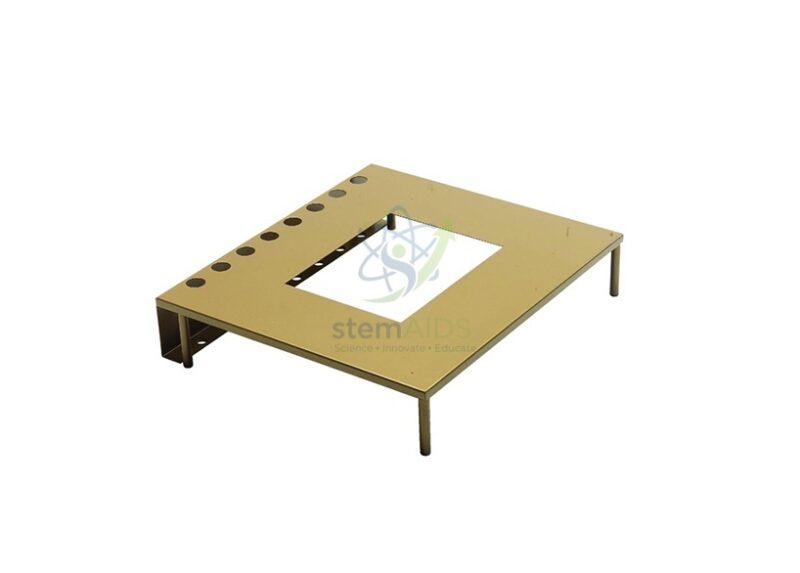
Quick Answer: The Technibec microbiology table is a small sheet-metal work table that stands over the Technibec electric burner. In the listing photo it is golden-coloured, on four short legs, with a square opening in the centre above the heat and a row of holes along one edge for holding culture tubes.
A Workstation Built Around the Burner
In microbiology, anything that is opened should be opened close to the heat, and the operator needs somewhere to put tubes, loops and dish lids down for a moment without them touching the bench. This table creates that zone. Placed over the Technibec 2.0 electric burner, its central opening lets the heat rise through the table top while the flat surface around it becomes a working area.
The row of holes along one side, visible in the photo, holds culture tubes upright within reach of the heat, so a transfer from one tube to another happens without either tube leaving the warm zone. Petri dishes can be opened on the surface nearby. The golden finish shown in the photo should be cleaned only when the table is cool.
The table is not a stand-alone item. It has no heating element of its own, relies entirely on the burner beneath it, and is named for the Technibec; fit on other burners should not be assumed.
Applications
- Subculturing from one broth tube to another with both tubes held upright near the heat
- Streak-plate practicals in which the dish lid is lifted only within the warm zone
- Organising loops, tubes and a marker pen on one surface during timed microbiology assessments
- Demonstration benches where the teacher needs a tidy aseptic area visible to the class
Specifications
| Item | Microbiology work table for the Technibec electric burner |
| Top | Flat sheet-metal surface with a square central opening (photo) |
| Tube holding | Row of holes along one edge for culture tubes (photo) |
| Legs | Four short legs that stand over the burner (photo) |
| Finish | Golden colour, as photographed |
Care & Handling
- Set the table on the burner only when both are cold, and check that the opening is centred over the heating zone.
- Keep plastic items such as Petri dishes and pipette tips away from the edge of the central opening, where the heat is strongest.
- Clean with detergent and then the lab’s surface disinfectant after each session, once the table has cooled.
- Lift the table off by its outer edges; the area around the opening stays hot longest.
Why Choose LabEquip
Microbiology teachers who use the Technibec burner and want every student to follow the same aseptic routine are the buyers of this table. LabEquip lists it among its chemistry lab equipment; burner and table sets can be requested together through the contact page.
Frequently Asked Questions
Is the Technibec microbiology table a heater?
No. It has no heating element of its own. It stands over the Technibec electric burner, and the heat from the burner rises through the opening in its top.
How many tubes does it hold?
The listing photo shows a single row of holes along one edge for culture tubes. The number and diameter of the holes decide which tubes fit, so measure your tubes against the table before planning a practical.
Can Petri dishes be placed on the table?
Yes, on the flat surface away from the central opening. Plastic dishes should be kept clear of the opening, where heat rising from the burner could soften them. Keep dishes closed except during the transfer itself.
Does it make the working area sterile?
No surface near a burner is sterile. The table helps keep work close to the rising heat and off the bench, which supports aseptic technique, but lids should still be opened briefly and tube mouths passed through the heat.
How is the table cleaned?
Allow it to cool, then wash off any spilled medium with detergent solution, rinse, and wipe with the lab’s surface disinfectant. Avoid abrasive pads, which can scratch the coloured finish.
Can the table be used without the burner as a tube rack?
It can hold tubes when cold, but that wastes its purpose, and a standard test tube rack is simpler for storage. The table is intended for use over the burner during aseptic work.
Last Updated: September 2026
You must be logged in to post a review.
Bestsellers





Reviews
There are no reviews yet.