


















In Stock
Atoms, Electrons and Energy Kit
₹500.00
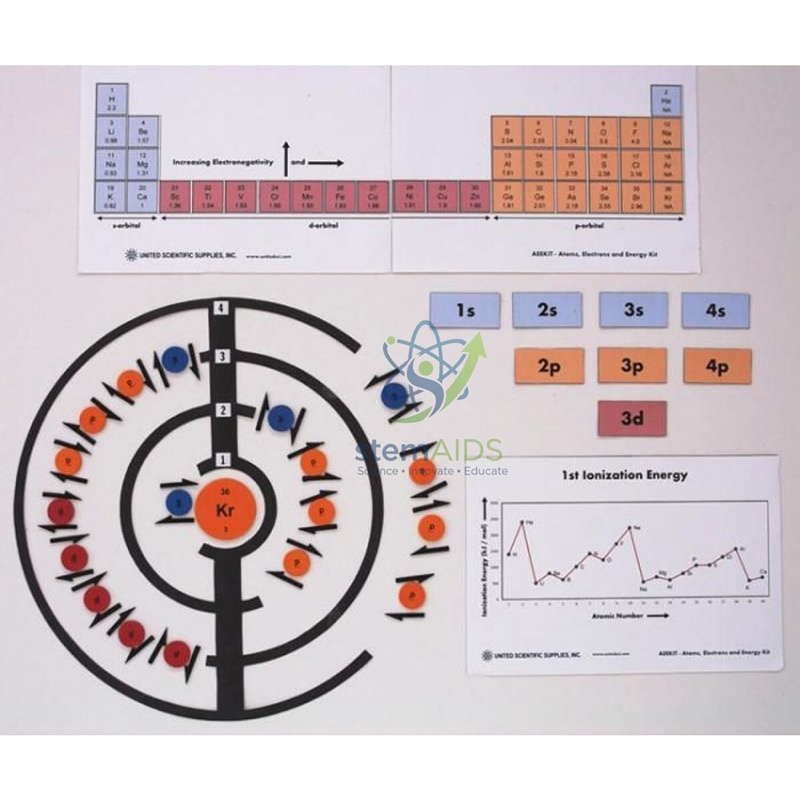
Quick Answer: The Atoms, Electrons and Energy Kit is a classroom set for building electron arrangements and linking them to ionisation energy. The listing photo shows a four-shell atom diagram with colour-coded electron pieces and arrows, sublevel tiles from 1s to 4p, a periodic table card and a graph of first ionisation energy against atomic number.
Building Electron Configurations Piece by Piece
Electron configurations are hard to learn from notation alone, and this kit makes them physical. In the photo a large diagram of four concentric shells surrounds a nucleus disc, and coloured discs marked s and p are placed on the shells one electron at a time, with arrow pieces beside them. The example laid out is krypton, atomic number 36, with all four shells in use.
Separate tiles labelled 1s, 2s, 3s, 4s, 2p, 3p, 4p and 3d let students arrange sublevels in filling order and see why 4s fills before 3d. A periodic table card covering the first 36 elements is coloured by s, p and d blocks and carries electronegativity values, and a printed graph of first ionisation energy against atomic number shows the familiar peaks at the noble gases and drops at the alkali metals.
Used together, the parts connect structure to evidence. Students build the configuration of an element, find it on the periodic table card, then explain its position on the ionisation energy graph: for example, why the value falls sharply from neon to sodium, where a new shell begins.
Specifications
| Item | Classroom kit for modelling electron arrangements |
| Atom model | Four-shell diagram with nucleus disc and colour-coded electron pieces (photo) |
| Sublevel tiles | 1s, 2s, 3s, 4s, 2p, 3p, 4p, 3d (photo) |
| Reference cards | Periodic table of the first 36 elements with electronegativity values; first ionisation energy graph (photo) |
| Magnetic or table-top use | Confirm at enquiry |
Applications
- Building electron configurations for elements 1 to 36 and writing the matching notation
- Explaining the order of sublevel filling, including 4s before 3d
- Relating trends in first ionisation energy to shells and sublevels
- Whole-class modelling in which students take turns to add electrons
Care & Handling
- Count the electron pieces and tiles of the Atoms, Electrons and Energy Kit back into their bags after each lesson; missing pieces stop the heavier elements being built.
- Keep the printed cards flat and dry, and wipe them with a barely damp cloth only.
- Store the shell diagram flat rather than rolled, so that pieces lie evenly on it.
Why Choose LabEquip
Chemistry teachers covering atomic structure at upper-secondary and pre-university level buy this kit to move students on from drawing shells to understanding sublevels. It is listed with LabEquip’s chemistry lab equipment; ask about sets for group work on the contact page.
Frequently Asked Questions
What does the Atoms, Electrons and Energy Kit teach?
It teaches how electrons are arranged in shells and sublevels, the order in which sublevels fill, and how those arrangements explain the pattern of first ionisation energies across the periodic table.
Which elements can be modelled with the kit?
The shell diagram has four shells and the periodic table card runs to krypton, atomic number 36, so elements from hydrogen to krypton can be built.
Why does 4s fill before 3d?
For potassium and calcium the 4s sublevel is lower in energy than 3d, so it fills first. The sublevel tiles let students set out 1s, 2s, 2p, 3s, 3p, 4s, 3d and 4p in that filling order.
Why does ionisation energy drop from neon to sodium?
Sodium’s outer electron is in a new shell, further from the nucleus and shielded by the inner electrons, so it is removed far more easily than an electron from neon’s full second shell.
What do the arrow pieces show?
They represent electron spin. Two electrons sharing an orbital have opposite spins, which is why the arrows are drawn in pairs pointing up and down.
Is the kit suitable for younger students?
Younger classes can use the four shells alone to build simple shell diagrams for the first 20 elements. The sublevel tiles and ionisation energy graph suit students in the final years of school and above.
Last Updated: September 2026
You must be logged in to post a review.
Bestsellers






Reviews
There are no reviews yet.