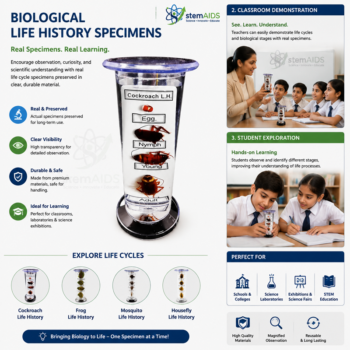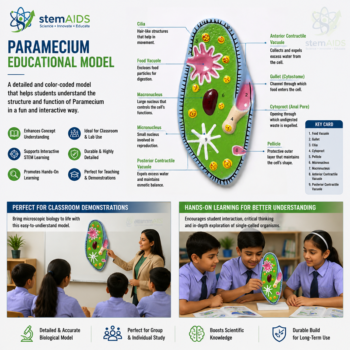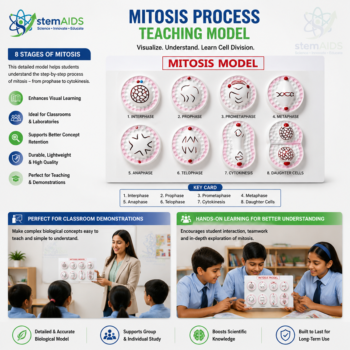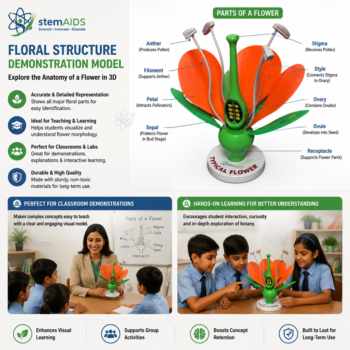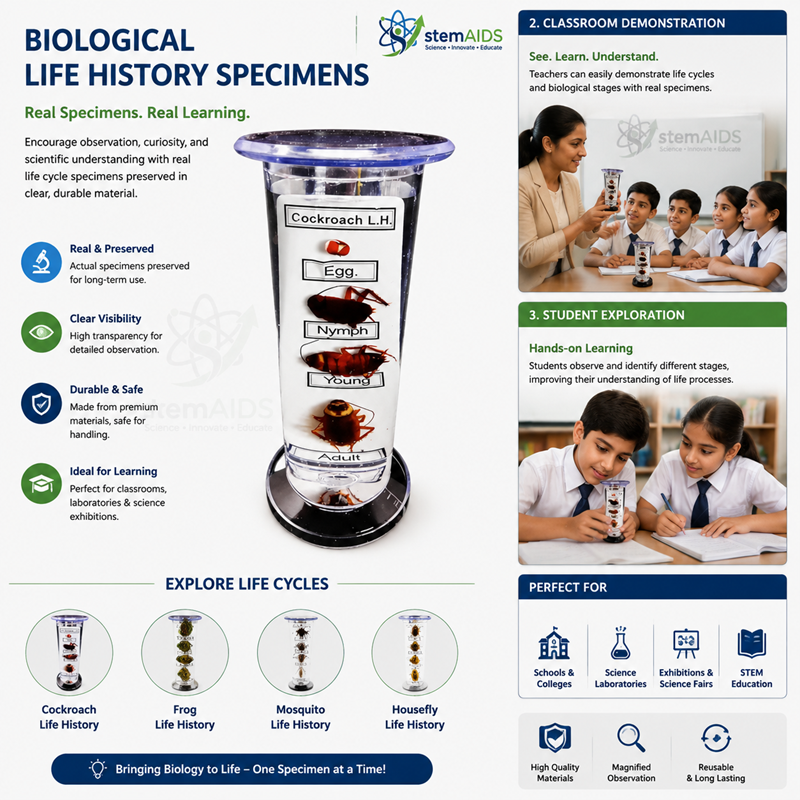
Quick Answer: The Biological Life History Specimens set is a preserved/prepared specimen collection used in biology laboratories so students can observe real organism structure, developmental stages and classification features directly, rather than only from textbook diagrams. LabEquip supplies it as part of the Biology Models range, alongside the Mitosis Process Teaching Model and Meiosis Visualization Model used for cell-division and life-cycle instruction.
Product Description
Specimen-based learning lets students connect theoretical biology concepts to real biological material rather than diagrams alone. This Biological Life History Specimens collection from LabEquip is intended to support that kind of observation-based teaching across zoology, botany, classification and life-cycle topics at school and college level.
Because organisms pass through multiple recognisable stages over a life cycle, a life-history specimen set is built to let students compare those stages side by side, discuss the biological significance of each stage, and relate specimen features to classification and developmental-biology concepts covered in the syllabus.
What This Specimen Collection Helps Students Learn
- Identify the developmental or life-cycle stages represented in the specimen set.
- Compare specimen features to textbook diagrams of organism life cycles.
- Recognise classification features that distinguish different life stages or organism groups.
- Practice careful observation and handling of preserved or prepared biological material.
- Connect specimen-based observation to zoology, botany and life-cycle topics in the biology syllabus.
- Follow safe handling practices for preserved biological specimens in a laboratory setting.
Specifications
| Attribute | Detail |
|---|---|
| Product name | Biological Life History Specimens |
| Category | Biology Models – Biology Laboratory Products |
| Product type | Preserved/prepared biological specimen collection |
| Typical use | Life-cycle, developmental-biology, zoology and botany teaching |
| Recommended for | Schools, colleges, biology laboratories, science educators |
Safety Note
Handle preserved specimens and their containers with care. Treat any preservation fluid as a laboratory chemical and avoid direct skin contact; follow your institution’s laboratory safety guidelines when opening or examining containers. Recommended for use under teacher or laboratory-instructor supervision, particularly with younger students.
Care & Maintenance
- Store specimens in a clean, dry area away from direct sunlight and heat.
- Keep containers sealed and upright to prevent leakage of any preservation fluid.
- Handle specimens and containers gently during classroom demonstrations; avoid unnecessary opening.
- Check containers and labels periodically for damage or fluid loss and report any issues before the next practical session.
Why Choose LabEquip
LabEquip supplies biology teaching models, specimen collections and laboratory equipment to schools, colleges and technical training institutes across India. Alongside this Biological Life History Specimens set, our Biology Models range includes the DNA Double Helix Model and Floral Structure Demonstration Model for molecular and plant biology, and the Mitosis Process Teaching Model and Meiosis Visualization Model for cell-division teaching. Browse our full Biology Models category for the complete range.
Related Products
- Model, Life History of Butterfly: A butterfly life cycle model showing egg, caterpillar, chrysalis and adult for complete metamorphosis.
- Model, Life History of Frog: A frog life history model following amphibian metamorphosis from spawn and tadpole to froglet and adult.
- Model, Life History of Mosquito: A mosquito life cycle model with aquatic larva and pupa stages, linking life history to disease control.
- Hookworm Life History Chart: A wall chart of the human hookworm life history, from eggs in soil to adults in the small intestine.
Frequently Asked Questions
What is a biological life history specimen set used for?
A life history set brings together real, prepared stages of an organism’s life cycle so students can compare them side by side, for example an egg, a larva, a pupa and an adult. The Biological Life History Specimens set is listed for life-cycle, developmental biology, zoology and botany teaching at school and college level.
What is the difference between complete and incomplete metamorphosis?
In complete metamorphosis, as in butterflies, mosquitoes and houseflies, the insect passes through egg, larva, pupa and adult, and the larva looks nothing like the adult. In incomplete metamorphosis, as in cockroaches and grasshoppers, a nymph hatches that resembles a small wingless adult and grows through several moults with no pupal stage.
Why study preserved specimens when models and charts are available?
A preserved specimen shows the true size, shape, proportions and surface detail of the organism at each stage, which a model or drawing simplifies. Students also learn to observe and describe real material, a skill they need for practical examinations, while models remain useful for showing internal structure clearly.
How should preserved biological specimens be stored in a school lab?
Keep sealed jars upright in a closed cupboard, away from sunlight and heat, which fade colours and speed evaporation of the preserving fluid. Check them each term for a falling fluid level, cloudiness or a loose seal, and keep the labels facing out so jars do not need to be lifted and turned to find a specimen.
Is it safe for students to handle preserved specimen jars?
Students can handle sealed jars safely with care, holding them by the body with both hands rather than by the lid. Jars should not be opened in class, because preserving fluids such as formalin or alcohol can irritate skin, eyes and airways. Wipe up any leak with gloves on and report a cracked jar to the teacher.
How can life history specimens be used in a practical exam?
They suit spotting stations, where each jar is set out with a question card asking students to name the organism and the stage, give one feature that identifies that stage and say what comes next in the cycle. Placing two stages of the same organism side by side makes a good comparison question.
Last Updated: November 2026