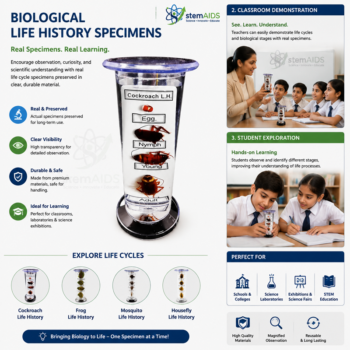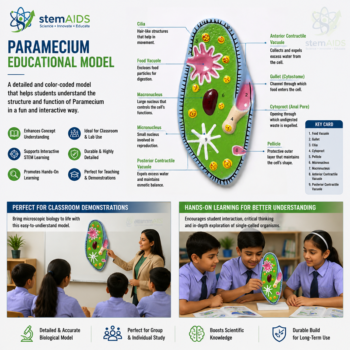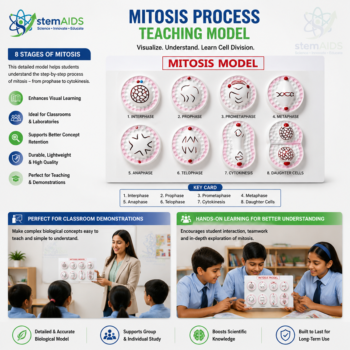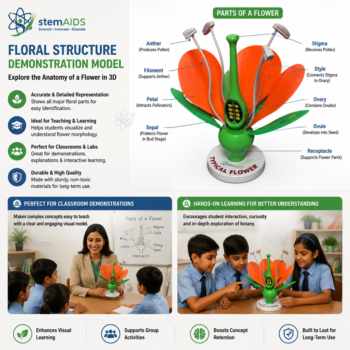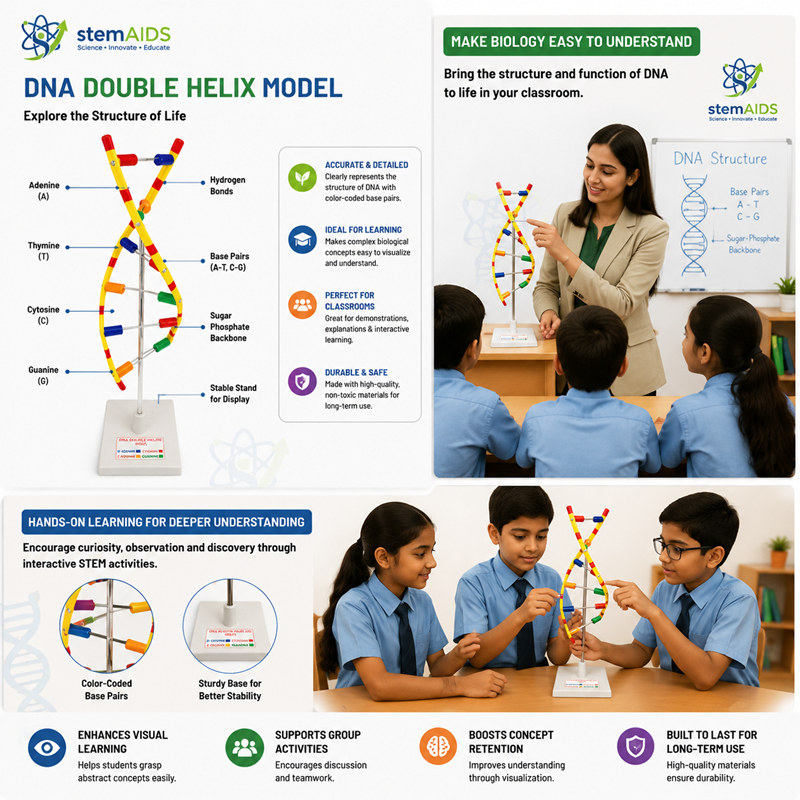
Quick Answer: The DNA Double Helix Model is a three-dimensional teaching model used in biology laboratories to show the double-helix structure of DNA — the sugar-phosphate backbone, base pairing and helical twist — so students can visualise molecular genetics concepts that are difficult to grasp from diagrams alone. LabEquip supplies it as part of the Biology Models range, alongside the Floral Structure Demonstration Model for plant biology and the Mitosis and Meiosis models used for cell-division teaching.
Product Description
DNA structure is a foundational topic in genetics and molecular biology teaching, and a physical, three-dimensional model helps students grasp a structure that is difficult to visualise from a flat textbook diagram alone. This DNA Double Helix Model from LabEquip is built to represent the double-helix arrangement, the sugar-phosphate backbone and the base-pairing rungs that connect the two strands.
Teachers commonly use a model like this to walk students through complementary base pairing — adenine with thymine, guanine with cytosine — and to explain how this pairing underlies genetic replication and the storage of hereditary information. Being able to physically rotate and inspect the helix helps reinforce the three-dimensional nature of the molecule in a way flat diagrams cannot.
What This Model Helps Students Learn
- Identify the sugar-phosphate backbone and base pairs that make up a DNA molecule.
- Explain complementary base pairing (adenine-thymine, guanine-cytosine) and its role in genetic replication.
- Visualise the helical twist of the DNA double helix in three dimensions.
- Connect DNA structure to heredity, genetics and molecular-biology topics in the syllabus.
- Describe how DNA structure supports replication and the storage of genetic information.
- Compare a physical DNA model to textbook diagrams of molecular structure.
Specifications
| Attribute | Detail |
|---|---|
| Product name | DNA Double Helix Model |
| Category | Biology Models – Biology Laboratory Products |
| Product type | Three-dimensional genetics/molecular-biology teaching model |
| Typical use | Teaching DNA structure, base pairing and molecular genetics |
| Recommended for | Schools, colleges, biology laboratories, genetics educators |
Safety Note
This is a static, non-electrical, non-chemical teaching model intended for normal classroom handling. Handle any detachable or assembled parts carefully to avoid breakage, and keep small detachable components away from very young children because of choking-hazard risk. Recommended for use under teacher supervision during classroom demonstrations.
Care & Maintenance
- Keep the model clean and free of dust, wiping with a dry or lightly damp cloth as suited to the material.
- Store away from direct sunlight and excess heat to prevent warping, fading or discolouration.
- Handle any detachable strands or base-pair pieces gently and store them together so none go missing.
- Check joints and connecting points periodically for looseness before each classroom session.
Why Choose LabEquip
LabEquip supplies biology teaching models, molecular-genetics teaching aids and laboratory equipment to schools, colleges and technical training institutes across India. Alongside this DNA Double Helix Model, our Biology Models range includes the Biological Life History Specimens set and Floral Structure Demonstration Model, plus the Mitosis Process Teaching Model and Meiosis Visualization Model for cell-division teaching. Browse our full Biology Models category for the complete range.
Related Products
- DNA Structure Model, Plastic Assembly Kit, Deluxe: A plastic assembly kit from which senior students build a double helix themselves and model mutations.
- DNA Manipulatives Kit: Hands-on pieces for building and pulling apart DNA strands to practise base pairing and replication.
- Molecular Model of DNA PCR Principle: A model of DNA in the polymerase chain reaction, showing strand separation, primer annealing and extension.
- Mitosis Process Teaching Model: A model of mitotic cell division, the next step after replication, when copied DNA is shared between two cells.
Frequently Asked Questions
What does a DNA double helix model show students?
The DNA Double Helix Model shows two strands twisted round each other, each with a sugar-phosphate backbone on the outside, joined across the middle by paired bases like the rungs of a twisted ladder. Rotating the model lets students see that the structure is three-dimensional and that the pairs stack on top of each other along the helix.
Why does adenine always pair with thymine and guanine with cytosine?
Each pair joins a larger two-ring base, a purine, with a smaller one-ring base, a pyrimidine, so every rung has the same width and the helix stays even. The shapes also line up hydrogen bonds: adenine and thymine form two, guanine and cytosine form three. Any other pairing would not fit or bond properly.
How many base pairs make one full turn of the DNA helix?
In the common B form of DNA, one complete turn of the helix contains about 10 base pairs and is about 3.4 nanometres long, with the pairs about 0.34 nanometres apart. Students can count the rungs between two matching points on a backbone of a classroom model and compare the count with this textbook figure.
What does antiparallel mean in DNA structure?
The two strands of DNA run in opposite directions. Each strand has a 5′ end and a 3′ end, named after carbon atoms in the sugar, and where one strand runs 5′ to 3′ from top to bottom, its partner runs 5′ to 3′ from bottom to top. This matters because enzymes copy DNA in one direction only.
Who discovered the double helix structure of DNA?
James Watson and Francis Crick proposed the double helix model in 1953. Their model relied on X-ray diffraction images of DNA produced by Rosalind Franklin and Maurice Wilkins, and on Erwin Chargaff’s finding that DNA contains equal amounts of adenine and thymine and of guanine and cytosine.
How can a DNA model be used to explain DNA replication?
Point out that the bases are held together only by hydrogen bonds, so the two strands can be separated like a zip. Each separated strand then acts as a template, and new nucleotides pair with it by the A-T and G-C rules. The result is two double helices, each made of one old and one new strand, which is semi-conservative replication.
Last Updated: November 2026