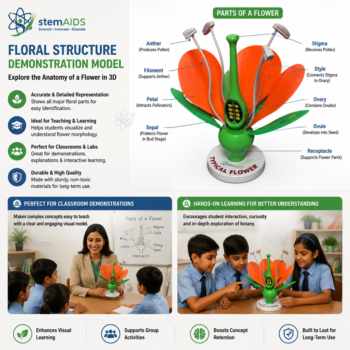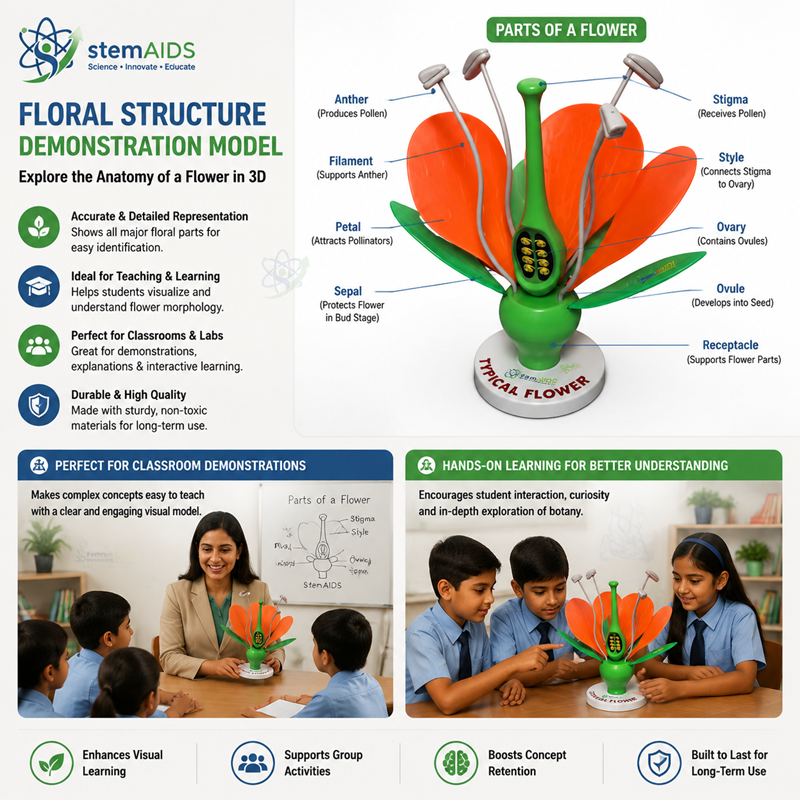
Quick Answer: The Floral Structure Demonstration Model is a three-dimensional botany teaching model of a flower, used to explain the parts of a flower and their roles in pollination, fertilisation and seed formation.
Parts of a Flower and What They Do
A flower is a reproductive shoot, and the floral model gives the class one large, steady example to work from instead of small specimens that wilt during the lesson. Lessons usually move from the outside in, following the four whorls of floral parts.
The outer whorl is the calyx, made of sepals, which protect the bud. Inside it is the corolla of petals, often coloured or scented to attract pollinators. Next comes the androecium, the male part, made of stamens, each with a filament carrying a pollen-producing anther. At the centre is the gynoecium, the female part: one or more carpels forming a pistil with a sticky stigma, a style and an ovary containing ovules.
With the parts named, the model supports the process lesson. Pollen reaches the stigma, a pollen tube grows down the style to an ovule, and fertilisation follows. Afterwards the ovule becomes a seed and the ovary ripens into a fruit.
Care & Handling
- Lift the floral model from its base or main body; thin floral parts are the most fragile.
- Remove dust from narrow spaces with a soft brush or a hair dryer on a cool setting.
- Keep it out of sunlight to protect its colours, and store it in a closed cabinet.
Applications
- Flower structure lessons before a real flower dissection
- Pollination lessons comparing insect-pollinated and wind-pollinated flowers
- Fertilisation and seed formation in plant reproduction units
- Labelling practice for practical examinations
Specifications
| Subject | Structure of a flower |
| Format | Three-dimensional botany teaching model |
| Topics | Floral parts, pollination, fertilisation, seed and fruit formation |
| Course fit | School biology and botany, first-year college botany |
Why Choose LabEquip
Botany teachers often follow a lesson on the Floral Structure Demonstration Model with the Meiosis Visualization Model, which explains how pollen and egg cells are formed. School orders can be sent through the contact page; both are in Biology Models for the plant reproduction unit.
Related Products
- Model, L. S. Flower: A longitudinal section model that opens up the ovary, ovules and pollen tube path in a single flower.
- Botanical Flower Structure Chart: A labelled wall chart of flower structure that supports terms such as hypogynous and epigynous.
- Model, Flower on Stand: A flower model mounted on a stand for all-round viewing of sepals, petals, stamens and pistil.
- Flower Cutter: A hand cutter for collecting fresh flowers and soft stems for the follow-up dissection.
Frequently Asked Questions
What are the four whorls of a flower and which ones are essential?
From outside in, a flower has the calyx of sepals, the corolla of petals, the androecium of stamens and the gynoecium of carpels. The stamens and carpels are the essential whorls because they produce pollen and ovules; sepals and petals are accessory whorls that protect the bud and attract pollinators.
Which part of a flower becomes the fruit and which becomes the seed?
After fertilisation the ovary wall develops into the fruit, and each fertilised ovule inside it develops into a seed. The sepals, petals and stamens usually wither and fall. On the Floral Structure Demonstration Model, tracing the ovary and its ovules shows students where the pea pod or tomato they eat actually comes from.
What is the difference between pollination and fertilisation in flowers?
Pollination is the transfer of pollen from an anther to a stigma, carried by insects, wind, water or birds. Fertilisation comes afterwards: a pollen tube grows down the style to an ovule, and a male gamete fuses with the egg cell. Pollination can happen without fertilisation following, but fertilisation cannot happen without pollination.
What is double fertilisation in flowering plants?
In flowering plants the pollen tube delivers two male gametes. One fuses with the egg cell to form the zygote, which grows into the embryo; the other fuses with the two polar nuclei to form the endosperm, a food store for the developing seed. Two fusions in one ovule is what the term describes.
Which real flowers are good to dissect after studying a flower model?
Large, simple flowers with clearly separate parts work well, such as hibiscus, lily, petunia or mustard. Students lay the parts out whorl by whorl on paper, then cut the ovary across with a blade to see the ovules. Comparing their dissection with the model helps them recognise the same parts in a real, smaller flower.
How do insect-pollinated flowers differ from wind-pollinated flowers?
Insect-pollinated flowers usually have large, coloured or scented petals, nectar, sticky or spiny pollen and stamens and stigma kept inside the flower. Wind-pollinated flowers, as in grasses and maize, have small dull petals or none, anthers and feathery stigmas hanging outside the flower, and large amounts of light, smooth pollen.
Last Updated: November 2026