


Sale
In Stock
Hookworm Life History Chart
Original price was: ₹340.00.₹160.00Current price is: ₹160.00.
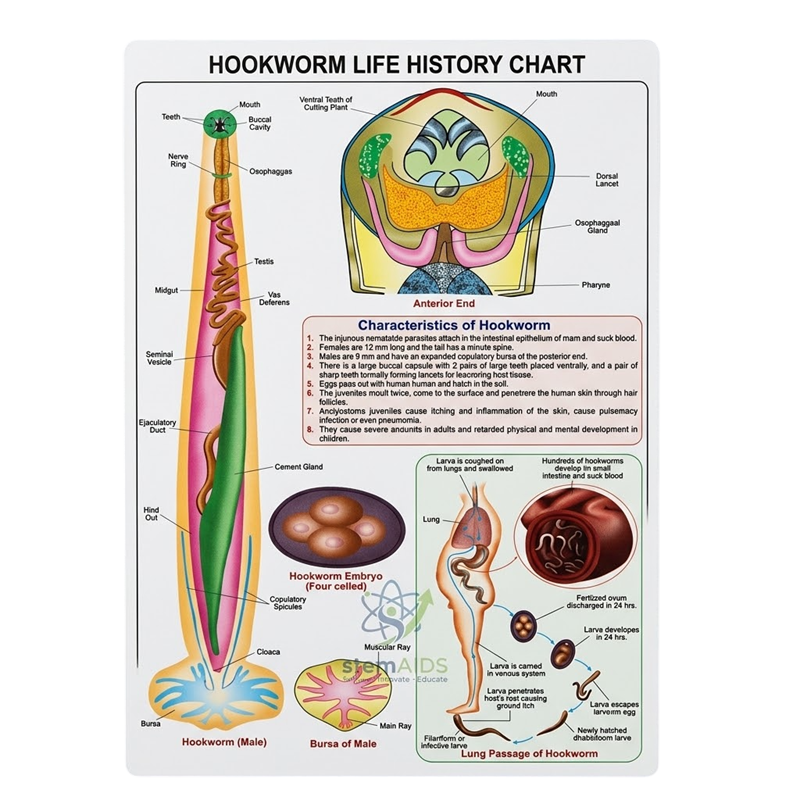
The Hookworm Life History Chart is a visual biology teaching aid used to explain hookworm development, transmission and movement through the human host. It supports zoology, parasitology and health-science lessons by helping students trace the sequence from eggs and soil-dwelling larvae to infective larvae and adult intestinal worms.
Product Description
The STEMAids Hookworm Life History Chart is designed for visual instruction on the life cycle of intestinal hookworms. In the commonly taught human hookworm pathway, eggs leave the host in feces, larvae develop in suitable soil, and an infective larval stage can enter a human host before eventually developing into adult worms in the small intestine.
The exact hookworm species illustrated, developmental stages labeled, transmission routes, anatomical migration pathway, chart dimensions, material, lamination, language and mounting format are . Species-specific features should only be added after checking the final STEMAids chart artwork.
Key Features
- Hookworm life-cycle visualization: Supports study of parasite development from eggs through larval and adult stages.
- Transmission-pathway learning: Helps explain how infective hookworm larvae reach a human host according to the species represented.
- Host migration concept: Supports teaching of larval migration through body systems where this pathway is illustrated.
- Parasitology teaching aid: Suitable for biology, zoology and introductory health-science lessons.
- Environmental stage learning: Connects soil conditions with the free-living larval stages of intestinal hookworms.
- Visual classroom reference: Useful for teacher explanation, sequencing activities and diagram-based revision.
- Specification transparency: Species, chart dimensions, material, exact labels and grade level remain .
Technical Specifications
|
Specification |
Detail |
|
Product Name |
Hookworm Life History Chart |
|
Brand |
STEMAids |
|
Category |
Educational Charts – Zoology & Parasitology |
|
Subject Area |
Biology / Zoology / Parasitology |
|
Learning Topic |
Hookworm life history, transmission and host migration |
What’s Included in the Kit
- Hookworm Life History Chart
- Hanging rail / eyelets
- Teacher guide or activity sheet
- Protective packaging
Applications / Uses
- Teaching the life history of human intestinal hookworms.
- Explaining development from egg to larval and adult stages.
- Introducing infective larval stages and parasite transmission.
- Tracing larval migration through the human host where illustrated.
- Connecting sanitation, contaminated soil and parasite transmission.
- Comparing hookworm development with other helminth life cycles.
- Supporting parasitology revision, sequencing and diagram-labeling exercises.
For related resources, browse STEMAids Educational Charts and STEMAids Biology Models. Additional institutional science teaching resources are available through the STEMAids catalogue.
How to Use the Hookworm Life History Chart
- Display the chart where students can clearly view the developmental stages and arrows.
- Identify the hookworm species named on the verified artwork.
- Begin with eggs passed from the infected host where shown.
- Trace development through the free-living larval stages in the environment.
- Identify the infective larval stage and the route by which it enters the host.
- Follow the illustrated migration pathway through the body, if included on the chart.
- Complete the sequence by identifying the adult intestinal stage and return of eggs to the environment.
Teaching note: Do not apply one transmission route universally to every hookworm species. Skin penetration is the classic route for major human intestinal hookworms, while some species can also be acquired through other routes. Follow the species and pathway specifically identified on the verified chart.
Care & Maintenance
- Keep the chart dry unless its material is specifically verified as water-resistant.
- Avoid folding, creasing or scratching the printed surface.
- Use only cleaning methods compatible with the confirmed chart finish.
- Store flat or hang securely in a clean, dry biology classroom or laboratory.
Why Choose STEMAids
STEMAids is the STEM education brand of Eduscope Smart Learning Solutions Private Limited, a New Delhi-based manufacturer of Teaching Learning Material, educational charts, laboratory products and science models. Its current Educational Charts range covers zoology and other curriculum subjects, while its Biology Models range provides complementary life-science teaching resources. STEMAids publishes ISO 9001:2015 and ISO 14001:2015 company-level management-system credentials and maintains an active Importer-Exporter Code. These corporate credentials do not constitute product-specific certification for this educational chart.
Frequently Asked Questions
What is a Hookworm Life History Chart?
A Hookworm Life History Chart is a visual teaching aid used to explain hookworm developmental stages, environmental larval stages, transmission and development within the host.
What are the main stages in a hookworm life cycle?
The commonly taught intestinal hookworm cycle includes eggs, rhabditiform larvae, infective filariform larvae and adult worms. The exact terminology printed on the STEMAids chart is .
How do hookworms commonly enter the human body?
For major human intestinal hookworms, infective larvae commonly penetrate exposed skin after contact with contaminated soil. Transmission can vary by species.
Where do adult human hookworms live?
Adult intestinal hookworms live in the small intestine, where they attach to the intestinal wall.
Which hookworm species is shown on this chart?
The exact species is . Names such as Ancylostoma duodenale or Necator americanus should only be added after the final chart artwork has been verified.
Is the Hookworm Life History Chart laminated?
Lamination is . STEMAids states that finish and lamination vary across its educational chart range, so the specification should be confirmed for this exact product.
Bestsellers


Sale



