

Sale
In Stock
Water Cycle Model
Original price was: ₹1,150.00.₹565.00Current price is: ₹565.00.
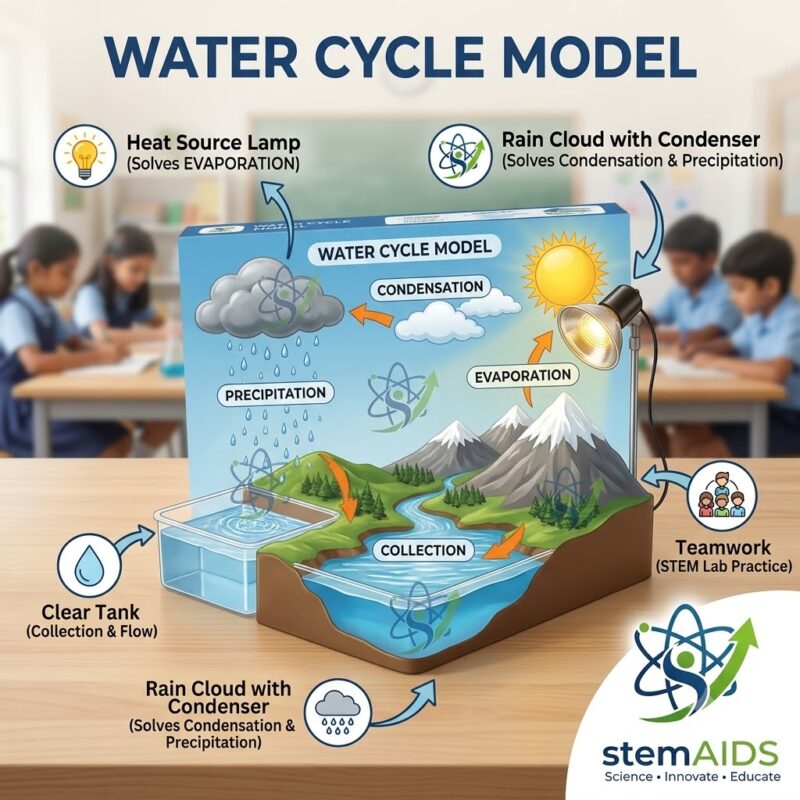
Quick Answer: The Water Cycle Model is a classroom display that shows how water moves between the land, the oceans and the air. The listing image shows a landscape of mountains and a river, a clear water tank and a lamp representing the Sun, labelled for evaporation, condensation, precipitation and collection.
What the Water Cycle Model Shows
The water cycle model sets the stages of the hydrological cycle out as a single landscape so that pupils can follow one drop of water around the loop. The Sun, represented by a lamp in the listing image, heats the surface of a lake or sea and water evaporates. The vapour rises, cools and condenses into tiny droplets that form clouds. When droplets grow heavy enough they fall as precipitation, as rain, snow or hail, and the water returns to rivers, lakes and ground water before flowing back to the sea.
Teachers use the model to put the key words in the right order and to show that the cycle has no start or end. It also opens up the parts that textbooks often skip: runoff over the surface, infiltration into soil, water taken up by plants and released by transpiration, and snow stored on mountains and released in spring. A labelled model gives pupils something to point at while they explain each step in their own words.
The image suggests a working set-up, with a clear tank for collection and a lamp for heating, but whether the unit produces visible condensation and ‘rain’ or is a static display should be confirmed when ordering. A static model still works well alongside a teacher-led demonstration of condensation on a cold surface.
Classroom Uses
- Introducing the stages of the water cycle and the vocabulary for each
- Discussing how temperature drives evaporation and condensation
- Linking rainfall to rivers, ground water and the local water supply
- Supporting lessons on climate, weather and water conservation
Care & Handling
- Keep electrical parts, including any lamp, away from the water section, and unplug before refilling or cleaning.
- If the model holds water, empty and dry it after the lesson to prevent algae and stains.
- Dust the painted landscape with a soft dry brush; solvents can lift paint and labels.
- Store flat, away from direct sunlight, which fades printed labels.
Specifications
| Item | Water cycle teaching model |
| Layout | Landscape with mountains, river and water body, per listing image |
| Labelled stages | Evaporation, condensation, precipitation, collection |
| Heat source shown | Lamp representing the Sun |
| Level | Primary and lower secondary geography and science |
| Working or static version | Confirm at enquiry |
Why Choose LabEquip
Primary teachers and geography departments usually want a water cycle display that can stay out on a bench for a whole topic. LabEquip lists this model in its STEM kits range, and further display pieces are in the educational science models collection. Tell us how many classrooms you are equipping through the contact page.
Frequently Asked Questions
What are the main stages shown on the model?
Evaporation, condensation, precipitation and collection are the four stages most models label. Fuller versions add transpiration from plants, infiltration into soil, surface runoff and ground water flow. Together they describe how the same water is used again and again.
What makes water evaporate in the real water cycle?
Energy from the Sun warms oceans, lakes and damp ground, and some water molecules gain enough energy to escape as vapour. Wind carries the moist air away and speeds up evaporation. On the model, the lamp stands in for the Sun.
Why do clouds form when water vapour rises?
Air cools as it rises because the pressure around it falls. Cooler air holds less water vapour, so some of it condenses onto dust and salt particles, forming the droplets that make up clouds. The same idea explains the mist on a cold window.
Is the model suitable for primary pupils?
Yes. Younger pupils name and sequence the stages, while older ones explain the energy changes and link the cycle to weather, rivers and water supply. The same model can be revisited at each level with deeper questions.
Can the model produce real rain?
Some water cycle models heat water under a cold surface so that droplets form and drip back down; others are painted displays. The listing image shows a lamp and a clear tank, so check at enquiry whether this version is a working or static model.
How can I show condensation alongside a static model?
Hold a cold metal tray or a glass of ice above steam from a kettle, operated by the teacher with pupils kept back from the steam. Droplets form on the cold surface and drip off, a small-scale version of clouds and rain. Pupils then find the same stages on the model.
Last Updated: September 2026
You must be logged in to post a review.
Bestsellers



Sale

Sale
Sale


Reviews
There are no reviews yet.