
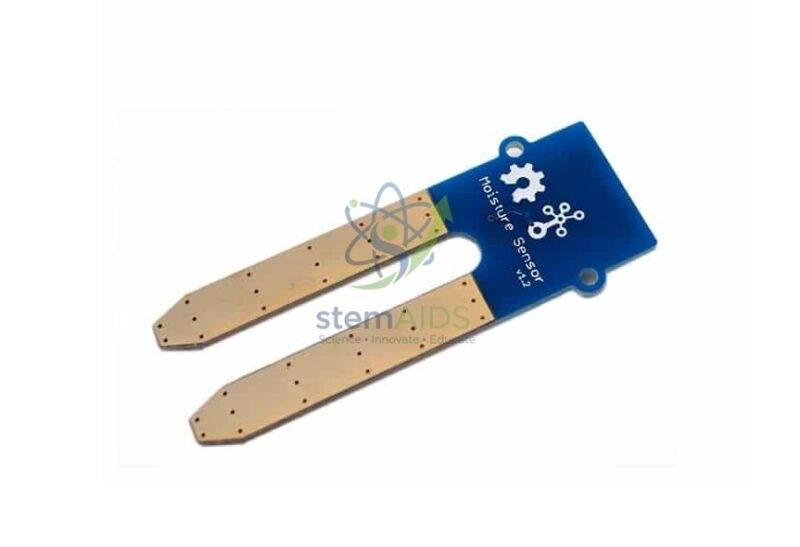
Quick Answer: The Grove Moisture Sensor is a soil moisture probe on a Grove board: two metal prongs pushed into soil give an analogue reading that rises as the soil gets wetter. Students use the Grove moisture sensor to build plant-watering alerts and to compare how different soils hold water.
How Wet Soil Changes the Reading
Dry soil conducts electricity poorly, while wet soil, with water and dissolved salts in the gaps between particles, conducts much better. The Grove Moisture Sensor passes a small current between its two prongs and outputs a voltage that depends on how easily the current flows, so the analogue reading climbs as the soil gets wetter.
Because the reading also depends on soil type, salt content and how deep the prongs go, each project starts with calibration. Students take a reading in dry soil, another in freshly watered soil, and map the range between them to a scale such as 0 to 100. That process shows clearly that a sensor gives a raw number and that meaning comes from comparison with known conditions.
Metal probes corrode when current flows through wet soil for long periods. Powering the sensor only at the moment of each reading, or taking readings minutes apart, makes the prongs last much longer and doubles as a practical lesson in electrolysis.
Care & Handling
- Insert only the prongs of the Grove Moisture Sensor into soil; keep the electronics and connector above the surface and dry.
- Wipe the prongs clean after use and let them dry before storage.
- Reduce corrosion by powering the probe only when a reading is taken rather than continuously.
- Keep the probe out of strong salt solutions and acids, which attack the prongs quickly.
Applications
- Plant-care alerts that light an LED or sound a buzzer when the soil dries out
- Comparing the water retention of sand, loam and clay in geography or biology practicals
- Logging the drying curve of potted soil over several days
- School-garden monitoring alongside air readings from the Grove Temperature and Humidity Sensor
Specifications
| Sensor | Resistive soil moisture probe on a Grove board |
| Output | Analogue voltage rising with moisture |
| Connection | Grove analogue port |
| Reading type | Relative moisture; calibrate for each soil |
| Supply voltage and probe length | Confirm at enquiry |
Why Choose LabEquip
Biology and environmental-science teachers often choose soil-moisture projects because students can link a reading directly to a living plant. LabEquip lists this probe in its Stem Kits range; request class quantities through the contact page.
Frequently Asked Questions
What does the moisture reading actually measure?
It measures how easily current flows between the two prongs. Wetter soil conducts better, so the reading rises. It is a relative value that depends on soil type and salt content, so calibrate it for the soil you are using.
How do I calibrate the sensor?
Record the reading in dry soil and again in soil watered until it drains. Treat those as the ends of your scale, map readings between them to a percentage, and repeat whenever you change the soil type.
Why do the prongs corrode?
Current flowing through moist soil causes electrolysis at the metal surfaces. Powering the sensor only while taking a reading, rather than all the time, slows the corrosion considerably.
Can the sensor stay in a plant pot permanently?
It can for the length of a project if the electronics stay dry and the probe is powered intermittently. For long-term use, inspect the prongs regularly and replace the sensor when corrosion starts to change the readings.
Can it measure the moisture of materials other than soil?
It can compare wetness in similar materials such as compost or sand. Readings from different materials are not directly comparable, because each conducts differently even at the same water content.
Which port should it use?
An analogue port, since the reading has to vary smoothly between dry and wet. In a digital port the sensor could only report two states.
Last Updated: September 2026






Reviews
There are no reviews yet.