





















Sale
In Stock
Motion Inertia Apparatus
Original price was: ₹900.00.₹440.00Current price is: ₹440.00.
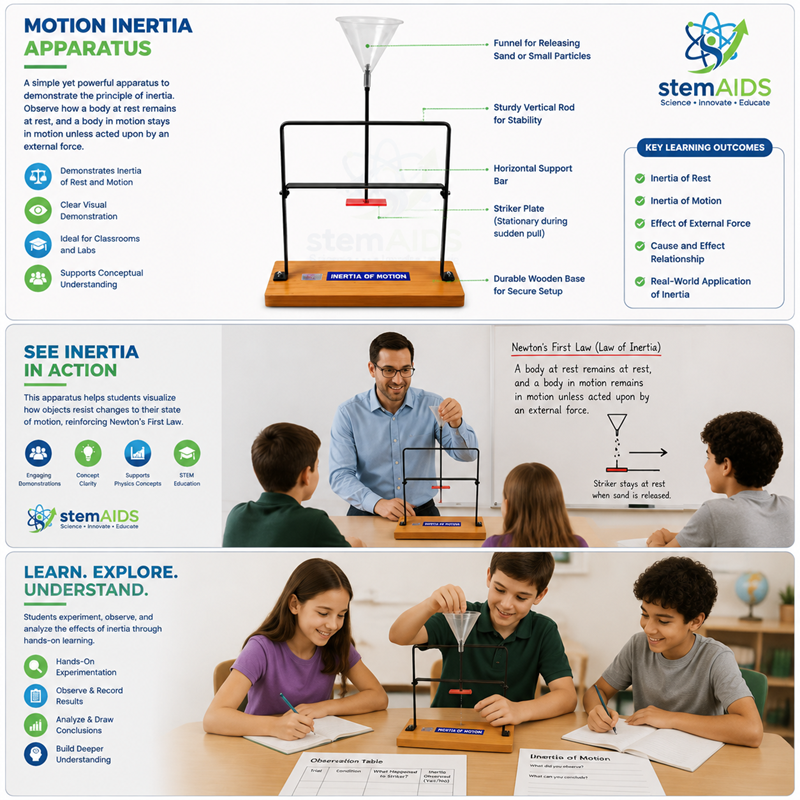
Quick Answer: The Motion Inertia Apparatus is a teaching stand for demonstrating inertia and Newton’s first law of motion. The listing image shows a vertical rod on a wooden base carrying a horizontal support bar, a flat striker plate and a funnel at the top; when a support is removed suddenly, the object resting on it stays put instead of moving with it.
Inertia of Rest in Action
Inertia is the tendency of every object to keep doing what it is already doing: to stay at rest if it is at rest, or to keep moving at a steady velocity if it is moving. Newton’s first law says this continues until a resultant force acts. The motion inertia apparatus makes the idea visible by applying a very short, sharp pull or strike, so that the force on the resting object lasts too briefly to get it moving.
The classroom version most pupils know is a coin on a card over a beaker: flick the card away and the coin drops straight into the beaker. The listing image for this inertia apparatus shows a stand-mounted equivalent, with a vertical rod, a horizontal bar, a striker plate and a funnel above, labelled to show the plate staying in place during a sudden pull.
A stand version gives more repeatable results than a flick of the finger, so the class can compare a slow pull, which drags the object along by friction, with a sharp one, which leaves it behind. Exactly how the parts are operated, and what is supplied with the stand, should be confirmed when ordering.
Applications
- Introducing Newton’s first law in middle school
- Comparing slow and sudden removal of a support
- Explaining seat belts, headrests and why passengers lurch when a bus brakes
- Connecting inertia with mass: heavier objects resist changes more strongly
Specifications
| Apparatus type | Inertia of rest demonstration stand |
| Frame | Vertical rod on a wooden base with a horizontal bar, as pictured |
| Parts shown in image | Striker plate and top-mounted funnel |
| Principle | Newton’s first law of motion |
| Power | None; operated by hand |
| Operating method and accessories | Confirm at enquiry |
Care & Handling
- Stand the apparatus on a firm, level bench so the base does not shift during a strike.
- Clear loose objects from the area in front of the striker, which moves quickly.
- Collect any sand or small particles after use so they do not get into the moving parts.
- Store the stand upright and dry to protect the wooden base.
Why Choose LabEquip
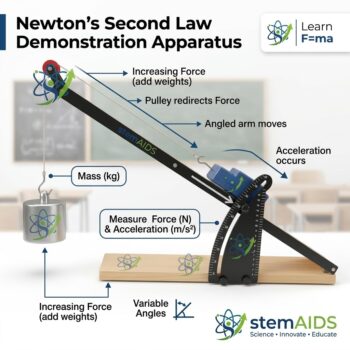
Science teachers buy this stand for the opening lesson on Newton’s laws, because inertia is easy to state but hard to believe until it is seen. LabEquip provides it in the STEM kits range, and the Newton’s Second Law Demonstration Apparatus follows on when the class moves from zero resultant force to a steady push. Order through our contact page.
Frequently Asked Questions
What is inertia?
Inertia is the resistance of any object to a change in its state of motion. An object at rest stays at rest, and a moving object keeps moving in a straight line at a steady speed, unless a resultant force acts on it. The more mass an object has, the greater its inertia.
Why does the object stay behind when its support is pulled away quickly?
Friction between the support and the object is the only horizontal force on the object. In a sudden pull that force acts for such a short time that it gives the object almost no velocity, so it stays roughly in place and then falls straight down.
What happens if the support is pulled slowly?
A slow pull lets friction act for a long time, so the object is dragged along with the support. Comparing slow and sudden pulls shows that the same friction force can produce very different results depending on how long it acts.
Does a heavier object show the effect better?
Usually, yes. A heavier object has more inertia, so the brief friction force changes its motion even less. A very light object may be flicked off with the support, which is itself a useful point for discussion.
What everyday examples show inertia?
Passengers lurch forward when a bus brakes suddenly, dust leaves a carpet when it is beaten, and a tablecloth can be whipped from under dishes. Seat belts and headrests exist because the body keeps moving when a vehicle stops.
How is inertia different from momentum?
Inertia is a property that depends only on mass. Momentum is mass multiplied by velocity, so it depends on how fast the object is moving too. A parked truck has large inertia but zero momentum.
Last Updated: September 2026
You must be logged in to post a review.
Bestsellers


Sale

Sale

Sale


Reviews
There are no reviews yet.