
















Sale
In Stock
Formation of Chlorine Ion Model
Original price was: $9.59.$4.68Current price is: $4.68.
Quick Answer: The Formation of Chlorine Ion Model is a chemistry teaching display showing a chlorine atom, with 17 electrons arranged 2,8,7, gaining one electron to become a negatively charged chloride ion with the arrangement 2,8,8. It explains how non-metals form negative ions and prepares students for ionic bonding in sodium chloride.
From Chlorine Atom to Chloride Ion
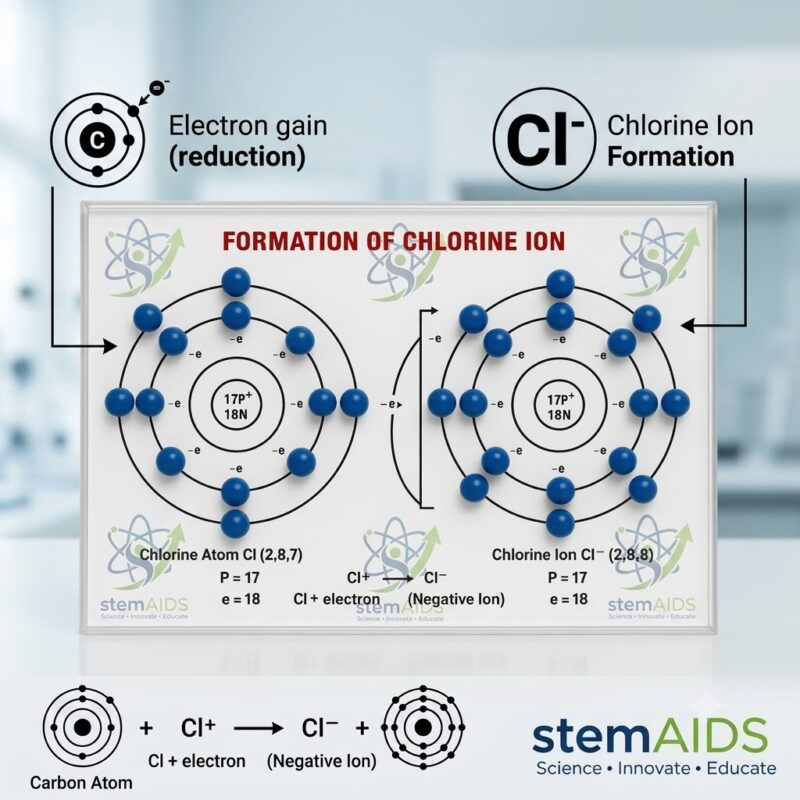
The listing image of the formation of chlorine ion model shows two shell diagrams side by side: the neutral atom, with 17 protons and seven electrons in its third shell, and the ion after one extra electron has joined that shell to make eight. Because the nucleus is unchanged, 17 protons now face 18 electrons, and the particle carries a single negative charge.
Chlorine sits in Group 17, the halogens, where every element is one electron short of a full outer shell. Gaining that electron releases energy, which is why chlorine reacts so readily with metals. The new outer arrangement matches argon, the next noble gas. The model is a good place to introduce the naming rule: the atom is chlorine, but the ion is called chloride, just as oxygen forms oxide and sulfur forms sulfide.
Gaining an electron is reduction, as the memory aid OIL RIG (oxidation is loss, reduction is gain) reminds students. The chloride ion is also larger than the chlorine atom, because the extra electron increases repulsion in the outer shell while the nuclear charge stays the same. These points link neatly to the sodium ion, where the opposite change takes place.
Specifications
| Item | Ion formation model for chlorine |
| Chlorine atom | 17 protons, 17 electrons, arrangement 2,8,7 |
| Chloride ion | 17 protons, 18 electrons, arrangement 2,8,8, charge 1− |
| Change shown | Gain of one electron (reduction) |
| Format | Side-by-side shell diagrams with bead electrons, as pictured |
| Size and mounting | Confirm at enquiry |
Applications
- Introducing negative ions and the halogen group
- Teaching the naming of ions, from chlorine to chloride
- Pairing with the sodium ion model to build up the formation of sodium chloride
- Revising electron arrangements for the first 20 elements
Care & Handling
- Keep the model out of direct sunlight and damp so the printed labels stay clear.
- Do not pull on the electron beads; wipe gently with a soft cloth.
- Store it beside the matching sodium ion model if both are used together, so the pair stays complete.
Why Choose LabEquip
Chemistry teachers usually buy this model together with the Formation of Sodium Ion Model, since the two halves make up the textbook sodium chloride example. LabEquip lists both in the STEM kits range. Send your order details through the contact page.
Frequently Asked Questions
Why does chlorine gain an electron rather than lose seven?
Gaining one electron completes the outer shell with eight electrons. Losing seven would take a very large amount of energy, so gaining one is far more favourable.
Why is it called a chloride ion and not a chlorine ion?
By convention, simple negative ions formed from non-metals take the ending -ide. The element and the gas are chlorine, while the negative ion is chloride, as in sodium chloride.
What is the charge on a chloride ion?
It carries a single negative charge, because it has 17 protons and 18 electrons, one more electron than protons.
Is gaining an electron oxidation or reduction?
Reduction. Oxidation is loss of electrons and reduction is gain, so chlorine is reduced when it forms chloride. In a reaction with sodium, the sodium is oxidised at the same time.
Which noble gas has the same electron arrangement as a chloride ion?
Argon, with the arrangement 2,8,8. Ions that share the electron arrangement of a noble gas are described as isoelectronic with it.
Is a chloride ion bigger or smaller than a chlorine atom?
Bigger. The extra electron increases repulsion between the electrons in the outer shell while the nuclear charge stays the same, so the electron cloud spreads out a little.
Last Updated: September 2026
You must be logged in to post a review.
Bestsellers




Sale

Sale

Sale

Sale


Reviews
There are no reviews yet.