


Sale
In Stock
Formation of Sodium Ion Model
Original price was: ₹850.00.₹415.00Current price is: ₹415.00.
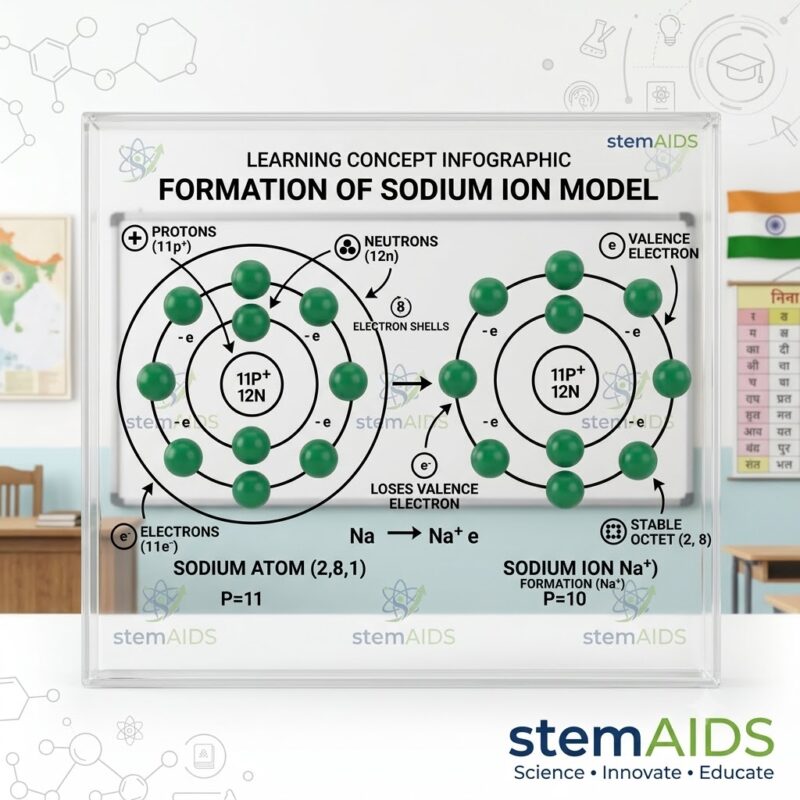
The Formation of Sodium Ion Model is a chemistry teaching model used for explaining how a sodium atom loses one electron to form a positively charged sodium ion. It helps students, chemistry teachers and laboratory instructors visualise valence electrons, electronic configuration, ion formation and charge development through one classroom display.
Product Description
The STEMAids Formation of Sodium Ion Model provides a visual representation of the change from a neutral sodium atom to a sodium ion. A neutral sodium atom contains 11 protons and 11 electrons, with one electron in its outer shell in the simplified shell model.
When sodium loses its outer electron, it retains 11 protons but has only 10 electrons. The resulting excess positive charge produces a sodium ion with a net charge of positive one, represented as Na⁺. The exact shell layout, electron-transfer mechanism, colour coding and construction method must be confirmed against the current STEMAids specification.
Key Features
- Demonstrates electron loss: Shows the removal of sodium’s single outer-shell electron.
- Explains positive-ion formation: Clarifies why losing one electron produces an Na⁺ ion.
- Shows stable shell configuration: Illustrates the change from the simplified arrangement 2,8,1 to 2,8.
- Distinguishes atoms from ions: Helps learners compare electrically neutral sodium with positively charged sodium ions.
- Supports electronic-configuration lessons: Connects shell diagrams, valence electrons and ion formation.
- Introduces ionic bonding: Provides a foundation for explaining electron transfer from metals to non-metals.
- Suitable for group instruction: Supports classroom demonstrations, chemistry revision and science exhibitions.
Technical Specifications
|
Specification |
Detail |
|
Product name |
Formation of Sodium Ion Model |
|
Brand |
STEMAids |
|
Product category |
Ion-formation model / chemistry teaching model |
|
Display capacity |
One sodium-atom-to-sodium-ion representation |
|
Represented element |
Sodium, atomic number 11 |
|
Represented ion |
Sodium ion, Na⁺ |
|
Basic shell configuration |
Sodium atom: 2,8,1; sodium ion: 2,8 |
|
Intended users |
Secondary-school students, chemistry teachers and laboratory instructors |
|
Standards or certifications |
No product-specific certification publicly verified |
What’s Included in the Kit
- Neutral sodium-atom representation
- Sodium-ion representation
- Electron, shell or orbital elements
- Removable outer electron
- Display base, labels or supporting frame
- Instructional diagram or activity guide
Applications and Uses
- Teaching the electronic configuration of sodium.
- Demonstrating the loss of one valence electron.
- Explaining the formation and charge of an Na⁺ ion.
- Comparing neutral atoms with positive and negative ions.
- Introducing school-level octet-rule explanations.
- Preparing learners for ionic bonding and formula-writing lessons.
- Supporting chemistry demonstrations, revision and exhibitions.
How to Use the Formation of Sodium Ion Model
- Place the model on a stable surface where all learners can see it.
- Identify the nucleus, electron shells and outer-shell electron shown.
- Count 11 electrons in the neutral sodium representation where individually displayed.
- Identify the single electron occupying the outermost shell.
- Remove or reposition that electron according to the model instructions.
- Count the remaining 10 electrons and compare them with the 11 protons.
- Explain that the particle now has one more proton than electrons.
- Label the resulting particle as a sodium ion with the symbol Na⁺.
Safety and handling: Do not force movable electron pieces or bend supporting components. Keep small detachable parts away from young children unless the model is specifically approved for their age group.
Care & Maintenance
- Remove dust with a soft, dry cloth or brush.
- Support the model from its base when moving it.
- Keep removable electrons and labels in a closed, marked container.
- Store the model away from excessive heat, moisture and direct sunlight.
Why Choose STEMAids
STEMAids develops educational models, experiment kits and laboratory resources for practical science instruction. Buyers can explore related educational science models, chemistry laboratory equipment, STEM learning kits and the complete scientific and educational product range. Buyers should request the current model photograph, electron arrangement, materials and packing list before procurement.
Frequently Asked Questions
What is a Formation of Sodium Ion Model used for?
It is used to show how a neutral sodium atom loses one electron and becomes a positively charged sodium ion.
How many electrons does a sodium atom have?
A neutral sodium atom has 11 electrons because sodium has atomic number 11.
How is a sodium ion formed?
A sodium ion forms when a sodium atom loses its single outer-shell electron, reducing its electron count from 11 to 10.
Why does a sodium ion have a positive charge?
The ion contains 11 protons but only 10 electrons, giving it a net charge of positive one.
What is the electronic configuration of Na⁺?
In the simplified shell model, Na⁺ has the configuration 2,8. Its spectroscopic electron configuration is 1s² 2s² 2p⁶.
Does the model include a movable electron?
The operating format is not publicly verified. Confirm whether the outer electron can be physically removed or whether the model uses fixed diagrams.
Explore more educational science models from STEMAids for atomic structure, ions and chemical bonding.
Recommended primary image ALT text: Formation of Sodium Ion Model showing a sodium atom losing one valence electron.
Recommended detail image ALT text: Sodium-ion teaching model displaying the stable 2,8 electron-shell arrangement.
Recommended application image ALT text: Chemistry teacher explaining Na+ ion formation with an atomic structure model.
You must be logged in to post a review.
Bestsellers


Sale
Sale

Sale


Reviews
There are no reviews yet.