
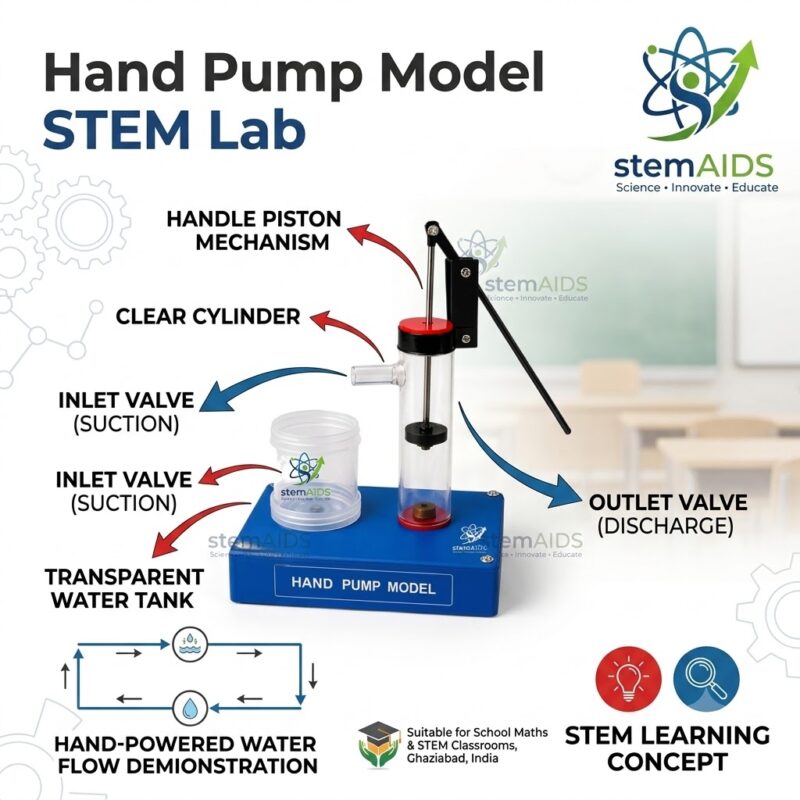
Quick Answer: The Hand Pump Model is a working school demonstration of a piston pump: a handle moves a piston inside a transparent cylinder, and one-way inlet and outlet valves let water move in one direction only. Students watch water drawn up on one stroke and pushed out on the next, learning how atmospheric pressure makes a hand pump work.
How the Piston and Valves Move Water
A hand pump relies on the air pressing on the water supply rather than on the piston pulling the water. On one stroke of this hand pump model the piston enlarges the space inside the cylinder, the pressure there falls, and atmospheric pressure acting on the water in the tank pushes water up through the inlet valve. On the other stroke the inlet valve closes, so the water has only one way to go and is driven out through the outlet valve.
The transparent cylinder is what makes the model useful in class. Pupils can see the water level rise behind the piston and watch the valves open and shut, so the idea of a one-way valve stops being abstract. The same principle appears in the valves of the heart, in bicycle pumps and in the village hand pumps that supply drinking water in many parts of India.
The model also sets up an important limit. Atmospheric pressure can hold up a water column only about ten metres high, so a pump that works by suction from the surface cannot raise water from deeper than that. Deep-well hand pumps solve this by placing the cylinder down in the well near the water, a point older students can explain with pressure calculations.
Specifications
| Item | Working model of a piston hand pump |
| Cylinder | Transparent, so piston and water movement are visible |
| Valves | One-way inlet (suction) and outlet (discharge) valves |
| Operation | Manual handle driving the piston |
| Water supply | Transparent tank, as shown in the listing image |
| Dimensions | Confirm at enquiry |
Care & Handling
- Use clean water only; sand or grit in the cylinder scores the walls and stops the valves from seating.
- Operate the handle with smooth, full strokes rather than jerks, which can loosen the joints.
- Drain the cylinder and tank after each session and leave them open to dry, so no mould or scale forms on the valves.
- If the model stops lifting water, check the valves for debris before assuming a fault.
Applications
- Teaching atmospheric pressure and suction in middle-school physics
- Showing the role of one-way valves, with links to heart valves in biology
- Explaining how village and borewell hand pumps deliver water
- Project work comparing lift pumps, force pumps and syringes
Why Choose LabEquip
Science teachers usually choose this hand pump model for lessons on air pressure, and rural schools find it a familiar starting point because pupils see full-size pumps every day. LabEquip lists it in the STEM kits range beside the Invisible Pipe Water Tap Model, which moves water with an electric pump instead. Use the contact page to ask about quantities.
Frequently Asked Questions
Why does the pump need two valves?
Without valves, the water drawn in on one stroke would simply flow back out the same way on the next. The inlet valve lets water enter the cylinder but not return to the tank, and the outlet valve lets it leave but not come back, so the flow goes in one direction.
Does the piston suck the water up?
Not in the strict sense. The piston lowers the pressure inside the cylinder, and the higher atmospheric pressure acting on the water surface in the tank pushes the water up. Suction is really a pressure difference.
How high can a suction pump lift water?
In theory about ten metres, because that is the height of water column the atmosphere can support at sea level. In practice leaks and friction reduce it, which is why deep wells need the pump cylinder placed down near the water.
Why does the pump sometimes need priming?
If the cylinder and valves are dry, air leaks past them and the pressure cannot fall far enough to draw water up. Pouring a little water into the cylinder first seals the gaps, and then the pump starts lifting normally.
What everyday devices work on the same principle?
Syringes, drinking straws, bicycle pumps with their check valves and the pumps used on wells all rely on pressure differences and one-way valves. The human heart also uses valves to keep blood moving in one direction.
Can coloured water be used in the model?
Yes. A drop of food colouring makes the water easier to follow through the transparent cylinder. Rinse the model with clean water afterwards so the dye does not stain the valves or the cylinder walls.
Last Updated: September 2026





Reviews
There are no reviews yet.