










In Stock
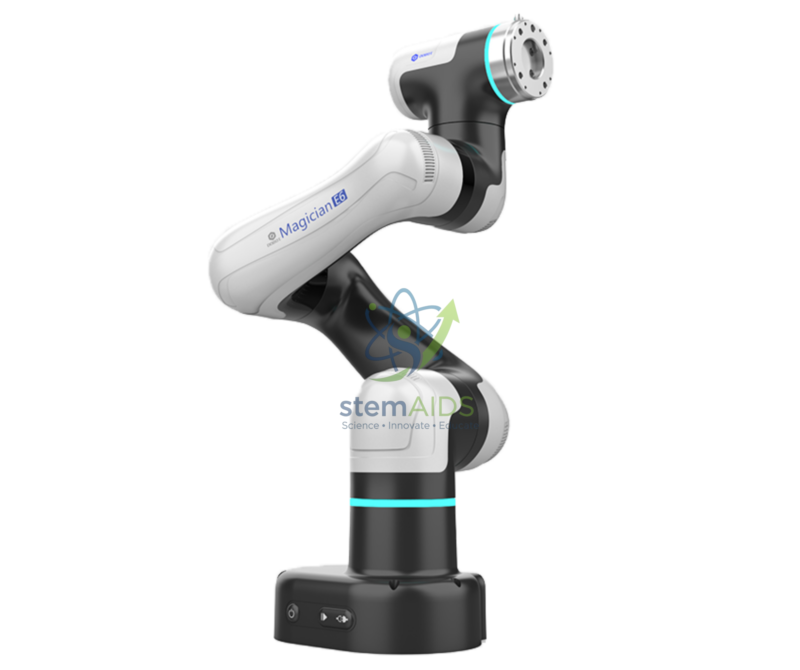
Dobot Magician E6
$636.85
Quick Answer: The Dobot Magician E6 is a compact six-axis collaborative robot arm (cobot) aimed at education and research, bridging desktop teaching arms and industrial robots. Colleges and research labs use the Dobot Magician E6 to teach kinematics, coordinate frames, end-tool programming and safe human-robot collaboration.
What Six Axes Make Possible
A robot needs three axes to reach a point in its workspace and three more to point its tool in any direction at that point. With six axes, the Magician E6 can approach a part from the side, tilt a tool to follow a sloping surface or keep a held object level while moving it, tasks that simpler desktop arms cannot manage. That makes it a practical way to teach the full kinematics covered in robotics and mechatronics courses.
Students work with joint moves, where each joint turns to a set angle, and linear moves, where the tool travels in a straight line between points. They learn to define a tool centre point for each end effector and a user frame for each workpiece, the same concepts used when programming industrial robots. As a collaborative robot, the E6 is intended to work near people, which opens discussions of risk assessment, reduced speeds and safeguarded zones.
End tools such as the electric gripper kit and the suction cup kit are listed separately. The payload, reach, controller and software supplied with the arm should be confirmed before ordering.
Specifications
| Type | Six-axis collaborative robot arm (cobot) |
| Brand and model | Dobot Magician E6 |
| Intended use | Education, training and research |
| Programming concepts | Joint and linear moves, tool centre point, user frames, I/O signals |
| End tools | Electric gripper, electromagnetic gripper and suction cup kits listed separately |
| Payload, reach and supplied software | Confirm at enquiry |
Applications
- Teaching forward and inverse kinematics with a real six-axis arm
- Pick-and-place and machine-tending simulations using gripper or suction end tools
- Programming practice that transfers to industrial robots: tool frames, waypoints, speeds and I/O
- Human-robot collaboration studies and risk-assessment exercises in automation courses
- Research prototypes in labs that need a small, programmable manipulator
Care & Handling
- Bolt or clamp the E6 base to a rigid bench before use; a six-axis arm moving quickly can shift an unsecured base.
- Carry out a risk assessment for each task, set conservative speeds for student work and keep the emergency stop within reach.
- Stay within the payload given in the manual, counting the weight of the end tool as well as the part.
- Keep the controller ventilated and dry, and power down before changing end tools or cables.
Why Choose LabEquip
Engineering colleges, polytechnics and university labs usually choose a cobot like the E6 when students have outgrown desktop teaching arms and need to practise concepts that transfer to industrial robots. LabEquip lists the arm in its Stem Kits range with its end tools; share your course and cell layout through the contact page before ordering.
Frequently Asked Questions
What makes the Magician E6 a collaborative robot?
A collaborative robot is designed to work close to people, typically with limited force and speed and the ability to stop when it meets resistance. Those features reduce risk but do not remove it, so every task still needs a risk assessment and supervision.
Why does the number of axes matter?
Three axes let the tool reach a position; three more let it take any orientation there. A six-axis arm can tilt, approach from the side or keep an object level, so students can learn the full kinematics used on industrial robots.
What is a tool centre point?
It is the point on the end tool that the robot controls, such as the tip of a gripper or the face of a suction cup. Defining it correctly for each tool keeps straight-line moves and rotations accurate.
Which end tools can be fitted?
LabEquip lists an electric gripper kit, an electromagnetic gripper kit and a suction cup kit for this arm. The choice depends on the parts: jaws for varied shapes, a magnet for steel parts and suction for flat, smooth surfaces.
Is the E6 suitable for school students?
It is aimed mainly at colleges, vocational institutes and research labs. Senior school robotics teams can use it with close supervision, but younger students usually start on a smaller desktop arm such as the Dobot Magician.
Can skills learned on the E6 transfer to industrial robots?
Yes, the concepts do. Joint and linear moves, tool and user frames, waypoints, I/O signals and safety planning are common to industrial arms, even though each manufacturer uses its own programming interface.
Last Updated: September 2026
You must be logged in to post a review.
Bestsellers
Sale
Sale
Sale
Sale


Reviews
There are no reviews yet.