











Sale
In Stock
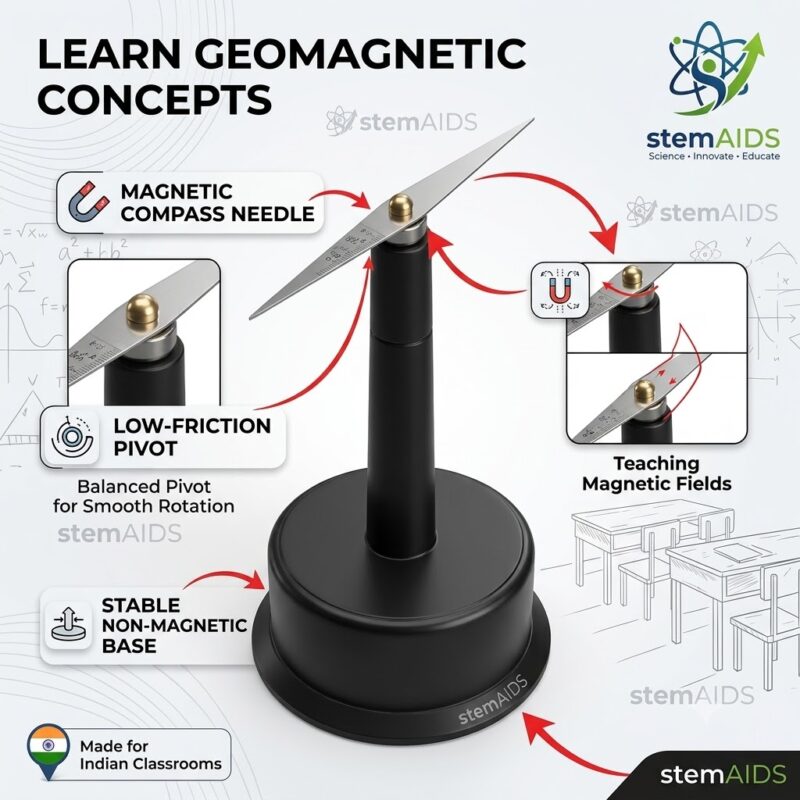
Compass Needle on Stand
Original price was: ₹50.00.₹15.00Current price is: ₹15.00.
Quick Answer: A compass needle on stand is a magnetised needle balanced on a pivot above a base so it can swing freely and settle along the magnetic field around it, north-seeking end pointing north. It is used in school physics to demonstrate Earth’s magnetism, magnetic poles and the field around a current-carrying wire.
A Large Needle for Class Demonstrations
Pocket compasses are too small for a teacher to show a whole class. A compass needle on stand is larger and raised, so everyone can see which way it points and how it swings when a magnet approaches. The needle rests on a sharp pivot with little friction, so even a weak magnetic force turns it, and the north-seeking end is usually marked by colour or shape.
The needle demonstrates the basic rules of magnetism. Like poles repel and unlike poles attract, so the north pole of a bar magnet pushes the needle’s north end away and pulls its south end round. It also shows that Earth behaves like a magnet and that iron and steel objects nearby distort the reading. Moving the stand round a bar magnet traces the direction of its field.
In Oersted’s experiment a straight wire carrying a current is placed just above the needle and parallel to it, running north to south. When the current flows the needle swings, showing that an electric current produces a magnetic field, and reversing the current reverses the swing. That observation is the starting point for electromagnets, motors and the right-hand grip rule.
Specifications
| Item | Pivoted magnetic needle mounted on a stand |
| Principle | The needle aligns with the local magnetic field |
| Pivot | Low-friction point support so the needle turns freely |
| Demonstrates | Earth’s field, magnetic poles and Oersted’s experiment |
| Level | Primary to secondary school physics |
| Needle length, base and pole marking | Confirm at enquiry |
Demonstrations
- Finding magnetic north in the classroom
- Showing attraction and repulsion between magnetic poles
- Oersted’s experiment: deflection of the needle by a current-carrying wire
- Tracing the direction of the field around a bar magnet
Care & Handling
- Store strong magnets well away from the needle; they can weaken or reverse its magnetism.
- Lift the needle off its pivot, or protect it, during transport so the point is not blunted.
- Keep the stand away from steel benches and toolboxes while taking readings.
- If the needle becomes sluggish, check the pivot for dust.
Why Choose LabEquip
Primary and secondary science teachers buy a stand-mounted needle for demonstrations the whole class can follow. LabEquip lists it in the STEM kits range, with more magnetism and electricity apparatus in the physics lab products range. Enquire about quantities through the contact page.
Frequently Asked Questions
Why does the compass needle point north?
Earth behaves like a giant magnet. The needle’s north-seeking pole is attracted towards the magnetic pole in the northern hemisphere, which is actually a south-type magnetic pole.
How is Oersted’s experiment done with this needle?
Lay a straight wire along the needle’s north-south direction, just above it. Pass a current briefly from a low-voltage supply and the needle swings; reverse the current and it swings the other way.
Why does the needle point the wrong way near my desk?
Iron and steel in desks, radiators and nearby equipment distort the local magnetic field. Move the stand to a clear area away from metal objects.
Can the needle lose its magnetism?
Yes, slowly over time or quickly if stored next to strong magnets, which can weaken or even reverse it. A weakened needle can be remagnetised by stroking it repeatedly in one direction with a strong magnet.
How is this different from a plotting compass?
A plotting compass is small and cased, made for drawing field lines on paper. A needle on a stand is larger and open, made for demonstrations the whole class can see.
Should the current in Oersted’s experiment flow for a long time?
No. Short pulses are enough to show the deflection. A continuous current heats the wire and drains the supply, so switch on only while observing and use the supply’s current limit.
Last Updated: September 2026
You must be logged in to post a review.
Bestsellers

Sale
Sale

Sale


Reviews
There are no reviews yet.