








In Stock
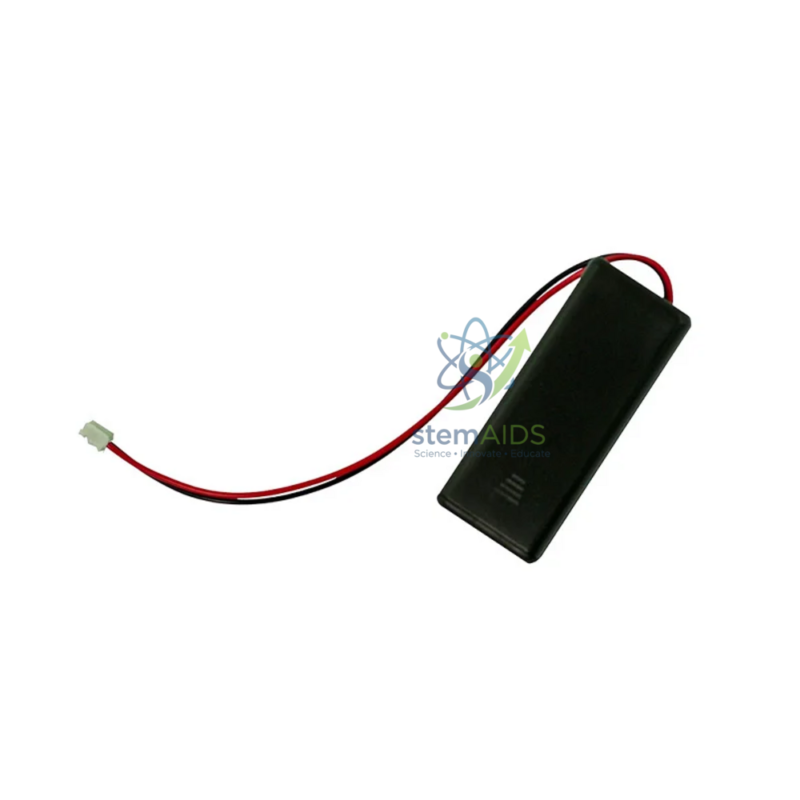
Case for 2 AA batteries with switch for micro:bit
$2.09
Quick Answer: The Case for 2 AA batteries with switch for micro:bit is a battery holder for two AA cells with an on-off switch and a lead that plugs into the BBC micro:bit’s battery socket. It powers the micro:bit when it is disconnected from the computer, so projects can be carried, worn or mounted in models.
Why a Switched Battery Case Helps
The micro:bit runs from about 3 V, which two 1.5 V cells in series provide. Basic battery holders have no switch, so students turn the board off by pulling the plug out of its socket, which strains the small connector over time. A case with its own switch lets the board be turned off in place, saving batteries between tests and protecting the socket.
AA cells hold more charge than the smaller AAA cells often supplied with micro:bit starter packs, so data loggers, robots and model-city displays run longer before a change. The trade-off is size and weight. Similar holders are sold for AAA cells, so confirm the cell size of this case before ordering.
The case suits any micro:bit with the standard battery socket, and it also powers projects built on shields, as long as the shield takes its power from the board. Motor projects usually need a separate supply. For a boxed starter set, see the micro:bit V2 beginner pack.
Specifications
| Item | Battery case with switch for the BBC micro:bit |
| Cells | 2 x AA, as stated in the listing title |
| Nominal voltage | About 3 V from two 1.5 V cells in series |
| Switch | On-off switch on the case |
| Connection | Lead to the micro:bit battery socket |
| Lead length and cover type | Confirm at enquiry |
Battery Care
- Insert cells with the polarity shown in the case, and never mix old and new cells or different types.
- Switch off and remove batteries when the project will be stored for more than a few weeks, to avoid leakage.
- Unplug the lead by gripping the plug, not the wires.
- Recycle used batteries through a proper collection point.
Applications
- Running programs away from the computer after download
- Wearable and portable projects such as step counters and badges
- Powering micro:bit boards inside models, robots and city displays
- Outdoor data logging of light or temperature
Why Choose LabEquip
Schools usually buy one battery case per micro:bit so every board can run projects away from the computer. LabEquip lists it in the STEM kits range alongside the Micro:bit v2 board. For class sets, use the contact page.
Frequently Asked Questions
Why use AA rather than AAA batteries?
AA cells are larger and store more energy, so a micro:bit project runs longer between battery changes. AAA holders are smaller and lighter, which suits wearables. For robots and data loggers, the longer run time of AA cells is usually more useful.
Can rechargeable batteries be used?
Rechargeable nickel-metal hydride AA cells give about 1.2 V each, so two provide about 2.4 V. The micro:bit generally runs on this, although the display may be dimmer and some add-ons may behave differently. Test your project with the cells you plan to use.
Can the battery case and USB be connected at the same time?
The micro:bit is designed to take power from either source, but for simplicity switch the battery case off while the board is connected to the computer. This saves the batteries and avoids confusion when testing.
Why is a switch useful?
Without a switch, the only way to turn the board off is to pull out the battery plug, which wears the small socket. The switch turns the project off in place and saves the batteries between tests.
Can the battery case power motors?
Two AA cells feeding the micro:bit cannot supply motors reliably, and motor current can reset the board. Use a motor driver board with its own battery supply for moving robots.
How long will the batteries last?
It depends on the project. A board showing a few LEDs uses little current, while one using the radio, speaker or several external modules drains the cells faster. Switching the case off between lessons makes a large difference.
Last Updated: September 2026
You must be logged in to post a review.
Bestsellers

Sale

Sale

Sale


Reviews
There are no reviews yet.