


Sale
In Stock
Bucky Ball Molecular Model
Original price was: ₹2,300.00.₹1,140.00Current price is: ₹1,140.00.
Quick Answer: The Bucky Ball Molecular Model is a ball-and-bond model of buckminsterfullerene, C60, the football-shaped molecule of 60 carbon atoms arranged in 12 pentagons and 20 hexagons. Chemistry teachers use it to show a third form of carbon beside diamond and graphite and to explore the geometry of a truncated icosahedron.
Inside the C60 Cage
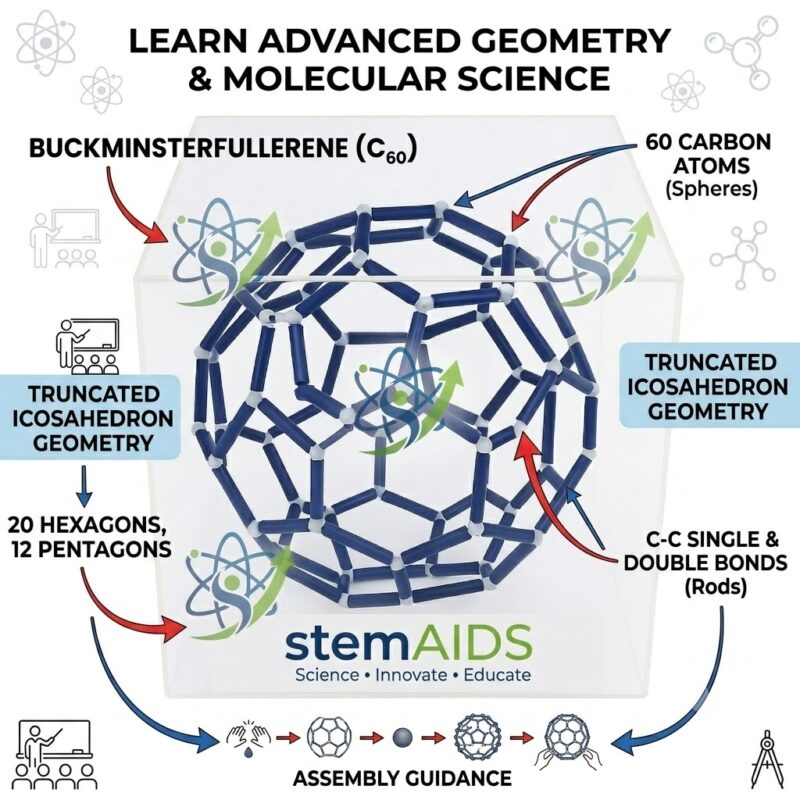
The listing image shows the bucky ball molecular model as a closed cage of dark spheres joined by rods, with assembly guidance, so the finished model is a complete ball of carbon atoms. In C60 every carbon atom bonds to three neighbours, and the atoms sit at the corners of 12 pentagons and 20 hexagons, the pattern found on a traditional football. No two pentagons share an edge; each is surrounded by hexagons, which spreads the strain of curving the sheet into a sphere.
The molecule was discovered in 1985 by Harold Kroto, Robert Curl and Richard Smalley, who shared the 1996 Nobel Prize in Chemistry for the work. They named it after the architect Buckminster Fuller, whose geodesic domes have a similar framework. The discovery showed that carbon forms a family of closed-cage molecules, the fullerenes, and it led on to carbon nanotubes, which are sheets of hexagons rolled into cylinders.
The model rewards careful counting. The 60 atoms are joined by 90 bonds, and checking Euler’s formula, vertices minus edges plus faces equals two (60 − 90 + 32), links chemistry with solid geometry. In the usual bonding picture the bonds shared by two hexagons are double bonds and those on pentagon edges are single, a pattern students can trace with differently coloured connectors if the set provides them.
Specifications
| Item | Molecular model of buckminsterfullerene (C60) |
| Atoms represented | 60 carbon atoms |
| Rings | 12 pentagons and 20 hexagons (truncated icosahedron) |
| Bonds represented | 90 carbon-carbon bonds, each atom bonded to three others |
| Format | Ball-and-rod cage, as shown in the listing image |
| Supplied assembled or as a kit, and size | Confirm at enquiry |
Applications
- Teaching allotropes of carbon alongside diamond and graphite models
- Introducing nanomaterials, fullerenes and carbon nanotubes
- Geometry lessons on polyhedra and Euler’s formula
- Model-building challenges for chemistry clubs
Care & Handling
- Push connectors into the atom holes straight rather than at an angle, so the holes do not split.
- Lift the finished model from underneath with both hands; the cage flexes if held by one side.
- Dust with a soft brush and keep the model in a box or display case away from direct sun.
- Count parts before and after building sessions so pieces are not lost.
Why Choose LabEquip
Chemistry teachers at senior secondary and college level usually buy this model to make carbon allotropes and nanoscience tangible. LabEquip lists it in the STEM kits range, and it pairs well with the Carbon Atom Structure Model, which explains the bonding capacity that makes the cage possible. Ask about quantities through the contact page.
Frequently Asked Questions
What is a buckyball?
A buckyball is the common name for buckminsterfullerene, a molecule of 60 carbon atoms joined into a hollow, nearly spherical cage. It is one of the fullerenes, a family of carbon allotropes discovered in 1985.
How many pentagons and hexagons does C60 have?
It has 12 pentagons and 20 hexagons, arranged so that every pentagon is surrounded by hexagons. The shape is called a truncated icosahedron, the same pattern as a classic football.
How is C60 different from diamond and graphite?
Diamond is a giant three-dimensional network with each carbon bonded to four others, and graphite is made of flat hexagonal layers. C60 is a discrete molecule, with each carbon bonded to three neighbours in a closed cage.
Why is it named after Buckminster Fuller?
The discoverers noticed that the structure resembled the geodesic domes designed by the architect Buckminster Fuller, which are built from linked pentagons and hexagons, and named the molecule in his honour.
How many bonds are in the C60 model?
There are 90 carbon-carbon bonds. Each of the 60 atoms has three bonds, which gives 180 bond ends, and since every bond joins two atoms, the total is 90.
Where are fullerenes used?
Fullerenes are studied for use in organic solar cells, lubricants, materials science and drug-delivery research. For school students they are an accessible introduction to nanotechnology and to the idea that one element can form very different structures.
Last Updated: September 2026
You must be logged in to post a review.
Bestsellers

Sale

Sale

Sale

Sale


Reviews
There are no reviews yet.