
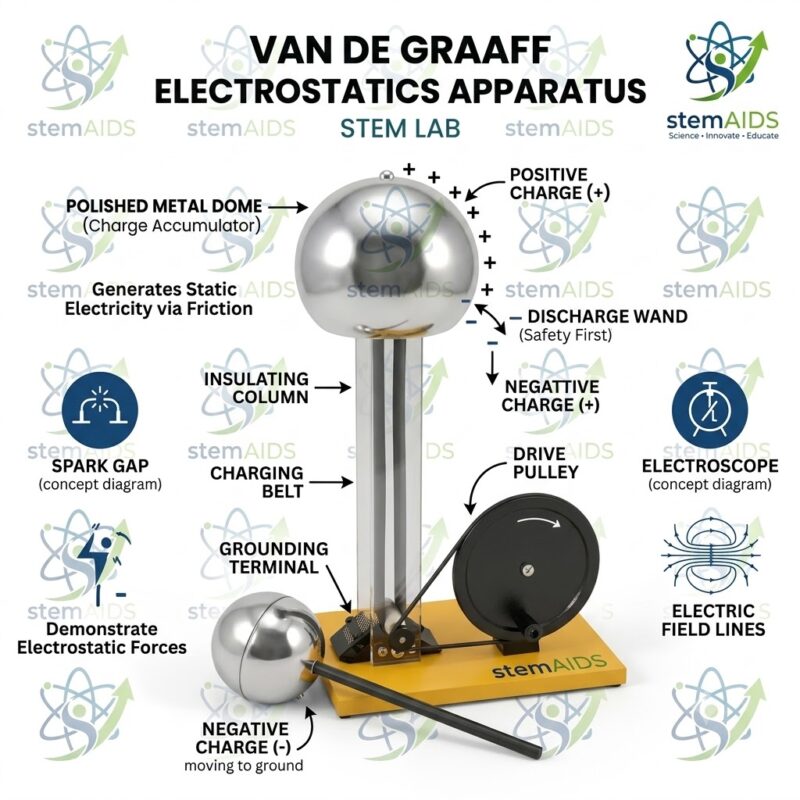
Quick Answer: The Van De Graaff Electrostatics Apparatus is a Van de Graaff generator for the physics lab: a moving belt carries electric charge up an insulating column to a polished metal dome, building a very high voltage at very low current. It is used to demonstrate static electricity, sparks, charge repulsion and electric fields.
How the Generator Builds Its Charge
The listing image shows a polished metal dome on a clear insulating column, a belt running up the column, a large hand-turned drive wheel at the side and a separate discharge sphere on a rod connected to the base. As the wheel turns, the belt rubs over the lower roller and becomes charged by contact, and a metal comb near the belt at the bottom helps transfer charge. A second comb inside the dome draws that charge off the belt, and because charge on a conductor moves to its outer surface, it spreads over the dome and keeps accumulating.
The dome’s potential can reach tens of thousands of volts or more, but the charge stored is small, which is why a classroom generator gives a startling spark that stings rather than a dangerous shock for most people. Bringing the discharge sphere near the dome produces a visible spark once the field between them is strong enough to ionise the air.
Classic demonstrations include paper strips or tinsel on the dome standing out as like charges repel, a stack of foil dishes flying off one by one, a student on an insulating stool whose hair stands on end, a fluorescent tube glowing near the dome, and an ‘electric wind’ from a pointed conductor that can deflect a candle flame. Whether the unit is hand-driven as shown or motor-driven, and the dome size, should be confirmed at enquiry.
Demonstrations
- Showing repulsion of like charges with paper strips, tinsel or hair
- Producing sparks to the discharge sphere and discussing lightning
- Lighting a fluorescent tube held in the electric field near the dome
- Showing that charge collects on the outside of a hollow conductor
Care & Handling
- Keep the belt, column and dome clean and dry; dust and humidity let charge leak away and weaken every demonstration.
- Discharge the dome with the discharge sphere before touching it or moving the Van de Graaff generator.
- Keep phones, laptops and other electronic devices well away from the dome.
- Store the generator covered, and replace the belt if it becomes cracked or glazed.
Specifications
| Item | Van de Graaff electrostatic generator |
| Terminal | Polished metal dome on an insulating column (listing image) |
| Charging | Moving belt with collecting combs |
| Drive | Hand-turned wheel, as shown in the listing image |
| Accessory shown | Discharge sphere on a rod |
| Concepts | Charging by contact, conductors, electric fields, sparks, corona discharge |
Why Choose LabEquip
Physics teachers choose a Van de Graaff generator when they want electrostatics to be seen, heard and felt rather than drawn on a board. LabEquip lists this apparatus in its STEM kits range, and further electrical apparatus is in the electrical and electronics section. Ask about the drive type and accessories through the contact page.
Frequently Asked Questions
Is the spark from a Van de Graaff generator dangerous?
A classroom generator stores only a small amount of charge, so the spark is startling and can sting but is not normally dangerous to healthy people. Anyone with a pacemaker or other implanted electronic device should keep well away, and the teacher should control all demonstrations.
Why does hair stand on end when someone touches the dome?
The person stands on an insulating stool and touches the dome before it is charged. As the generator runs, charge spreads over their body and hair. Each strand carries the same kind of charge, so the strands repel one another and stand apart.
Why does the generator work poorly on humid days?
Moist air and a thin film of water on the surfaces allow charge to leak away almost as fast as it builds up. Dry, warm conditions give the strongest results, and wiping the column and belt dry helps.
Why is the dome smooth and rounded?
Charge concentrates at sharp points, where the electric field becomes strong enough to ionise the air and let charge escape. A smooth, rounded dome spreads the charge evenly so it can build up to a much higher voltage.
What is the discharge sphere for?
It is usually connected to the base of the generator and brought near the dome to draw sparks and to discharge the dome safely at the end of a demonstration. Always discharge the dome before touching it or adjusting the generator.
How does a Van de Graaff generator relate to lightning?
In a thundercloud, charge separates and builds up much as it does on the dome. When the electric field becomes strong enough, the air breaks down and a spark jumps, on a vastly larger scale, as a lightning flash.
Last Updated: September 2026





Reviews
There are no reviews yet.