
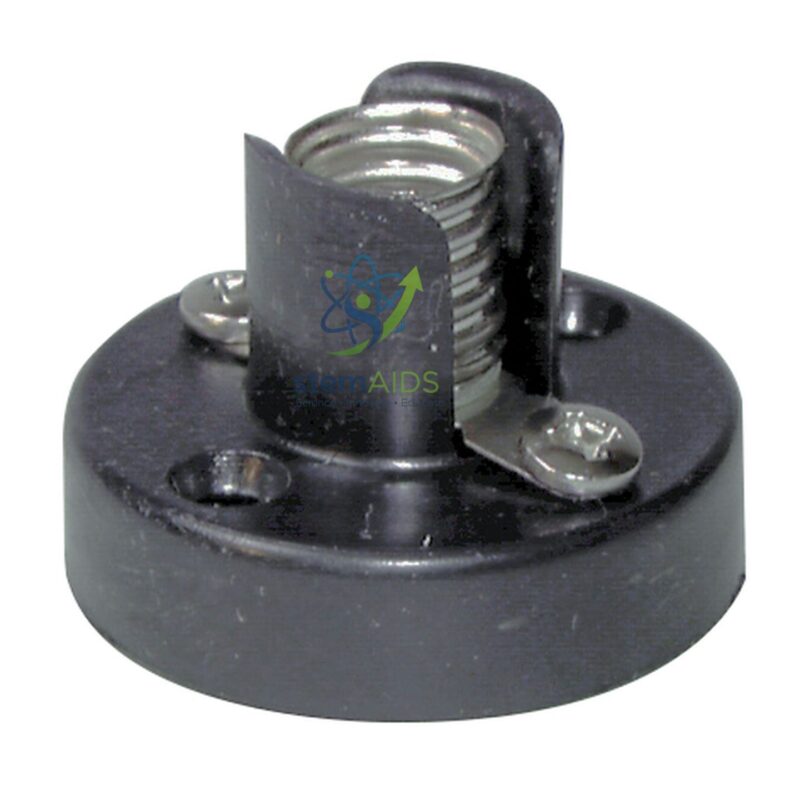
Quick Answer: Screw Sockets are lamp holders with an internal screw thread that grip small screw-base bulbs and connect them to two terminals, so a bulb can be wired into a bench circuit. These screw lamp sockets are used in class sets for series and parallel lamp circuits and for any practical that needs a lamp as an indicator or a load.
Two Contacts in One Thread
A screw-base bulb carries its two connections in an unusual way. The threaded metal shell of the cap is one contact; a small insulated button at the very bottom of the cap is the other, with the filament joined between them inside the glass. The socket mirrors this: its threaded sleeve touches the shell, and a springy centre contact meets the button when the bulb is screwed fully home. Each of these is wired to one of the socket’s terminals, where the circuit leads connect.
Seeing this arrangement helps students understand why a lamp that is half unscrewed goes out, since the button no longer meets the centre contact, and reinforces the idea that a lamp is a component with two ends like any other. It also explains why a filament bulb lights either way round: the filament does not care which contact is positive.
Screw or Bayonet?
Lamp caps come in two main families. Screw caps hold the bulb by its thread, while bayonet caps push in and twist, locking on two side pins. School circuit work mostly uses small screw-base torch bulbs, and holders of the screw type are the ones that match them. Screw sockets are made in several thread sizes, so the size of these holders should be checked against the bulbs already in the lab; for a holder whose size is stated in its name, see the E10 bulb socket.
Applications
- Class sets of lamp holders for series and parallel circuit practicals
- Lamp indicators for conductor and insulator tests
- Using a lamp as the load when measuring current and voltage
- Showing the effect of a switch, fuse or variable resistor on a lamp
Specifications
| Type | Screw-type lamp holders (sockets) |
| Contacts | Threaded sleeve and centre contact, each wired to a terminal |
| Bulbs | Small screw-base bulbs of the matching thread size |
| Use | Student lamp circuits |
| Thread size, base material and quantity | Confirm at enquiry |
Care & Handling
- Turn the supply off before fitting or removing bulbs from the screw lamp sockets, and let lit bulbs cool first.
- Screw bulbs in until firm without forcing them, so the glass does not crack.
- Tighten the terminal screws firmly onto each wire or lead, and check them before every class.
- Store the holders in a box so the small terminal screws are not lost.
Why Choose LabEquip
Teachers ordering lamp holders for a whole class usually buy them with spare bulbs, leads and sources. LabEquip supplies screw sockets within our physics lab equipment range; tell us through the contact page which bulb size you use and how many groups you teach.
Frequently Asked Questions
How does a screw socket connect to a bulb?
Through two contacts. The threaded sleeve of the socket touches the metal thread of the bulb cap, and a centre contact touches the small button at the bottom of the cap. The filament is connected between these two points, and each contact is wired to one terminal of the socket.
Why does the bulb go out if it is slightly unscrewed?
Unscrewing it lifts the button at the base of the cap away from the centre contact, which breaks the circuit even though the threads still touch. Screwing it back in until firm restores the contact.
Does it matter which terminal goes to positive?
Not for a filament bulb, which lights equally well either way round. Some LED replacement bulbs are polarity-sensitive, so if one stays dark, reverse the leads.
What size of bulb do these sockets take?
Screw-base bulbs with the matching thread size. School torch bulbs are usually the miniature Edison screw size, but holders are made in several sizes, so the thread size should be confirmed at enquiry before bulbs are ordered.
What is the difference between screw and bayonet lamp holders?
A screw holder grips the bulb by its thread and uses the thread as one contact. A bayonet holder takes a cap with two side pins that push in and twist to lock. They are not interchangeable, so the holder must match the bulb cap.
Can these sockets be used for mains lamps?
No. They are intended for low-voltage bulbs in student circuits. Mains lamps need holders, wiring and enclosures made for mains voltage and installed by a competent person.
Last Updated: October 2026




Reviews
There are no reviews yet.