
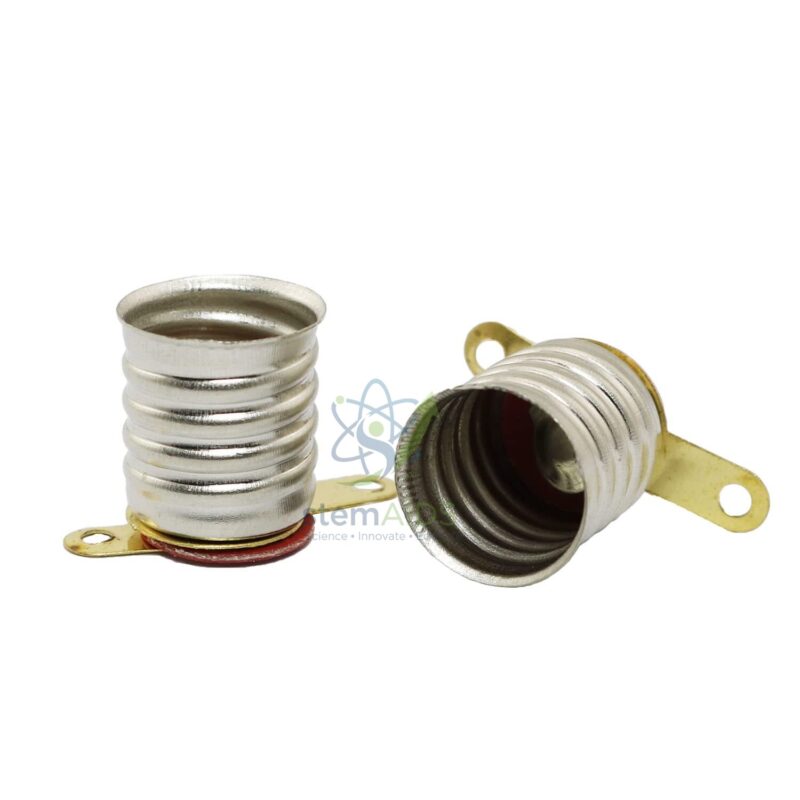
Quick Answer: The Bulb Socket E10 is a lamp holder with an E10 (miniature Edison screw) thread that accepts the small screw-in torch bulbs and LED replacements used in school electricity. With an E10 bulb socket a bulb becomes a circuit component that students can wire in, unscrew and swap during practicals on current, voltage and resistance.
What E10 Means
Screw lamp caps are named by a letter and a number: E stands for Edison screw and the number is the nominal thread diameter in millimetres. E10 is therefore the miniature size found on torch bulbs and many low-voltage indicator lamps, and any bulb with an E10 cap fits this socket whatever its voltage. The bulb’s own rating, printed on its glass or cap, must match the supply. The thread forms one contact and the small button at the base of the bulb the other, which is why a bulb that is not screwed fully home may flicker or stay dark.
The Filament Lamp as a Teaching Component
A torch bulb in a socket is more than a current indicator. Its tungsten filament heats up as the current rises, and because the resistance of a metal increases with temperature, the current-voltage graph for a bulb curves over instead of following the straight line of a fixed resistor. Plotting it is one of the standard practicals on non-ohmic components, and the socket makes it easy to connect the bulb to the meters.
With two or three sockets, students compare identical bulbs in series, where each receives part of the supply voltage and glows dimly, with the same bulbs in parallel, where every bulb sees the whole supply voltage. Take one bulb out of its socket and the lesson about broken paths makes itself: in the series loop every lamp goes dark, while in the parallel arrangement the others stay lit. Mixing bulbs of different ratings in series makes a good puzzle: with the same current through both, the bulb with the higher resistance takes the larger share of the voltage and glows more brightly.
Specifications
| Type | Lamp holder (bulb socket) |
| Cap size | E10 miniature Edison screw (as titled) |
| Bulbs | Any E10-capped bulb rated for the supply used |
| Use | Student lamp circuits and filament-lamp practicals |
| Base and terminal style | Confirm at enquiry |
Lamp Circuits and Practicals
- Building series and parallel lamp circuits with younger classes
- Plotting the current-voltage characteristic of a filament lamp
- Using a lamp as the indicator when testing conductors or switches
- Comparing a filament bulb with an E10 LED lamp for brightness and current drawn
Care & Handling
- Switch off before screwing a bulb into or out of the E10 bulb socket, and let a bulb that has been lit cool before touching it.
- Screw bulbs in until firm but not forced; overtightening can crack the glass or flatten the centre contact.
- Match each bulb’s voltage rating to the supply, since an under-rated bulb will blow at once.
- Keep sockets dry and check that the terminals are tight before each lesson.
Why Choose LabEquip
Schools usually buy E10 sockets in class sets, with spare bulbs, so every group can build lamp circuits. LabEquip supplies them within our physics lab equipment range; for holders on bases suited to younger classes see our regular bulb holders, and send quantities through the contact page.
Frequently Asked Questions
Which bulbs fit an E10 socket?
Any bulb with an E10 miniature Edison screw cap, which includes most torch bulbs and many low-voltage indicator and LED lamps. The socket does not set the voltage, so choose bulbs rated for the supply you will use.
Why does my bulb flicker or not light in the socket?
The bulb is probably not screwed in far enough for its base contact to touch the centre contact of the socket. Screw it in gently until firm. If it still does not light, check the filament, the supply and the terminal connections.
Why does a filament bulb not give a straight-line I-V graph?
Because the filament’s resistance is not constant. More current makes the tungsten hotter, and hot metal opposes the flow of charge more strongly than cold metal. At higher voltages each step up in voltage therefore adds less current than it did at low voltages, and the line flattens out.
Why do two bulbs in series glow more dimly than one?
In series the bulbs share the supply voltage and the same current flows through both. Each gets roughly half the voltage, so the current and the power in each filament are lower and they glow less brightly. In parallel each bulb receives the full voltage.
Can I use an LED bulb in the socket?
Yes, if it has an E10 cap and is rated for your supply. Many E10 LED lamps are polarity-sensitive, so if one stays dark try reversing the supply leads. An LED lamp draws much less current than a filament bulb of similar brightness.
Is the E10 socket suitable for mains lamps?
No. E10 is a miniature size for low-voltage bulbs in student circuits. Mains lamps use larger caps such as E27 and need holders and wiring designed and installed for mains voltage.
Last Updated: October 2026




Reviews
There are no reviews yet.